0
0
Subtotal: $0.00

No products in the cart.

Return To Shop

LEED Concepts Explained: Exam Prep, Project Guidance, and LEED v4 to v5 Transition

The Go-To LEED Clarity Page

Demystifying complex LEED concepts for your exams and real-world project implementation. Because understanding shouldn't be the hardest part.

🤔 "What does this really mean?"
📖 "Is this for the exam or a project?"
🧩 "Why is it worded this way?"
💡

Simple Explanations

Breakdowns of key LEED concepts and commonly confused terms in plain, intuitive language.

🏗️

Exam vs. Reality

Clear distinctions between sample exam questions and practical interpretations for real-world scenarios.

🤝

Shared Learning

A community space to ask questions, contribute your own scenarios, and learn from other professionals.

Not just a study guide—a shared space for learning.

Sign in to submit your own scenarios, view practice questions, and participate in discussions with other learners.

Sign In to Post Your Feedback

LEED Certification Overview

Welcome to LEED Certification. Please select a concept from the sidebar.

LEED Certification Process

View Full Page ↗
  1. Register your project by completing key forms and submitting payment.
  2. Apply for LEED certification by submitting your completed certification application and paying a certification review fee.
  3. Receive a technical review by Green Business Certification Inc. (GBCI).
  4. Achieve certification and market your accomplishments.

The LEED certification process follows a structured sequence (for LEED BD+C, ID+C and O+M):

  1. Register the project in LEED Online and submitting the payment
  2. Select the appropriate rating system . remember the 60/40 rule
  3. Check Minimum Program Requirements (MPRs)
  4. Establish project goals
  5. Define the LEED project scope
  6. Develop a LEED scorecard
  7. Assign roles and responsibilities
  8. Develop and coordinate documentation. Apply for LEED certification by submitting your completed certification application through LEED online and paying a certification review fee.
  9. Receive a technical review by Green Business Certification Inc. (GBCI).
  10. Respond to review comments
  11. Receive certification decision and market your accomplishments

This process ensures that sustainability strategies are planned, documented, and verified in a consistent and transparent manner.

No official FAQs available for this concept yet.

No comments yet. Be the first to post!

LEED Project Registration

View Full Page ↗

Registration is an important step in the process, signifying your intent to pursue LEED certification.

Before you begin, you’ll want to make sure that your project meets all of the LEED Minimum Program Requirements, the minimum characteristics that make a project appropriate for pursuing LEED.

Building projects pursuing certification must:

  • Be in a permanent location on existing land
  • Use reasonable LEED boundaries
  • Comply with project size requirements (1000 for BD+C and O+M Projects) amd 250 square feet for ID+C Projects. ND Projects (1500 acres)

LEED Online and Project Roles

LEED Online is the platform used to manage project registration, documentation, and submission.

Key responsibilities include:

  • inviting team members
  • assigning responsibilities for credits
  • submitting documentation for review

Several roles are involved in the LEED process:

  • Owner – defines project goals and secures funding
  • LEED Project Administrator – manages registration, team coordination, and submissions (key role)
  • Architect / Engineers – design building systems
  • Commissioning Authority – verifies building performance
  • Contractor – manages construction
  • Facility Manager – operates the building after completion

👉 Understanding roles is important for both exam questions and real project coordination.

Credit Interpretation Requests and LEED Interpretations

When project teams need clarification on how to apply a LEED credit, they can use formal interpretation tools.

  • Credit Interpretation Request (CIR)
    → used for project-specific clarification
    → does not award points
    → does not change credit requirements
  • LEED Interpretations
    → official technical guidance
    → applies to multiple projects
    → can set precedent for future applications

These tools help teams navigate unique situations while maintaining consistency within the LEED framework.

Important Concepts: Boundaries

LEED distinguishes between different types of boundaries:

  • Project Boundary – the development footprint of the project
  • Property Boundary – the legal property line
  • LEED Boundary – the area affected by construction activities

Understanding these distinctions is important for both documentation and credit compliance.

No official FAQs available for this concept yet.

No comments yet. Be the first to post!

Understanding LEED Certification – Common Questions & Clarifications

View Full Page ↗

Explanation

To earn LEED certification, a project must satisfy three fundamental conditions:

  1. Minimum Program Requirements (MPRs)
    → Establish whether the project is eligible to pursue LEED certification
  2. Prerequisites
    → Mandatory requirements that must be met across credit categories
  3. Credits (Points)
    → Projects must earn a minimum number of points to achieve certification levels

Certification Levels

  • Certified: 40–49 points
  • Silver: 50–59 points
  • Gold: 60–79 points
  • Platinum: 80+ points
What is USGBC membership? Can individuals become members?
USGBC membership is primarily designed for organizations and companies, not individuals.
Organizations join USGBC to:
• support green building initiatives
• access resources and industry collaboration
• participate in the LEED community
👉 Individuals do not need to be USGBC members to:
• take LEED exams
• work on LEED projects
What is the difference between LEED certification and LEED accreditation?
• LEED Certification applies to projects (buildings or spaces)
• LEED Accreditation applies to people (professionals)
👉 Simple way to remember:
• Projects → Certified
• People → Accredited
Does LEED certify products?
No. LEED does not certify products.
• LEED certifies projects
• LEED accredits professionals
Products can contribute toward LEED credits (e.g., EPDs, HPDs), but they are not LEED-certified.
What is LEED international applicability?
LEED is a global rating system used in over 180 countries.
It supports international projects by:
• allowing local standard equivalencies (in place of U.S.-based standards such as ASHRAE)
• supporting both SI (metric) and IP (imperial) units
• incorporating regional adaptations
👉 This allows LEED to maintain consistency globally while remaining adaptable to local practices.
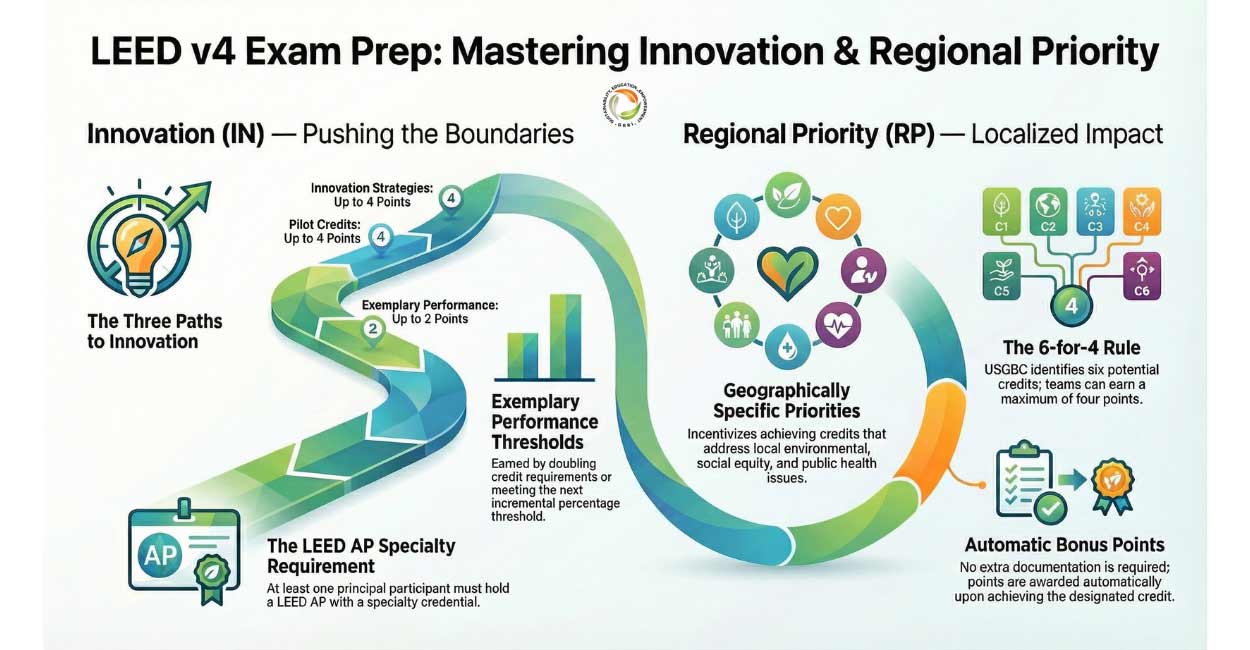
What are Regional Priority (RP) credits?
Regional Priority credits address location-specific environmental priorities.
They are existing LEED credits that have been identified by:
• USGBC regional councils
• LEED International Roundtable
as particularly important for a given region.
• Each project is assigned 6 Regional Priority credits based on location
• A project can earn up to 4 points (1 point per credit)
👉 These credits encourage teams to focus on local environmental challenges
https://www.usgbc.org/regional-priority-credits
What is Innovation (IN) in LEED?
Innovation credits reward strategies that go beyond standard LEED requirements.
Projects can earn points for:
• innovative strategies not addressed in existing credits
• exemplary performance
• pilot credits
What qualifies as Innovation?
To qualify as innovation, a strategy must:
• be measurable and verifiable
• demonstrate a significant environmental benefit
• go beyond standard LEED requirements
👉 It cannot simply replicate an existing credit requirement.
https://www.usgbc.org/innovationcatalog
What is Exemplary Performance?
Exemplary performance is achieved when a project significantly exceeds the requirements of an existing LEED credit.
Example:
• diverting a very high percentage of construction waste beyond standard thresholds
👉 This can earn an Innovation point.
What are Pilot Credits?
Pilot credits are experimental credits available through the USGBC Pilot Credit Library.
They are used to:
• test new sustainability strategies
• evaluate potential future LEED credits
👉 Projects can pursue pilot credits and earn Innovation points if successful.
https://www.usgbc.org/pilotcredits
What are Minimum Program Requirements (MPRs)?
MPRs are the basic eligibility requirements for a LEED project.
Examples include:
• compliance with environmental laws
• being a complete, permanent building or space
• using a reasonable site boundary
👉 If MPRs are not met, the project cannot pursue LEED certification.
What is an example of an MPR-related limitation?
A LEED project must be a permanent structure.
👉 Example:
• A boat or temporary structure cannot qualify for LEED certification
What is the minimum project size for LEED certification?
• BD+C and O+M projects → minimum 1,000 sq ft (93 m²)
• ID+C projects → minimum 250 sq ft (22 m²)
👉 Projects below these thresholds are not eligible for certification.
Do all team members need to be LEED accredited?
No. LEED accreditation is not required for all team members.
However:
• having a LEED Accredited Professional (LEED AP) with specialty on the project can contribute to certification
Who can submit a Credit Interpretation Request (CIR)?
A CIR can be submitted by:
• the LEED Project Administrator, or
• a project team member responsible for the credit
👉 CIRs are submitted through LEED Online for project-specific clarification
What is the role of a Credit Interpretation Request (CIR)?
A Credit Interpretation Request (CIR) is used to obtain clarification on how a LEED credit or prerequisite applies to a specific project.
It is typically used when:
• project conditions are unique
• credit requirements are unclear
• the team needs confirmation before proceeding
👉 CIRs help ensure that project teams apply LEED requirements correctly while maintaining consistency across projects.
Does a CIR award points?
No. A CIR does not award points.
• It provides guidance or clarification only
• It does not guarantee credit achievement
• It does not modify credit requirements
👉 The project must still meet all credit requirements during review to earn points.
What happens if a project qualifies for more than one rating system?
If a project appears to fit more than one rating system, the 60/40 rule is used as guidance.
• If a project clearly aligns (>60%) with one system → that system should be used
• If it falls within 40–60% → the project team can choose
👉 The goal is to select the rating system that best reflects the project scope and level of control.
What is the role of LEED Reference Guides?
LEED Reference Guides provide detailed technical guidance on how to interpret and implement LEED requirements.
They include:
• credit intents
• step-by-step requirements
• calculation methods
• documentation guidance
👉 They are the primary technical resource for both:
• exam preparation
• project implementation
What is the role of LEED Online?
LEED Online is the platform used to manage the LEED certification process.
It is used to:
• register projects
• assign credits and responsibilities
• upload documentation
• submit for review
• communicate with GBCI
👉 All LEED project submissions and reviews are conducted through LEED Online.
What must be true for a project to earn LEED certification?
Correct Answer
• Achieve all prerequisites for the rating system ✅
• Meet the Minimum Program Requirements (MPRs) ✅
• Achieve the required number of points based on certification level ✅

No comments yet. Be the first to post!

Integrative Strategies Overview

Welcome to Integrative Strategies. Please select a concept from the sidebar.

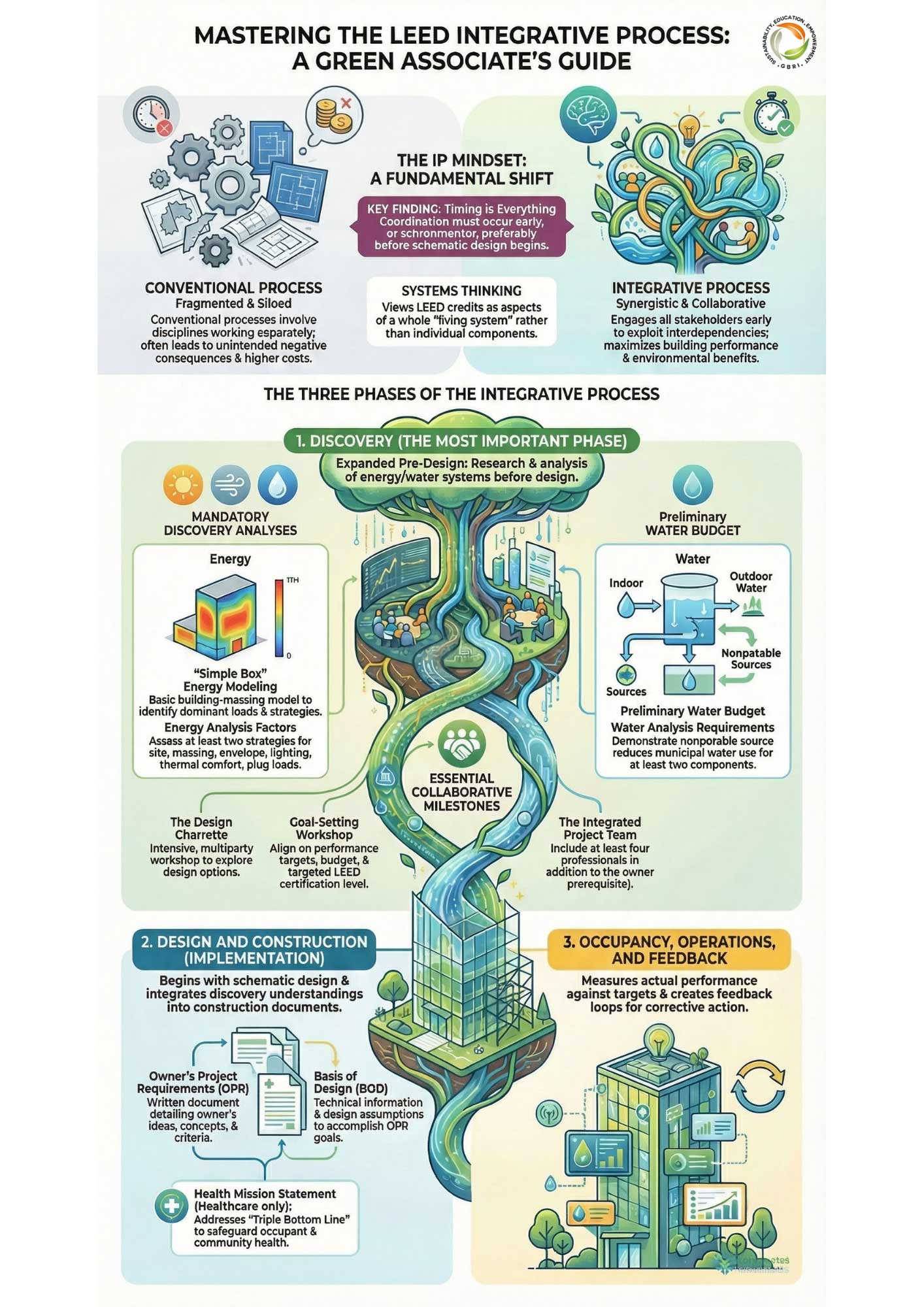
Integrative Process Credit (LEED v4)

View Full Page ↗

Exam-Style Questions (Refined with Healthcare + Depth)

Question 1 (Core Concept)

When must integrative process activities begin?

  • During construction
  • During design development
  • Early in pre-design or schematic design ✅
  • After commissioning

Question 2 (Healthcare Prerequisite)

Which of the following are required for the Integrative Project Planning and Design prerequisite in healthcare projects? (Choose 3)

  • Owner’s Project Requirements (OPR) ✅
  • Design charrette ✅
  • Preliminary LEED rating goals ✅
  • Final construction drawings
  • Post-occupancy survey

Question 3 (Technical)

Which of the following is required for the Integrative Process credit?

  • Detailed final energy model
  • Simple box energy model ✅
  • Commissioning report
  • Life cycle cost analysis

Question 4 (Application)

A project team conducts energy modeling late in design development.

Does this meet the intent of the Integrative Process credit?

  • Yes
  • No ✅

Explanation:
Analysis must occur early, not after decisions are locked.

Question 5 (OPR vs BOD)

Which document explains how the design team will meet the Owner’s Project Requirements?

  • OPR
  • BOD ✅
  • LEED Scorecard
  • Commissioning Plan

Question 6 (Scenario-Based)

A healthcare project conducts a design charrette with only architects and engineers.

Does this meet LEED requirements?

  • Yes
  • No ✅

Explanation:
Must include broader stakeholders such as owner and facility staff.

Question 7 (Energy + Water Requirement)

Which of the following must be completed for Integrative Process credit?

  • Identify at least 2 energy strategies ✅
  • Identify at least 1 water strategy ✅
  • Perform post-occupancy evaluation
  • Conduct full commissioning

(Integrative Process + Registration Timing)

Question

To support an effective integrative design process, when should a project ideally be registered for LEED?

  • During construction
  • After design development is complete
  • Before or early in the design phase (BD+C / ID+C) and early in planning for O+M ✅
  • After commissioning

Answer:

Before or early in the design phase (BD+C / ID+C) and early in planning for O+M

Is Integrative Process required for all projects?
• Credit → optional for most projects
• Prerequisite → required only for Healthcare
What is a design charrette?
An early collaborative workshop where:
• stakeholders define goals
• strategies are discussed
• synergies are identified
What is the difference between OPR and BOD?
• OPR → what the owner wants
• BOD → how the design meets those goals
What is a “simple box energy model”?
A simplified early-stage energy model used to:
• test massing and orientation
• estimate energy performance
• evaluate design options
👉 It is not a detailed final energy model.
Is integrative process just coordination meetings?
No.
👉 It requires:
• analysis
• modeling
• documented decisions

No comments yet. Be the first to post!

Location and Transportation Overview
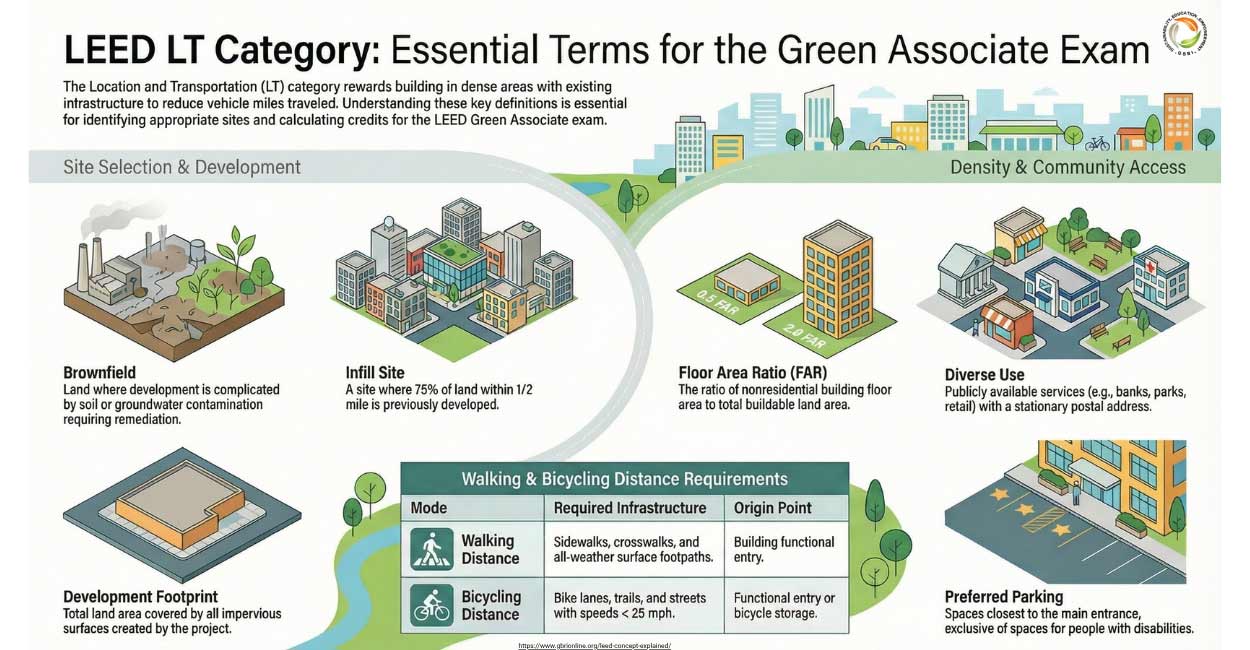
Welcome to Location and Transportation. Please select a concept from the sidebar.

LT Credit: LEED for Neighborhood Development (LEED ND Location)

View Full Page ↗

What is this Credit About?

This credit rewards projects that are located within:

👉 a LEED-certified Neighborhood Development (LEED ND)

Why This Matters

LEED ND combines:

  • Smart Growth
  • New Urbanism
  • Green Building

👉 Result:
Sustainable, walkable, and well-connected communities

What is LEED ND?

LEED ND applies to:

  • new development
  • redevelopment projects
  • mixed-use communities

Projects may be:

  • in planning
  • under construction
  • completed

Types of LEED ND Projects

  1. LEED ND: Plan
  • conceptual or master planning stage
  • or under construction
  1. LEED ND: Built Project
  • fully completed development

🎯 Exam Insight

Plan = Not fully built
Built Project = Completed

Eligibility Requirements (Critical for Exam)

To earn this credit:

👉 The project must be located within a:

✅ LEED ND Certified Development

❗ Important Rule:

  • Registered projects → ❌ NOT eligible
  • Submitted for review → ❌ NOT eligible
  • Certified projects → ✅ REQUIRED

Acceptable Certification Types

The LEED ND project must be:

  • Stage 2 or Stage 3 (LEED 2009 / Pilot)
    OR
  • Certified Plan or Certified Project (LEED v4)

🎯 Exam Trap

“Registered LEED ND project”
👉 Always incorrect


⚠️ Very Important Rule

👉 If you pursue this credit:

❌ You CANNOT pursue other LT credits

💡 Why?

Because this credit:

👉 acts as a streamlined alternative
👉 replaces multiple LT credits

⚖️ Strategy Decision (Highly Testable Concept)

Project teams must choose:

✅ Option 1: LEED ND Credit

Best when:

  • project is within eligible LEED ND area
  • points (up to 16) are higher than individual LT credits
  • want simplified documentation

✅ Option 2: Individual LT Credits

Best when:

  • project can earn more total points
  • team is willing to do more documentation
  • LEED ND area is not fully qualifying

❗ Option 3: If LEED ND is NOT eligible

👉 Must pursue individual LT credits

What is the key difference between a LEED ND Plan and a Built Project?
• Plan → in planning or under construction
• Built Project → completed development
Can a project earn this credit if the LEED ND project is only registered?
No.
👉 The LEED ND project must be certified
Registered or submitted projects do not qualify
A project is located within a LEED ND project that is currently under review for certification. Does it qualify?
No.
👉 Certification must already be achieved
“Under review” is not sufficient
A project is located within a certified LEED ND development but chooses to pursue individual LT credits. Is this allowed?
Yes.
👉 The project can choose between:
• LEED ND credit
• individual LT credits
But cannot do both
A project can earn: •12 points via LEED ND credit • 16 points via individual LT credits . Which path should the project choose?
👉 Individual LT credits
Because:
• LEED allows only one path
• project should choose higher total points
Why does LEED restrict projects from pursuing both LEED ND credit and individual LT credits?
To prevent:
• double-counting benefits
• overlapping strategies
👉 LEED ND already incorporates multiple LT strategies into one credit

No comments yet. Be the first to post!

LT Credit: Sensitive Land Protection

View Full Page ↗

The best site is not untouched land—it’s land that has already been used.
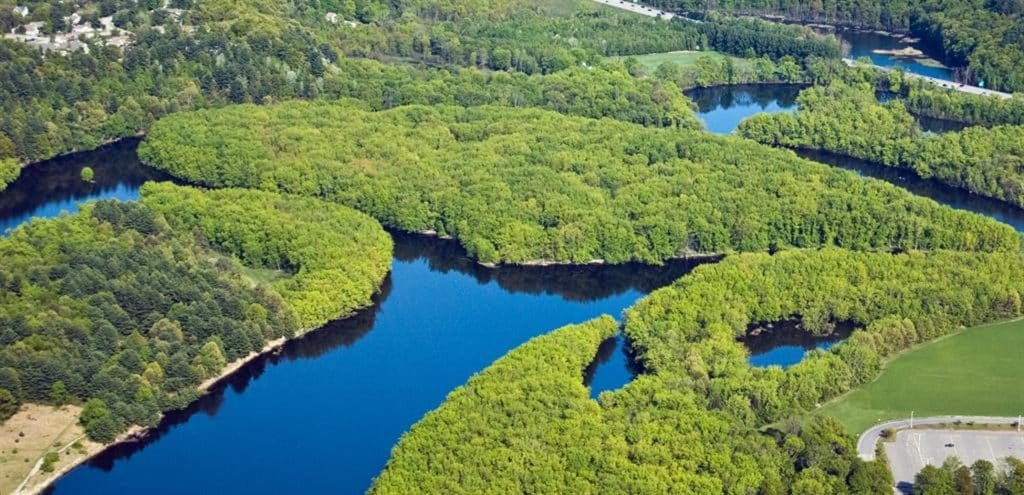
What is the Intent of this Credit?

The goal is to:

👉 avoid development on environmentally sensitive land
👉 reduce environmental impact from site selection

Two Compliance Options

✅ Option 1: Previously Developed Land

👉 Locate the project on previously developed land

What does “Previously Developed Land” mean?

Land that has been:

  • previously built on
  • altered by human activity
  • includes existing infrastructure

💡 Why LEED prefers this:

  • avoids disturbing natural land
  • supports redevelopment
  • uses existing infrastructure
  • strengthens existing communities

🎯 Exam Insight

Previously developed land = ✅ Good
Greenfield land = ❌ Avoid

❓ What is a Greenfield Site?

👉 A previously undeveloped piece of land

  • natural condition
  • no prior construction

👉 Typically not preferred in LEED

💡 Common Strategies

  • redevelopment projects
  • infill development
  • building near existing infrastructure

✅ Option 2: Avoid Sensitive Land

Used when:
👉 Project cannot be entirely on previously developed land

Requirement: Do NOT disturb sensitive land types
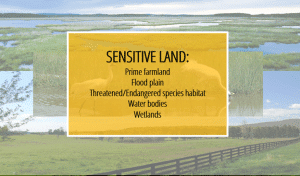
🚫 Sensitive Land Types (VERY IMPORTANT)

You must avoid development on or near:

  1. 🌾 Prime Farmland
  • identified by NRCS soil survey (or local equivalent)
  • includes:
    • prime farmland
    • unique farmland
    • farmland of statewide/local importance

👉 Defined by U.S. Code of Federal Regulations (CFR)

  1. 🌊 Floodplains

👉 Avoid areas with:

  • ≥1% annual chance of flooding
    (also known as 100-year floodplain)
  • based on:
    • legally adopted flood maps
    • local/state designation
  1. 🐾 Habitat for Threatened or Endangered Species

Must avoid habitat for species that are:

  • listed under:
    • U.S. Endangered Species Act
    • state endangered species lists
  • OR classified by NatureServe as:
    • GH, G1, or G2

👉 Requires coordination with:

  • state wildlife agencies
  • Natural Heritage Program
  1. 💧 Wetlands and Water Bodies

📏 Critical Distances (HIGH PROBABILITY EXAM QUESTION)

Avoid:

  • Within 50 feet (15 m) of wetlands
  • Within 100 feet (30 m) of water bodies

👉 Except for minor improvements

🎯 Exam Insight

Wetlands → 50 ft
Water bodies → 100 ft

👉 These numbers are frequently tested

🧠 Where People Get Confused

❌ Misconception 1:

“Any previously used land qualifies”

👉 Not always—must confirm it is previously developed, not just disturbed

❌ Misconception 2:

“You can build near wetlands if careful”

👉 No—distance requirements must be met
👉 50 ft buffer is required

❌ Misconception 3:

“Floodplains are only major rivers”

👉 No—defined by probability (1% annual flood risk)

🧠 Targeted Concept Checks (Descriptive)

What are the two compliance options for Sensitive Land Protection?
1. Build on previously developed land
2. Avoid disturbing sensitive land types
What is a greenfield site?
A greenfield is:
👉 previously undeveloped land
Typically:
• natural condition
• not preferred under LEED
What are the required buffer distances for wetlands and water bodies?
• Wetlands → 50 feet (15 m)
• Water bodies → 100 feet (30 m)
A project is located on previously developed land but expands into a nearby wetland buffer. Does it comply?
No.
👉 Even under Option 1, the project must avoid disturbing sensitive land
👉 Violating buffer distances disqualifies compliance
A project avoids wetlands and floodplains but is built on farmland identified as “prime farmland.” Does it comply?
No.
👉 Prime farmland is considered sensitive land
👉 Must be avoided
A project cannot locate entirely on previously developed land. What is the best strategy to still earn this credit?
Follow Option 2:
• avoid all sensitive land types
• ensure compliance with:
o farmland restrictions
o floodplain avoidance
o habitat protection
o buffer distances
Why does LEED prioritize previously developed land over greenfield sites?
Because it:
• reduces ecosystem disruption
• prevents urban sprawl
• leverages existing infrastructure
• minimizes environmental impact
👉 This aligns with smart growth principles

No comments yet. Be the first to post!

LT Credit: High-Priority Site

View Full Page ↗

High-priority sites are not just about location—they’re about impact: restoring, revitalizing, and reusing land that needs attention.

 What is the Intent of this Credit?

The goal is to:

👉 encourage development in high-priority areas
👉 revitalize communities and reduce environmental impact

💡 Why This Matters

Many sites already have:

  • existing infrastructure
  • historical or cultural value
  • environmental challenges (like contamination)

👉 Redeveloping these sites is better than building on greenfields

🧩 Three Compliance Options

🏛️ Option 1: Historic District + Infill Site

Requirement

👉 Locate the project:

  • within a historic district
  • AND on an infill site

❓ What is an Infill Site? (VERY IMPORTANT)

👉 A site where:

  • ≥75% of land area
  • within ½ mile (800 m) of project boundary
  • is previously developed

⚠️ Critical Clarification

  • Roads / rights-of-way → ❌ NOT counted
  • What matters → land beyond the road

🎯 Exam Must-Know

75% + ½ mile = Infill Site

💡 Why LEED rewards this:

  • strengthens existing communities
  • reduces sprawl
  • supports historic preservation

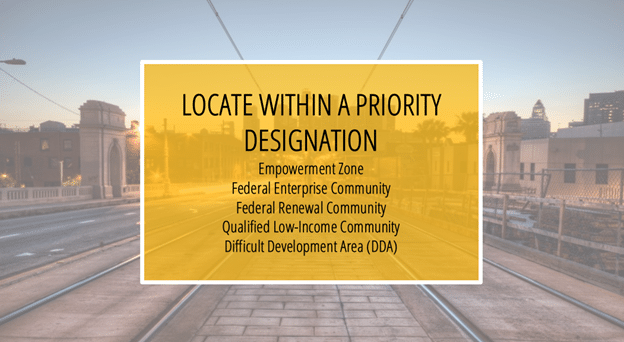
🌆 Option 2: Priority / Economically Distressed Areas

Requirement

👉 Locate the project in a qualified high-priority area

✅ Examples (You don’t need to memorize all, but recognize types)

  • EPA National Priorities List
  • Federal Empowerment Zone
  • Enterprise Community
  • Renewal Community
  • Low-Income Community (Treasury CDFI Fund)
  • HUD Qualified Census Tract or DDA
  • International equivalent programs

🎯 Exam Insight

This option is about:
👉 economic + social revitalization

☣️ Option 3: Brownfield Redevelopment

Requirement

👉 Locate the project on a:

👉 Brownfield site with contamination AND required remediation

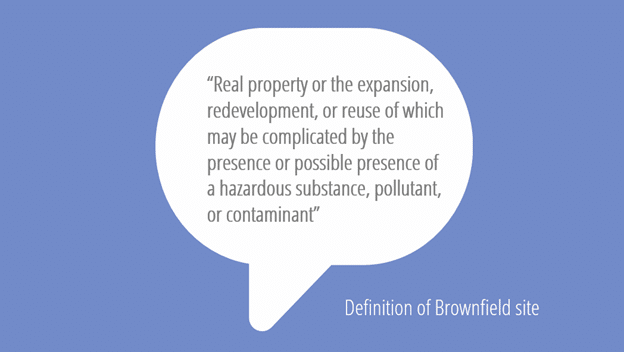
❓ What is a Brownfield?

👉 A site where:

  • redevelopment is complicated by
  • presence or potential presence of contamination
⚠️ Key Requirement

👉 Contamination must be:

  • in soil or groundwater
  • AND identified by authority having jurisdiction

🔬 How is Contamination Identified? (HIGH PROBABILITY QUESTION)

  • Phase I Environmental Site Assessment
  • Phase II Environmental Site Assessment
  • Local equivalent
  • Environmental expert evaluation

❗ Important Limitation

👉 This credit applies ONLY to:

  • soil contamination
  • groundwater contamination

🚫 What Does NOT Count

  • asbestos in buildings
  • interior hazardous materials
  • demolition debris

👉 These are NOT valid for this credit

🎯 Exam Trap

“Contamination inside building = qualifies”
👉 ❌ Incorrect


🏗️ Remediation Requirement

If NOT yet remediated:

👉 Project must:

  • obtain confirmation from authority
  • follow required remediation plan
  • complete remediation to their satisfaction

If ALREADY remediated:

👉 Can still qualify if:

  • proper documentation is provided

⚠️ Critical Rule (Very Testable)

👉 If ANY part of the site is contaminated:

➡️ Entire LEED project boundary = considered contaminated

🧠 Where People Get Confused

❌ Misconception 1:

“Any contaminated site qualifies”

👉 No
Must be:

  • soil or groundwater contamination
  • officially recognized
  • remediation required

❌ Misconception 2:

“Interior contamination counts”

👉 No
Only soil + groundwater qualify

❌ Misconception 3:

“Infill just means urban site”

👉 No
Must meet:

  • 75% previously developed
  • within ½ mile
What are the three options under High-Priority Site?
1. Historic district + infill site
2. Priority/economically distressed area
3. Brownfield redevelopment
What defines an infill site?
A site where:
• ≥75% of surrounding land
• within ½ mile
• is previously developed
A project is located in a historic district but does not meet the infill definition. Does it qualify under Option 1?
No.
👉 BOTH conditions are required:
• historic district
• infill site
A project site has asbestos in an existing building but no soil contamination. Can it qualify as a brownfield?
No.
👉 Only soil or groundwater contamination qualifies
A project has minor soil contamination in one portion of the site. How is the site treated under LEED?
The entire project boundary is considered contaminated
A project is located in a low-income designated area but not on a brownfield or historic site. Can it still earn this credit?
Yes.
👉 It can qualify under Option 2

No comments yet. Be the first to post!

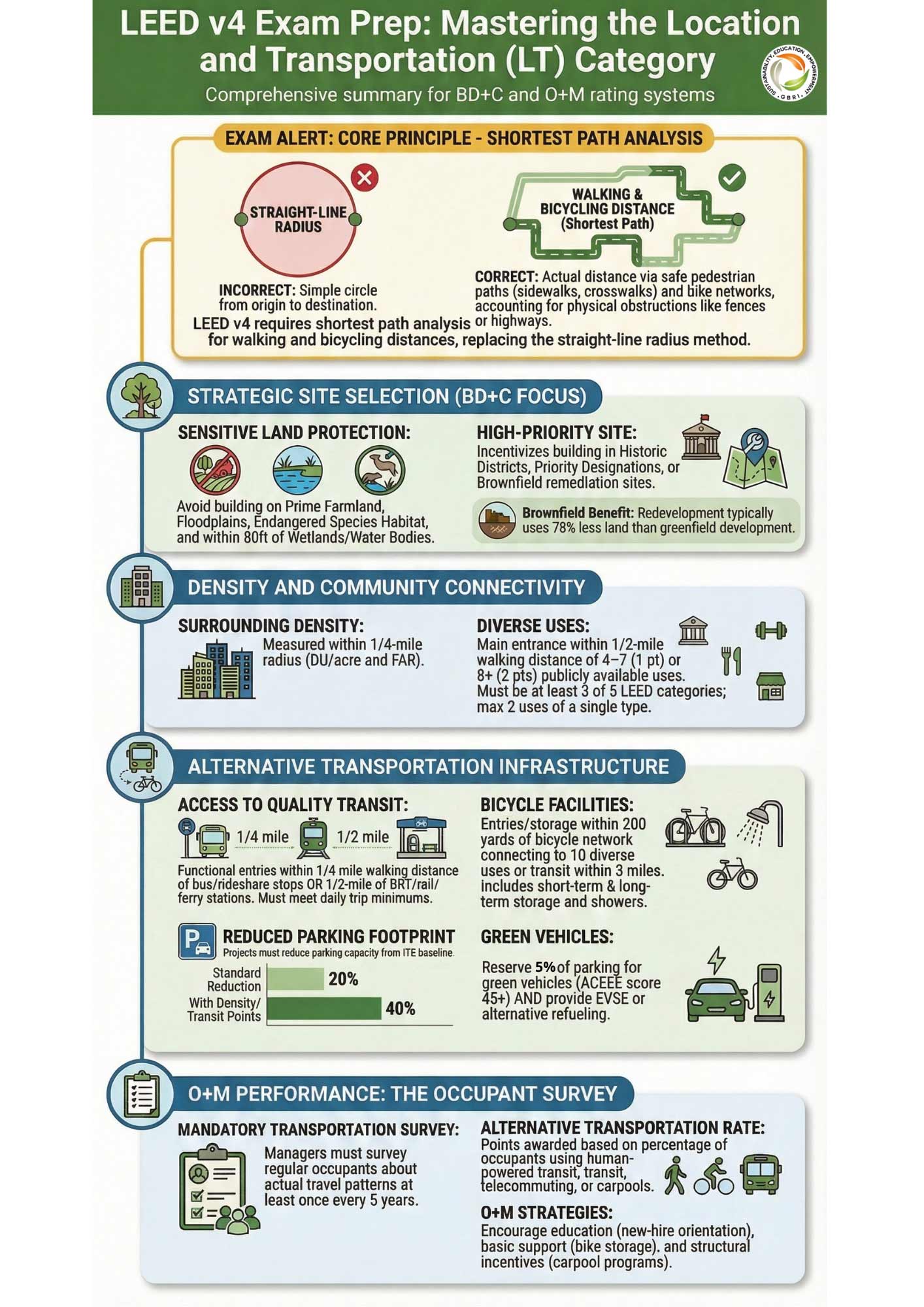
LT Credit: Surrounding Density & Diverse Uses

View Full Page ↗

Density brings people together.
Diverse uses give them a reason to stay.
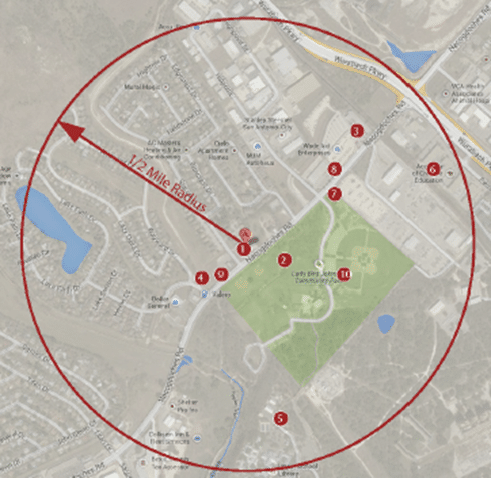
What is the Intent of this Credit?

The intent of this credit is to conserve land and protect farmland and wildlife habitat by

encouraging development in areas with existing infrastructure. To promote walkability, and transportation efficiency and reduce vehicle distance traveled. To improve public health by encouraging daily physical activity.

This credit aims to:

👉 encourage development in dense, well-connected areas

So that we:

  • conserve land and protect farmland/wildlife
  • use existing infrastructure
  • promote walkability & transit use
  • reduce vehicle travel distance (VMT)
  • improve public health through daily activity

🎯 Big Picture (Exam Insight)

This credit is about:
👉 Density + Walkability + Daily Needs Nearby

This credit rewards a project location that is surrounded by existing built density and within walking distance of a variety of services (“uses”). The density thresholds correspond to the minimum densities needed to support bus transit (seven dwelling units per acre, 17.5 DU per hectare) and fixed-rail transit (12 DU per acre, 30 DU per hectare). Two threshold types are listed, one combining residential and nonresidential densities, the second separating them. Project teams therefore have flexibility in calculating the surrounding built density based on the information available to them.

🧩 Two Options

👉 Projects can:

  • pursue Option 1 only
  • pursue Option 2 only
  • OR combine both

Important Exam Point

You do NOT need to do both

📊 Option 1: Surrounding Density

Requirement

👉 Project must be located in an area with existing density

Measured within:

👉 ¼ mile (400 m) radius

📏 Thresholds

🏠 For Residential

  • 7 dwelling units/acre → 2 points
  • 12 dwelling units/acre → 3 points

🏢 For Non-Residential

  • FAR = 0.5 → 2 points
  • FAR = 0.8 → 3 points

❓ What is FAR?

👉 Floor Area Ratio (FAR) =
Total building floor area ÷ total land area

🎯 Memory Trick

  • 7 / 0.5 → lower threshold
  • 12 / 0.8 → higher threshold

💡 Key Concept

LEED aligns density with transit viability:

  • ~7 DU/acre → supports bus transit
  • ~12 DU/acre → supports rail transit

🏪 Option 2: Diverse Uses
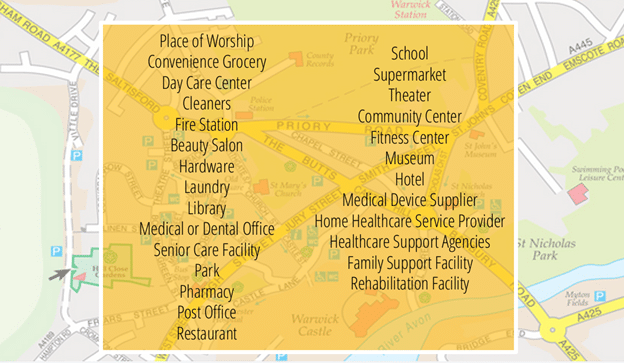
Requirement

👉 Project must be within:

👉 ½ mile walking distance

from its main entrance to:

  • 4–7 diverse uses → 1 point
  • 8+ diverse uses → 2 points

🎯 Must Remember

½ mile + entrance to entrance

⚠️ Critical Rules (HIGH PROBABILITY QUESTIONS)

  1. ✅ Uses must be:
  • existing
  • publicly available

To be eligible, uses that are planned but not currently operating must be occupied within one year of the date of the LEED project’s initial certificate of occupancy.

  1. ❌ No double counting

👉 One location = one use type

  1. ❌ Limit per category

👉 Max 2 uses per use type

Example:

  • 5 restaurants → only 2 count
  1. ✅ Diversity requirement

👉 Uses must include:

👉 at least 3 of 5 categories

(excluding project’s primary use)

🎯 Exam Insight

This is NOT about quantity alone
👉 It’s about diversity

🧠 What Counts as “Diverse Uses”?

You don’t need to memorize all, but understand:

👉 Daily life services:

  • bank
  • grocery
  • restaurant
  • school
  • pharmacy
  • park
  • fitness center
  • daycare
  • medical office

💡 Best Way to Think

“Can I live my daily life without a car?”

🧠 Where People Get Confused

❌ Misconception 1:

“More uses = automatically qualifies”

👉 No
Must meet:

  • category diversity
  • max 2 per type

❌ Misconception 2:

“Distance is straight-line”

👉 No
👉 Must be walking distance

❌ Misconception 3:

“You must do both options”

👉 No
👉 One option is enough

❌ Misconception 4:

“Project entrance doesn’t matter”

👉 It does
👉 Measured entrance to entrance

What are the two options under this credit?
1. Surrounding Density
2. Diverse Uses
What is the required radius for density calculations?
¼ mile (400 m)
What is the required distance for diverse uses?
½ mile walking distance
A project has 10 restaurants within ½ mile. Can it earn 2 points for diverse uses?
No.
👉 Only 2 restaurants can be counted
👉 Must include different categories
A project meets density thresholds but has no nearby services. Can it still earn points?
Yes.
👉 Option 1 alone is sufficient
A project has: • 8 total uses • but only from 2 categories . Does it qualify for 2 points?
No.
👉 Must include at least 3 categories
Why does LEED emphasize both density and diverse uses?
Because together they:
• reduce car dependence
• support transit
• enable daily needs within walking distance
• improve health and reduce emissions

No comments yet. Be the first to post!

LT Credit: Access to Quality Transit

View Full Page ↗

Transit access is not about being close to a stop—it’s about having a reason to use it.

What is the Intent of this Credit?

The goal is to:

👉 encourage development in areas with strong transit access

So that we:

  • reduce car dependency
  • lower GHG emissions
  • improve air quality
  • support public health + mobility

🎯 Big Picture

This credit is about:
👉 Access + Frequency of Transit
 

📍 Location Requirement

Projects must locate any functional entry within:

🚍 Transit Distance Thresholds (VERY IMPORTANT)

🟢 ¼ mile (400 m)

For:

  • bus stops
  • streetcar stops
  • rideshare stops

🔵 ½ mile (800 m)

For:

  • bus rapid transit (BRT)
  • light rail
  • heavy rail
  • commuter rail
  • ferry terminals

🎯 Memory Trick

¼ mile = basic transit (bus)
½ mile = high-capacity transit (rail)

⚠️ Important Clarification

👉 Distance must be:

  • walking distance
  • NOT straight-line radius

🏫 Special Rule for Schools (Common Question)

Schools must:

👉 ensure safe pedestrian access

From:

  • surrounding residential neighborhoods
  • within the walkshed boundary

🎯 Exam Insight

Schools = must consider student access + safety

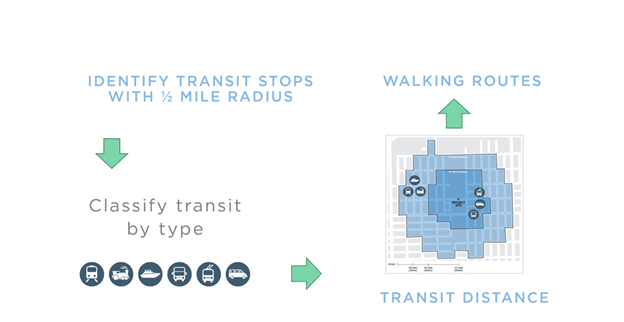
⚙️ How to Earn the Credit (Process)

Step 1: Identify Transit Stops

👉 Within ¼ or ½ mile depending on type

Step 2: Classify Transit Type

👉 Determine:

  • bus vs rail vs BRT
  • correct distance threshold

Step 3: Confirm Walkability

👉 Must be:

  • safe
  • accessible
  • continuous pedestrian route

Step 4: Count Aggregate Trips (CRITICAL STEP)**

👉 Total number of daily transit trips

Across:

  • all qualifying stops

🔢 Trip Frequency (WHERE MOST PEOPLE STRUGGLE)

LEED evaluates:

👉 how often transit runs

Not just presence of stops

💡 Key Concept

A stop with low frequency ≠ high quality transit

🎯 Exam Insight

👉 More frequent service = more points

👉 Multiple stops = can combine trips

🧠 Where People Get Confused

❌ Misconception 1:

“Having a bus stop nearby is enough”

👉 No
👉 Must meet minimum trip frequency

❌ Misconception 2:

“¼ mile applies to all transit”

👉 No

  • Bus → ¼ mile
  • Rail → ½ mile

❌ Misconception 3:

“Distance is radial”

👉 No
👉 Must be walking path

❌ Misconception 4:

“Only one stop is counted”

👉 No
👉 You can aggregate trips from multiple stops

What are the two key distance thresholds in this credit?
• ¼ mile (400 m) → bus, streetcar
• ½ mile (800 m) → rail, BRT, ferry
What is the key factor that determines “quality transit”?
👉 Frequency of trips (number of daily transit trips)
A project is within ¼ mile of a bus stop, but the bus runs only twice a day. Does it qualify?
No.
👉 Transit must meet minimum trip frequency requirements
A project is within ½ mile of two rail stations. Can both be counted?
Yes.
👉 Trips from multiple stations can be aggregated
A project is within ½ mile of a rail station and ¼ mile of a bus stop. How should it evaluate compliance?
👉 Include both transit types
• apply correct distance thresholds
• sum total trips from both
Why does LEED focus on trip frequency instead of just proximity?
Because:
• reliable, frequent transit reduces car use
• low-frequency transit does not change behavior
• ensures true accessibility, not just proximity

No comments yet. Be the first to post!

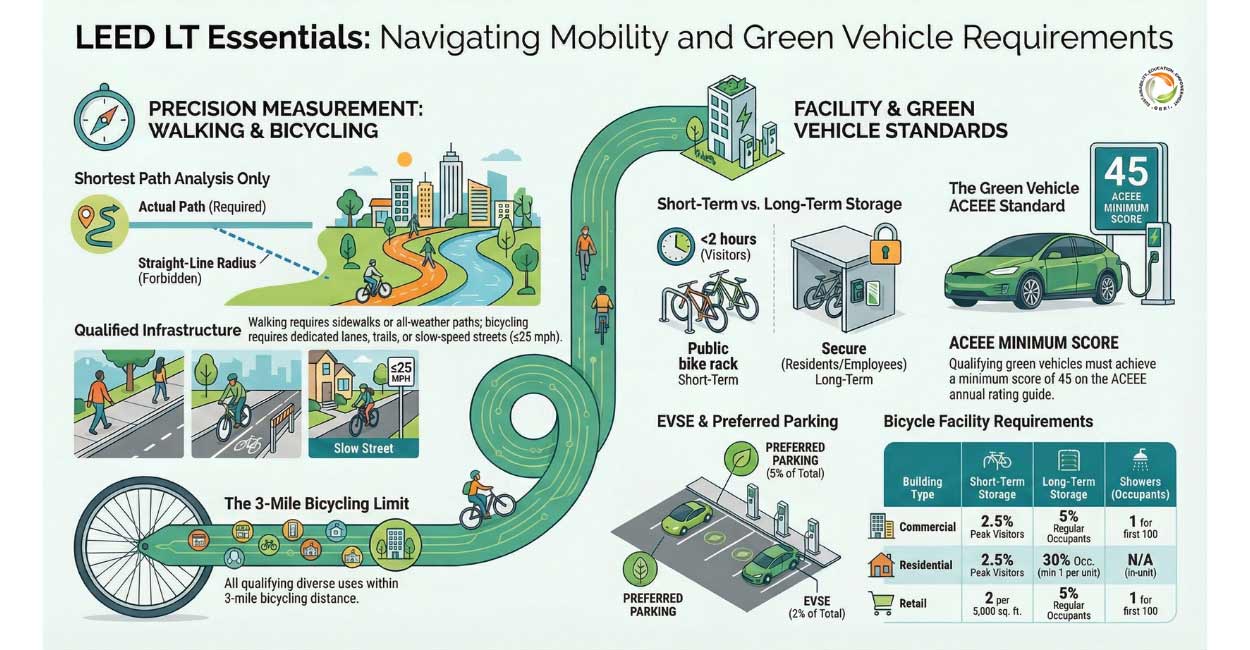
LT Credit: Bicycle Facilities

View Full Page ↗

Bicycles need two things: a place to go—and a place to stay.

 What is the Intent of this Credit?

The goal is to:

👉 promote bicycling and transportation efficiency
👉 reduce vehicle miles traveled (VMT)
👉 improve public health through physical activity

🎯 Big Picture

This credit is about:
👉 Access to bike routes + Proper bike storage + User support (showers)

🧩 Two Main Components

  1. Bicycle Network (Access Requirement)

Requirement

👉 The project must have:

  • a functional entry OR bicycle storage location
    within:

👉 200 yards (180 m)

of a bicycle network

❓ What is a Bicycle Network?

Includes:

  • bike lanes
  • bike paths
  • trails
  • low-speed roads

📍 What must the network connect to?

At least ONE of the following:

✅ Option A: Diverse Uses

  • At least 10 diverse uses
  • within 3 miles (4800 m) biking distance

✅ Option B: School or Employment Center

👉 Applies if:

  • project is ≥50% residential

✅ Option C: Transit

  • BRT
  • rail stations
  • commuter rail
  • ferry

🎯 Critical Numbers (MUST MEMORIZE)

  • 200 yards → connection distance
  • 3 miles → biking reach
  • 10 diverse uses

⚠️ Planned Bike Network (Exam Trap)

👉 Can count ONLY if:

  • fully funded

completed within 1 year of certificate of occupancy

🚲 2. Bicycle Storage & Shower Facilities
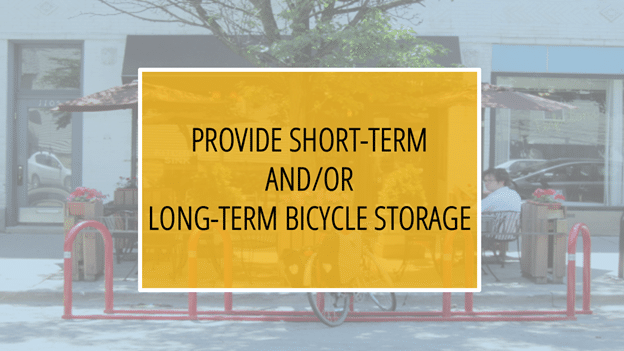
Three Cases

🏢 Case 1: Commercial / Institutional Projects

📦 Short-Term Storage (Visitors)

  • 2.5% of peak visitors
  • minimum 4 spaces

🏠 Long-Term Storage (Occupants)

  • 5% of regular occupants
  • minimum 4 spaces

🚿 Showers

  • 1 shower for first 100 occupants
  • +1 shower for every 150 additional occupants

🏠 Case 2: Residential Projects

📦 Short-Term Storage

  • 2.5% of peak visitors
  • minimum 4 spaces

🏠 Long-Term Storage

  • 30% of occupants
  • OR ≥1 per dwelling unit

🏙️ Case 3: Mixed-Use Projects

👉 Must meet:

  • Case 1 (non-residential portion)
  • Case 2 (residential portion)

📍 Location Requirements (ALL PROJECTS)

🚲 Short-Term Storage

👉 within:

  • 100 feet (30 m)
    of main entrance

🚲 Long-Term Storage

👉 within:

  • 100 feet (30 m)
    of functional entry

⚠️ Important Rules (Exam Traps)

❌ No Double Counting

👉 Bicycle storage:

  • cannot be shared with non-project users
  • must be dedicated to project occupants

❌ Short-term ≠ Long-term

  • short-term → visitors
  • long-term → regular occupants

👉 Cannot substitute one for the other

🧠 Where People Get Confused

❌ Misconception 1:

“Any bike path nearby qualifies”

👉 No
👉 Must connect to:

  • 10 uses OR
  • transit OR
  • school/employment

❌ Misconception 2:

“Distance is from site boundary”

👉 No
👉 Must be from:

  • functional entry OR storage location

❌ Misconception 3:

“Storage is enough”

👉 No
👉 Must also meet:

  • network requirement

❌ Misconception 4:

“Planned bike lanes always count”

👉 Only if:

  • fully funded
  • completed within 1 year
What are the two main components of the Bicycle Facilities credit?
1. Bicycle network access
2. Bicycle storage and shower facilities
What are the key distances in this credit?
• 200 yards → to bicycle network
• 3 miles → to destinations
• 100 feet → storage location
A project has bike storage but no nearby bicycle network. Does it qualify?
No.
👉 Both requirements must be met:
• network access
• storage facilities
A project has access to 8 diverse uses within 3 miles. Does it meet the requirement?
No.
👉 Minimum is 10 diverse uses. Projects are required to Design or locate the project such that a functional entry or bicycle storage is within a 200-yard (180-meter) walking
distance or bicycling distance from a bicycle network that connects to at least one of the following:
·· at least 10 diverse uses;
·· a school or employment center, if the project total floor area is 50% or more residential; or
·· a bus rapid transit stop, light or heavy rail station, commuter rail station, or ferry terminal.
A project has a planned bike lane nearby, but construction will begin 2 years after occupancy. Does it qualify?
No.
👉 Must be:
• fully funded
• completed within 1 year
Why does LEED require both network access and storage?
Because:
• network → enables bicycling
• storage + showers → supports user behavior
👉 Both are needed to change transportation habits

No comments yet. Be the first to post!

LT Credit: Reduced Parking Footprint

View Full Page ↗

Parking is not just a design decision—it’s a behavior decision.

 What is the Intent of this Credit?

The goal is to:

👉 minimize environmental harms associated with parking

Including:

  • automobile dependence
  • excessive land consumption
  • stormwater runoff from impervious surfaces

🎯 Key Idea

More parking = more driving
Less parking = behavior change

🌍 Why This Matters

  • Excess parking increases:
    • congestion
    • emissions
    • land use inefficiency
  • Impervious parking surfaces:
    • increase stormwater runoff
    • carry pollutants into waterways

👉 LEED encourages right-sizing parking, not maximizing it

📊 How LEED Evaluates Parking

Baseline

👉 Based on:

👉 Transportation Planning Handbook ratios

This represents:

  • “typical” parking demand

🧩 Two Compliance Cases

✅ Case 1: Standard Projects

👉 Applies if project does NOT earn LT points under:

  • Surrounding Density
  • Access to Quality Transit

📏 Requirement

👉 Reduce parking by:

👉 20% from baseline

✅ Case 2: Dense / Transit-Served Projects

👉 Applies if project earns:

  • ≥1 point in Surrounding Density OR Transit

📏 Requirement

👉 Reduce parking by:

👉 40% from baseline

🎯 Memory Trick

  • No density/transit → 20% reduction
  • Has density/transit → 40% reduction

⚠️ What Must Be Included in Calculations

✅ Include:

  • all new parking spaces
  • all existing parking spaces
  • off-site parking used by project
  • leased or owned parking

❌ Exclude:

👉 On-street parking

🎯 Exam Insight

On-street parking = ❌ NOT counted

🚘 Preferred Parking Requirement

👉 Must provide:

👉 ≥5% of total parking

as:

  • preferred parking for carpools

❗ Exception:

👉 If no off-street parking is provided

→ requirement does not apply

💡 Strategies to Achieve This Credit

(You included a great list—let’s structure it clearly)

🚫 Reduce Demand

  • limit parking supply
  • avoid overbuilding parking

🚍 Encourage Alternatives

  • transit subsidies
  • shuttle services

🧑‍💻 Reduce Travel Need

  • telecommuting
  • compressed work weeks

🅿️ Manage Parking Differently

  • shared parking
  • unbundle parking (sell separately)

📌 Strategy Summary

👉 These strategies all aim to:

reduce dependence on personal vehicles

🧠 Where People Get Confused

❌ Misconception 1:

“Providing more parking is better for users”

👉 LEED discourages this
👉 More parking = more driving

❌ Misconception 2:

“On-street parking counts”

👉 No
👉 Only off-street parking is counted

❌ Misconception 3:

“Reduction is from local code minimum”

👉 No

👉 Reduction is from:

👉 Transportation Planning Handbook baseline

❌ Misconception 4:

“Preferred parking is always required”

👉 Not if:

👉 no off-street parking is provided

What are the two reduction thresholds in this credit?
• 20% reduction → standard projects
• 40% reduction → projects in dense/transit areas
What baseline is used for parking calculations?
Transportation Planning Handbook ratios
A project earns 1 point under Access to Quality Transit. What parking reduction is required?
40% reduction
A project includes 200 parking spaces on-site and 50 leased spaces off-site. How many spaces must be included in calculations?
250 spaces
(All off-street parking used by project must be included)
Why does LEED require greater parking reduction in transit-served areas?
Because:
• alternative transportation is available
• less parking is needed
• encourages behavioral shift
👉 Supports efficient land use and lower emissions
A project provides zero parking spaces. Does it need to provide preferred parking for carpools?
No.
👉 Requirement applies only when parking is provided
If no off-street parking is provided for the project building’s users, can the project pursue LT Credit: Reduced Parking Footprint and LT Credit: Green Vehicles?
If a project provides no off-street parking, it:
👉 can pursue LT Credit: Reduced Parking Footprint
👉 cannot pursue LT Credit: Green Vehicles
________________________________________
Explanation:
• Reduced Parking Footprint rewards projects for minimizing or eliminating parking, which:
o reduces automobile dependence
o encourages alternative transportation (public transit, walking, biking)
👉 Therefore, a project with zero parking strongly aligns with this credit’s intent.
________________________________________
• Green Vehicles, on the other hand, requires:
o designated parking spaces for green vehicles
o OR EV charging / fueling infrastructure tied to parking
👉 If no parking is provided, there is:
• no location to assign preferred parking
• no parking base to calculate percentages

No comments yet. Be the first to post!

LT Credit: Green Vehicles

View Full Page ↗

Green vehicles need two things: a reason to choose them—and a way to use them.

 What is the Intent of this Credit?

The goal is to:

👉 reduce pollution from conventional vehicles
👉 promote low-emission and alternative fuel vehicles

🌍 Why This Matters

  • Transportation contributes ~27% of U.S. GHG emissions
  • Majority comes from:
    • passenger vehicles
    • light-duty trucks

👉 This credit focuses on reducing emissions at the user level

🎯 Big Picture

This credit is about:
👉 Encouraging cleaner vehicles through incentives + infrastructure

🧩 Two Main Requirements

To earn this credit, projects must:

✅ 1. Preferred Parking for Green Vehicles

📏 Requirement

👉 Provide:

👉 5% of total parking spaces

as:

👉 preferred parking for green vehicles

📍 What is Preferred Parking?

  • closest spaces to entrance
  • or otherwise highly convenient
  • clearly marked and enforced

⚠️ Important Rule

👉 Must be:

  • clearly identified
  • reserved exclusively for green vehicles
  • distributed across parking areas

🔁 Alternative Option (Substitution)

If preferred parking is not feasible:

👉 Provide:

👉 ≥20% discounted parking rate

⚠️ Conditions

  • must be:
    • publicly posted
    • available to all qualifying vehicles
    • permanent (not temporary)

🎯 Exam Insight

Discount = substitute for preferred parking

Important Concept: Parking Calculations

What Counts as Parking?

Include:

  • all off-street parking (new + existing)
  • parking inside and outside project boundary
  • shared/pooled parking (allocated portion)

❌ What Does NOT Count

  • on-street parking
  • bike parking
  • fleet vehicles (unless used for commuting)

Preferred Parking (Important Across LT Credits)

Preferred parking means:

👉 closest spaces to the building entrance

📍 Rules:

  • must be near main entrance
  • can be distributed across parking areas
  • must meet required percentages

🎯 Exam Insight

Preferred parking = proximity, not just designation

🚘 What is a “Green Vehicle”?

👉 Must achieve:

👉 Minimum score of 45

on:

👉 ACEEE Green Vehicle Rating

(or local equivalent)

🎯 Exam Trap

“Fuel-efficient vehicle automatically qualifies”
👉 ❌ Not unless it meets ACEEE ≥ 45

⚡ 2. Alternative Fueling Infrastructure

Projects must ALSO provide:

Option 1: Electric Vehicle Charging

👉 Install EV charging stations

Option 2: Alternative Fueling

👉 Provide fueling infrastructure for:

  • liquid fuels (e.g., biofuels)
  • gaseous fuels
  • battery charging

📏 Requirement

👉 Must support:

👉 2% of total parking spaces

🎯 Key Numbers (Must Know)

  • 5% → preferred parking
  • 20% → discount (alternative)
  • 2% → fueling stations
  • 45 → ACEEE score

🧠 Where People Get Confused

❌ Misconception 1:

“Preferred parking alone is enough”

👉 No
👉 Must ALSO provide fueling infrastructure

❌ Misconception 2:

“EV charging replaces parking requirement”

👉 No
👉 These are two separate requirements

❌ Misconception 3:

“Any hybrid vehicle qualifies”

👉 Only if:

👉 ACEEE score ≥ 45

❌ Misconception 4:

“Discounted parking is optional bonus”

👉 No
👉 It is a replacement strategy, not additional

What percentage of parking must be reserved for green vehicles?
5% of total parking spaces
What is the alternative to providing preferred parking?
20% parking discount
What is the minimum ACEEE score required?
45
A project has 200 parking spaces. How many must be equipped with alternative fueling infrastructure?
2% of 200 = 4 spaces
A project provides EV charging for 2% of spaces but no preferred parking or discount. Does it comply?
No.
👉 Both requirements must be met:
• parking incentive
• fueling infrastructure
Why does LEED require both preferred parking and fueling infrastructure?
Because:
• parking incentives → influence user behavior
• fueling infrastructure → enables use of green vehicles
👉 Both are needed to drive adoption
A project provides discounted parking but does not publicly post the discount. Does it qualify?
No.
👉 Discount must be:
• clearly posted
• permanently available

No comments yet. Be the first to post!

Synergies in Location & Transportation (LT)

View Full Page ↗

What Does “Synergy” Mean in LEED?

👉 Synergy means:

One strategy contributes to multiple credits or categories

🎯 Big Idea

In LEED, the best strategies solve multiple problems at once.

🚗 Part 1: Synergies Within LT Credits

🔹 1. Location Choice Drives Multiple Credits

Choosing the right site can help achieve:

  • Surrounding Density
  • Diverse Uses
  • Access to Quality Transit
  • Reduced Parking
  • Bicycle Facilities

💡 Example

A project in a dense urban area:

  • qualifies for density credit
  • has nearby services → diverse uses
  • near transit → transit credit
  • needs less parking → reduced parking
  • supports biking → bike facilities

🎯 Insight

One decision = multiple LT points

🔹 2. Reduced Parking + Transit + Density

These credits are tightly connected:

  • high density → supports transit
  • transit → reduces car use
  • reduced parking → reinforces behavior

💡 Example

If a project earns:

  • 1 point in transit
    👉 It must reduce parking by 40% (not 20%)

🎯 Insight

LT credits reinforce each other—they are not independent

🔹 3. Bicycle Facilities + Diverse Uses

  • bike network connects to 10 diverse uses
  • diverse uses support daily travel by bike

💡 Example

A mixed-use neighborhood:

  • enables biking for errands
  • reduces short car trips

🔹 4. Green Vehicles + Reduced Parking

At first glance, they seem opposite:

  • Green Vehicles → supports driving (cleaner)
  • Reduced Parking → discourages driving

🎯 Insight

LEED balances:

  • reducing driving
  • improving remaining driving

🌍 Part 2: LT Synergies with Other LEED Categories

⚡ 1. LT + Energy & Atmosphere (EA)

Connection:

  • Less driving → less fuel consumption
  • Reduced VMT → lower energy use

💡 Example:

A transit-oriented project:

  • reduces transportation energy
  • complements building energy savings

💧 2. LT + Sustainable Sites (SS)

Connection:

  • Less parking → less impervious area
  • reduces stormwater runoff

💡 Example:

Reducing parking footprint:

  • improves stormwater management
  • reduces heat island effect

🌿 3. LT + Sustainable Sites (Habitat Protection)

Connection:

  • dense development → less land disturbance
  • protects farmland and ecosystems

🧠 4. LT + Indoor Environmental Quality (IEQ)

Connection:

  • walkability → improved occupant health
  • reduced pollution → better air quality

👥 5. LT + Innovation / Social Equity

Connection:

  • transit access improves accessibility
  • supports underserved communities
  • reduces transportation costs

🧠 Where People Miss the Bigger Picture

❌ Misconception 1:

“Each credit is separate”

👉 Reality:
Credits are interconnected systems

❌ Misconception 2:

“Green vehicles alone solve transportation impact”

👉 Reality:

  • location matters more than vehicle type

❌ Misconception 3:

“Parking is just a design requirement”

👉 Reality:

  • parking influences behavior + emissions

The most sustainable transportation strategy is not cleaner travel—it’s less travel.

What is meant by synergy in LEED?
A strategy that contributes to multiple credits or categories simultaneously
A project is located in a dense area near transit and services. Which LT credits could this support?
• Surrounding Density
• Diverse Uses
• Access to Quality Transit
• Reduced Parking
• Bicycle Facilities
Why is site selection considered the most impactful decision in LT?
Because it determines:
• transportation behavior
• access to services
• emissions levels
• infrastructure efficiency
👉 A poor location cannot be compensated by later design decisions
How does reducing parking contribute to both LT and SS credits?
• LT → reduces car use
• SS → reduces impervious surface and runoff
A project installs EV charging but is located far from transit and services. How would LEED evaluate this?
• partial improvement (Green Vehicles credit)
• but weak overall LT performance
👉 Location-based strategies are more impactful

No comments yet. Be the first to post!

Location & Transportation – Closing

View Full Page ↗

Bringing It All Together

The Location & Transportation category is not just about:

  • transit
  • parking
  • or biking

👉 It is about influencing behavior through location and infrastructure

What LT Truly Rewards

  • smart site selection
  • compact development
  • access to daily needs
  • alternatives to private vehicles

Design + Location = Better Outcomes

LT credits work best when combined with design strategies such as:

  • reduced parking
  • bicycle infrastructure
  • green vehicle support

👉 Together, these create real, usable alternatives to driving

The Bigger Picture

By:

  • reusing previously developed land
  • investing in existing communities
  • improving access to transit and services

Projects can:

  • reduce environmental impact
  • support economic development
  • enhance quality of life

Sustainable buildings are not just efficient—they are well-connected.

No official FAQs available for this concept yet.

No comments yet. Be the first to post!

Sustainable Sites Overview

Welcome to Sustainable Sites. Please select a concept from the sidebar.

SS Prerequisite: Construction Activity Pollution Prevention

View Full Page ↗

Protecting the site starts before construction begins—and continues until it ends.

 What is the Intent of this Prerequisite?

The goal is to:

👉 reduce pollution from construction activities

Specifically:

  • soil erosion
  • water pollution (sedimentation)
  • air pollution (dust)

🎯 Big Picture

Construction is temporary—but its environmental damage can be permanent if not controlled.

🌍 Why This Matters

Construction activities can cause:

  • loss of topsoil
  • sediment runoff into waterways
  • airborne dust
  • degradation of nearby ecosystems

👉 The loss of topsoil is one of the most significant impacts of erosion.

🧩 Three Key Areas Addressed

This prerequisite focuses on:

  1. Soil erosion
  2. Water pollution (sedimentation)
  3. Air pollution (dust control)

📄 Core Requirement: ESC Plan

What Must the Project Do?

👉 Develop and implement:

👉 Erosion and Sedimentation Control (ESC) Plan

📏 Standards to Follow (VERY IMPORTANT)

The ESC plan must comply with:

👉 2012 EPA Construction General Permit (CGP)
OR
👉 Local erosion and sedimentation control standards

⚠️ Critical Rule

👉 Follow whichever is MORE stringent

🎯 Exam Insight

“EPA OR local code” → always choose the stricter one

⚠️ Applicability (High Probability Question)

👉 ALL projects must have an ESC plan:

  • even if not required by local code
  • even if minimal disturbance
  • even for zero lot line projects

❓ What is a Zero Lot Line Project?

👉 A project where:

  • building footprint aligns closely with site boundary
  • minimal or no exterior site area

🎯 Exam Insight

“No disturbance” ≠ “No ESC plan”

🛠️ Types of Control Measures

  1. Stabilization Measures (Prevent Erosion)

👉 These prevent soil from being disturbed

Examples:

  • Temporary seeding → fast-growing plants
  • Permanent seeding → long-term vegetation
  • Mulching → cover soil with materials

🎯 Key Idea

Stabilization = prevent erosion before it happens

  1. Structural Control Measures (Control Sediment)

👉 These manage sediment after erosion occurs

Examples:

🏞️ Earth Dikes

  • divert runoff
  • direct water to safe areas

🧵 Silt Fences

  • filter sediment from runoff
  • placed along flow paths

🏞️ Sediment Traps

  • small pond areas
  • allow sediment to settle

🌊 Sediment Basins

  • larger controlled ponds
  • include regulated water release

🎯 Key Idea

Structural = manage sediment after movement begins

⚠️ Important Rule (Exam Trap)

👉 ESC measures:

  • are temporary
  • can be removed after construction

🌍 Site-Specific Approach

👉 Strategies must be based on:

  • site conditions
  • climate
  • weather

🎯 Insight

What works in one region may not work in another

📄 Documentation Requirements

Projects must provide:

👉 ESC Plan Narrative

Must include:

  • timing of implementation
  • specific control measures used
  • maintenance procedures

💡 If Already Following EPA CGP

👉 No additional plan required

🎯 Exam Insight

Following CGP = automatically compliant

🧠 Where People Get Confused

❌ Misconception 1:

“ESC plan is optional if local code doesn’t require it”

👉 No
👉 Required for all LEED projects

❌ Misconception 2:

“ESC plan is only for large sites”

👉 No
👉 Applies to all projects

❌ Misconception 3:

“Only erosion control matters”

👉 No
👉 Must address:

  • erosion
  • sedimentation
  • dust

❌ Misconception 4:

“Measures must remain after construction”

👉 No
👉 They are temporary controls

What are the three environmental impacts addressed in this prerequisite?
• soil erosion
• water pollution (sedimentation)
• air pollution (dust)
What standard must the ESC plan follow?
👉 EPA Construction General Permit (2012)
OR local equivalent (whichever is stricter)
A project has minimal site disturbance and no local ESC requirements. Does it still need an ESC plan?
Yes.
👉 All LEED projects must have an ESC plan
A project is already compliant with EPA CGP. Does it need a separate LEED ESC plan?
No.
👉 Existing compliance is sufficient
Why does LEED require both stabilization and structural control measures?
Because:
• stabilization prevents erosion
• structural measures control sediment after erosion
👉 Both are needed for full protection
Why is ESC planning required even for zero lot line projects?
Because:
• even small sites can generate dust and runoff
• LEED requires proactive environmental protection

No comments yet. Be the first to post!

SS Prerequisite: Environmental Site Assessment (ESA)

View Full Page ↗

Before building sustainably, the site itself must be safe.

 What is the Intent of this Prerequisite?

The goal is to:

👉 identify and address environmental contamination on the project site

So that we:

  • protect human health
  • safeguard vulnerable populations
  • ensure safe site conditions before development

🎯 Big Picture

This prerequisite is about:
👉 “Is the site safe to build on?”

👶 Who Does This Apply To?

👉 ONLY required for:

  • Schools
  • Healthcare projects

💡 Why?

Because these projects serve:

  • children
  • patients
  • vulnerable populations

👉 Higher level of protection is required

🧩 Core Requirement

Step 1: Phase I ESA (Required)

👉 Perform:

👉 ASTM Phase I Environmental Site Assessment

(or equivalent standard)

❓ What does Phase I do?

  • reviews site history
  • identifies potential contamination risks
  • includes records review, site inspection, interviews

Step 2: Phase II / III ESA (If Needed)

👉 IF contamination is suspected:

👉 Perform:

  • Phase II ESA → testing (soil, groundwater)
  • Phase III ESA → remediation planning

🎯 Key Logic

Phase I → identifies risk
Phase II/III → confirms and addresses it

🌍 Standards

👉 Must follow:

  • ASTM standards
    OR
  • local equivalent (if equally stringent)

⏳ Validity Period (VERY IMPORTANT)

📅 Phase I ESA Validity

👉 Valid for:

👉 180 days

⚠️ If Between 180 Days and 1 Year:

👉 Must:

  • update specific sections of the report

❗ If Older Than 1 Year:

👉 Must:

👉 perform a new Phase I ESA

🎯 Memory Trick

  • 0–180 days → valid
  • 180–365 days → update required
  • >1 year → redo

🧠 Where People Get Confused

❌ Misconception 1:

“This prerequisite applies to all projects”

👉 No
👉 Only:

  • Schools
  • Healthcare

❌ Misconception 2:

“Phase II is always required”

👉 No

👉 Only if contamination is suspected

❌ Misconception 3:

“Old ESA reports are always acceptable”

👉 No

👉 Must meet:

  • 180-day validity rule
  • or be updated/replaced

❌ Misconception 4:

“Local standards are not allowed”

👉 They are allowed

👉 IF they are as stringent as ASTM

Which project types must comply with Environmental Site Assessment prerequisite?
Schools and Healthcare projects only
What is the purpose of Phase I ESA?
To identify potential environmental contamination risks
A school project completes Phase I ESA and finds no contamination risk. Is Phase II required?
No.
👉 Phase II is required only if contamination is suspected
A project has a Phase I ESA that is 8 months old. What must be done?
Update specific sections of the assessment
Why does LEED require this prerequisite only for schools and healthcare projects? Answer:
Because:
• these projects serve vulnerable populations
• exposure to contaminants has higher risk
• stricter environmental safety is necessary
Why is Phase I ESA limited to 180 days validity?
Because:
• site conditions can change
• new contamination risks may arise
• ensures decisions are based on current data

No comments yet. Be the first to post!

SS Credit: Site Assessment

View Full Page ↗

The best design decisions are made before design even begins.

 What is the Intent of this Credit?

The goal is to:

👉 assess site conditions early (pre-design)
👉 inform sustainable site design decisions

🎯 Big Picture

This credit is about:
👉 “Understand the site before you design the site.”

🌍 Why This Matters

Developing without understanding the site can lead to:

  • loss of prime farmland
  • destruction of habitats
  • poor stormwater management
  • inefficient building orientation

💡 Key Insight

👉 A good site assessment helps:

  • avoid inappropriate sites
  • reduce environmental impact
  • make smarter design decisions

🔗 Connection to Integrative Process (Important)

👉 Site Assessment is part of:

👉 Integrative Design Process

🎯 Exam Insight

“Site assessment” is often linked to
👉 early analysis + integrative process

🧩 What Must Be Assessed? (VERY IMPORTANT)

Projects must evaluate:

👥 Human Factors

  • human health impacts
  • human use of the site

🌱 Soils

  • soil type
  • fertility
  • contamination potential

🌿 Vegetation

  • existing plants
  • trees
  • ecological value

🌤️ Climate

  • temperature
  • solar exposure
  • prevailing winds

💧 Hydrology

  • water flow
  • drainage patterns
  • flood risks

⛰️ Topography

  • slopes
  • elevation
  • landform

🎯 Memory Tip

Human + Soil + Plants + Climate + Water + Land

🏗️ When Does This Happen?

👉 Must begin:

👉 as early as pre-design

🎯 Exam Insight

If you see:

  • “early phase”
  • “pre-design”

👉 Think Site Assessment / Integrative Process

⚙️ How It Is Implemented

Step 1: Assemble Team

👉 Identify:

  • professionals responsible for assessment

Step 2: Collect Data

From sources such as:

  • climate data
  • topographical maps
  • soil surveys
  • surrounding development

Step 3: Analyze Relationships

👉 This is critical:

  • how site conditions affect design
  • how design responds to site

Step 4: Document Decisions

👉 Must show:

  • how site features influenced design
  • OR explain why certain factors were not addressed

📄 Use of Existing Assessments

👉 Allowed if:

  • assessment is recent and accurate
  • reflects current site conditions

💡 Example:

  • campus-wide site assessment can be used

🌍 Examples of Good Design Decisions (From Assessment)

  • locating gardens in fertile soil
  • placing gathering spaces near trees/water
  • orienting building for solar/wind
  • optimizing stormwater strategies

🎯 Key Idea

Assessment → Informs Design

🧠 Where People Get Confused

❌ Misconception 1:

“Site assessment is optional analysis”

👉 No
👉 It is a required structured evaluation

❌ Misconception 2:

“Only environmental factors matter”

👉 No
👉 Must include:

  • human use
  • human health

❌ Misconception 3:

“Assessment is done during design”

👉 No
👉 Must be done before design (pre-design)

❌ Misconception 4:

“Collecting data is enough”

👉 No
👉 Must show:

  • relationships + influence on design
What is the purpose of the Site Assessment credit?
To evaluate site conditions early and inform sustainable design decisions
When must site assessment be conducted?
👉 Pre-design phase
A project collects soil and climate data but does not show how it influenced design decisions. Does it comply?
No.
👉 Must demonstrate:
• relationship between site features and design
Can a project use an existing site assessment?
Yes.
👉 If it accurately reflects current conditions
Why is site assessment considered part of the integrative process?
Because:
• it occurs early
• involves multiple disciplines
• informs key design decisions
👉 It supports systems thinking
Why does LEED require evaluation of both environmental and human factors?
Because:
• sustainability includes ecological + social aspects
• site design must support both environment and users

No comments yet. Be the first to post!

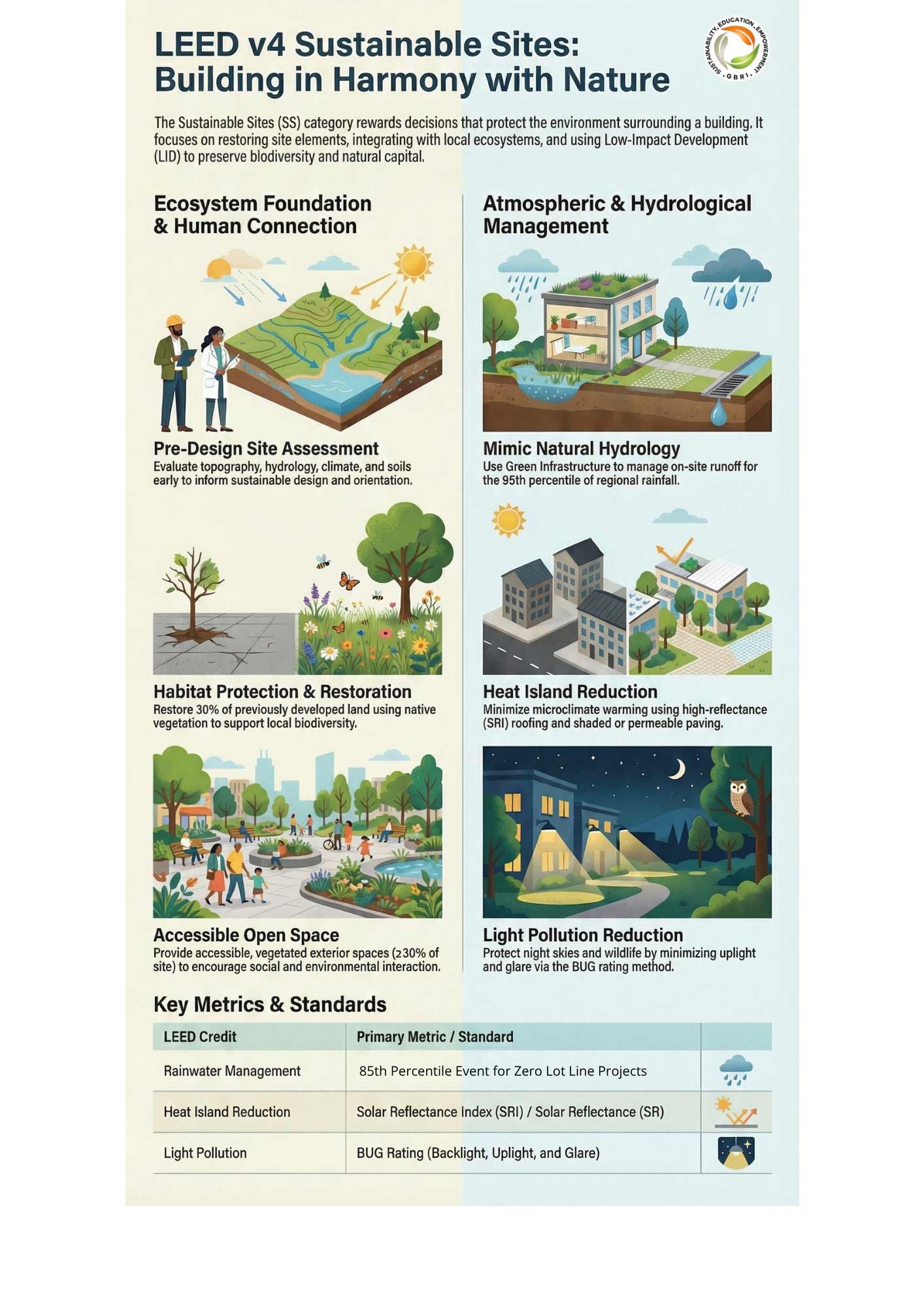
SS Credit: Site Development – Protect or Restore Habitat

View Full Page ↗

Protect what remains. Restore what was lost.

 What is the Intent of this Credit?

The goal is to:

👉 protect existing natural areas
👉 restore damaged areas
👉 promote biodiversity and habitat

🎯 Big Picture

Development should not eliminate nature—it should preserve and rebuild it.

🌍 Why This Matters

Construction can:

  • disturb ecosystems
  • destroy habitats
  • reduce biodiversity
  • alter natural hydrology

👉 This credit ensures projects:

  • minimize damage
  • actively restore ecological value

🧩 Core Requirement Structure

✅ Step 1: Protect Greenfield Areas (MANDATORY)

👉 Projects must:

👉 protect 40% of greenfield area

from:

  • development
  • construction disturbance

❓ What is Greenfield?

👉 Land that is:

  • not previously developed
  • not disturbed or graded
  • capable of supporting natural habitat

🎯 Exam Insight

Greenfield = natural land
Must protect 40%

✅ Step 2: Choose ONE of Two Options

🌱 Option 1: On-Site Restoration (Preferred)

Requirement

👉 Restore:

👉 30% of previously developed site area
⚠️ Important:

  • includes building footprint
  • must use native or adapted vegetation

🌿 Why Native/Adapted Plants?

  • support local ecosystems
  • require less maintenance
  • improve biodiversity

🏢 Special Allowance (High-Density Projects)

If:

👉 FAR ≥ 1.5

Then:

👉 vegetated roofs can count

⚠️ Conditions:

  • must use native/adapted plants
  • must provide habitat
  • must promote biodiversity

💧 Rainwater Management Overlap (Important)

👉 Areas used for:

  • stormwater infiltration

👉 Can be excluded if:

  • treated under Rainwater Management credit

🌍 What Counts as Habitat (Important Clarification)

Even if not vegetated:

👉 These CAN count:

  • natural rock areas
  • ponds
  • deserts

❗ Condition:

👉 Must prove they are:

  • naturally non-vegetated

🛠️ Implementation Steps

  • plan early (design phase)
  • include in construction documents
  • protect during construction

🌎 Option 2: Off-Site Conservation

When to Use This

👉 If on-site restoration is not feasible
Requirement

👉 Provide financial support:

👉 $0.40 per square foot of total site area

(including building footprint)

📍 Where Must Funds Go?

To a:

  • recognized land trust
  • conservation organization

📏 Location Requirement

Must be:

  • within same EPA Level III ecoregion
  • OR same state
  • OR within 100 miles (outside U.S.)

🇺🇸 U.S. Requirement (Important)

👉 Organization must be:

👉 accredited by the Land Trust Alliance

🧠 Where People Get Confused

❌ Misconception 1:

“Only restoration is required”

👉 No

👉 Must ALSO:

  • protect 40% of greenfield

❌ Misconception 2:

“Greenfield and previously developed are the same”

👉 No

  • Greenfield → untouched land
  • Previously developed → disturbed land

❌ Misconception 3:

“Any vegetation counts”

👉 No

👉 Must be:

  • native OR adapted

❌ Misconception 4:

“Off-site option is easier and always allowed”

👉 Only when:

  • on-site restoration is not feasible
What percentage of greenfield area must be protected?
👉 40%
What percentage of previously developed land must be restored (Option 1)?
👉 30%
A project restores 30% of site area but does not protect any greenfield. Does it comply?
No.
👉 Protection of 40% greenfield is mandatory
A project uses non-native decorative plants for restoration. Does it comply?
No.
👉 Must use native or adapted vegetation
Why does LEED require both protection and restoration?
Because:
• protection preserves existing ecosystems
• restoration improves degraded ecosystems
👉 Together, they maximize ecological benefit
A dense urban project cannot restore large areas on-site. What is the best approach?
👉 Use Option 2 (off-site conservation)

No comments yet. Be the first to post!

SS Credit: Open Space

View Full Page ↗

Open space is not about how much land is left—it’s about how well it is used.

 What is the Intent of this Credit?

The goal is to:

👉 create accessible outdoor space that:

  • encourages interaction with nature
  • supports social interaction
  • promotes physical activity

🎯 Big Picture

Open space is not leftover space—it is intentional, usable space.

🌍 Why This Matters

Open spaces provide:

👥 Human Benefits

  • improved well-being
  • increased productivity
  • opportunities for recreation

🌱 Environmental Benefits

  • habitat creation
  • urban biodiversity
  • rainwater infiltration
  • reduced heat island effect

📏 Core Requirement (VERY IMPORTANT)

✅ Total Open Space Requirement

👉 Provide:

👉 ≥30% of total site area

(including building footprint)

🌿 Vegetation Requirement

👉 Of that open space:

👉 ≥25% must be vegetated OR have canopy

⚠️ Important Rule

👉 Turf grass does NOT count as vegetation

🎯 Memory Trick

  • 30% = total open space
  • 25% = vegetated portion

📍 Where Can Open Space Be Located?

👉 Open space can be:

  • adjacent to building
  • elsewhere on site (master plan)
  • shared across development

💡 Shared Space Insight

👉 Shared open space:

  • can count toward compliance
  • must still meet usability criteria

🧩 What Qualifies as Open Space? (HIGHLY TESTABLE)

👉 Open space must be:

👉 physically accessible

AND include at least one of the following:

👣 1. Pedestrian-Oriented Space

  • seating areas
  • plazas
  • gathering areas

🏃 2. Recreation-Oriented Space

  • fitness areas
  • play areas
  • sports spaces

🌸 3. Garden Space

  • diverse vegetation
  • year-round interest

🌽 4. Community Gardens

  • urban agriculture
  • food production

🌿 5. Habitat Areas

  • restored or preserved habitat
  • must align with Habitat credit
  • must allow human interaction

🎯 Exam Insight

Open space must be:
👉 usable + accessible + intentional

🌊 Special Conditions

🐸 Wetlands & Ponds

👉 Can count if:

  • vegetated
  • side slope ≤ 1:4 (vertical:horizontal)

🏢 High-Density Projects (FAR ≥ 1.5)

👉 May include:

  • vegetated roofs (for vegetation requirement)
  • accessible roof areas (for open space)

⚠️ Conditions:

  • must be physically accessible
  • must support human use

⚠️ What Does NOT Qualify

❌ Non-Usable Spaces

  • narrow strips of turf
  • leftover landscaping
  • decorative-only areas

❌ Artificial Turf

👉 Does NOT count as:

  • vegetation
  • open space

💡 Design Considerations

👉 Open space should be:

  • appropriate for climate (e.g., xeriscape in arid regions)
  • designed for actual use
  • integrated with site design

🌿 Example:

  • shaded seating in hot climates
  • wind-protected areas in cold climates

🧠 Where People Get Confused

❌ Misconception 1:

“Any landscaping counts”

👉 No
👉 Must be:

  • usable
  • accessible

❌ Misconception 2:

“Turf grass counts as vegetation”

👉 No

❌ Misconception 3:

“Decorative spaces qualify”

👉 No
👉 Must support:

  • social or physical activity

❌ Misconception 4:

“Open space must be ground-level”

👉 No
👉 Roof spaces can qualify (if accessible)

What percentage of total site area must be open space?
👉 30%
What percentage of open space must be vegetated?
👉 25%
A project provides 30% open space, but only 10% is vegetated. Does it comply?
No.
👉 Must meet both:
• 30% open space
• 25% vegetated portion
A project provides rooftop open space that is not accessible. Does it count?
No.
👉 Must be physically accessible
Why does LEED require open space to be usable, not just available?
Because:
• usability drives human interaction
• improves well-being and activity
• ensures real benefit, not just compliance
Why does LEED exclude turf grass from vegetation calculations?
Because:
• turf provides limited ecological value
• requires high maintenance (water, chemicals)
• does not significantly support biodiversity

No comments yet. Be the first to post!

SS Credit: Rainwater Management

View Full Page ↗

The best stormwater system is the one you don’t notice—because it behaves like nature.

What is the Intent of this Credit?

The goal is to:

👉 reduce runoff volume
👉 improve water quality
👉 replicate natural hydrology of the site

🎯 Big Picture

Rainwater is not waste—it is a resource.

🌍 Why This Matters

Typical development:

  • increases impervious surfaces
  • sends stormwater to drains quickly
  • causes flooding and pollution

💡 LEED Approach

👉 Manage rainwater:

  • on-site
  • close to source
  • like natural land conditions

🌱 How LEED Achieves This

Using:

👉 Green Infrastructure (GI)
👉 Low Impact Development (LID)

📌 Common Techniques

  • vegetated roofs
  • bioretention areas
  • porous paving
  • rain gardens
  • rainwater harvesting
  • pervious decking
  • reduced hardscape
  • restored natural landscape

🎯 Key Idea

Manage water where it falls

🧩 Two Compliance Options

✅ Option 1: Percentile of Rainfall Events

What Does This Mean?

👉 Design the system to manage:

👉 a percentage of rainfall events

📊 Common Thresholds

  • 85th percentile
  • 95th percentile

💡 Example (Very Important)**

👉 85th percentile means:

  • system captures runoff from 85% of storms
  • only largest 15% overflow

🎯 Exam Insight

Percentile = % of storms managed
(not % of rainfall volume)
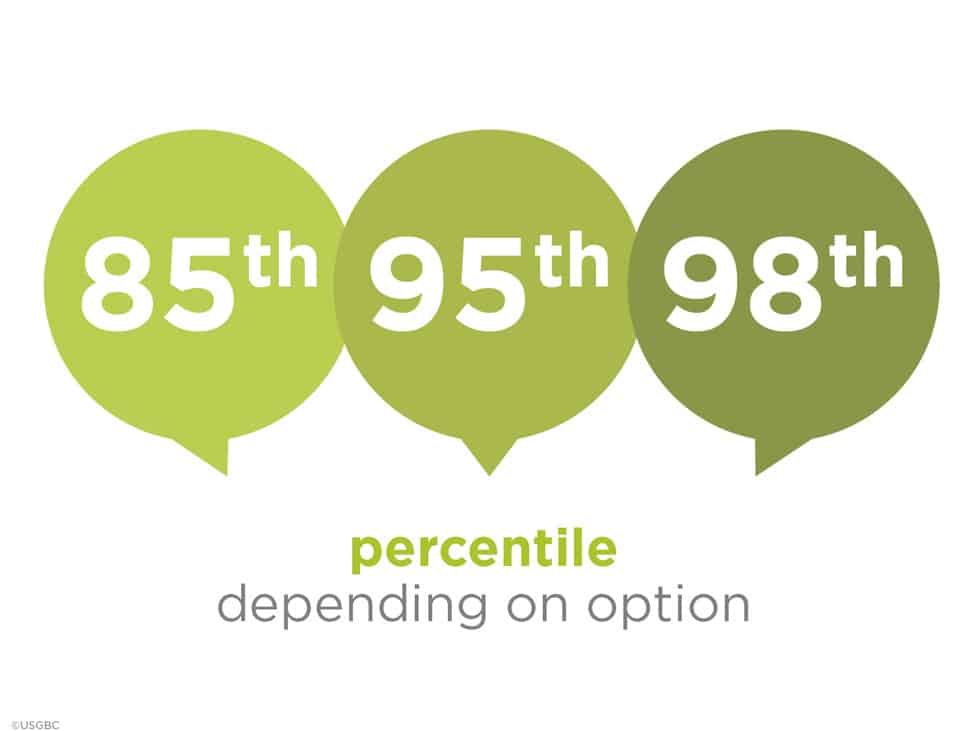
⚙️ Steps to Implement

Step 1: Collect Rainfall Data

  • minimum 10 years preferred
  • include seasonal variation

Step 2: Calculate Runoff Volume

👉 For selected percentile

Step 3: Manage That Volume On-Site

👉 Using GI + LID strategies

🏙️ Path 3: Zero Lot Line Projects

❓ What is a Zero Lot Line Project?

👉 Building footprint ≈ site boundary

📏 Eligibility Requirement

👉 Surrounding density must be:

👉 FAR ≥ 1.5

(within ¼ mile)

⚠️ Important

👉 If FAR < 1.5 → NOT eligible

✅ Option 2: Natural Land Cover Conditions

Concept

👉 Match post-development runoff to:

👉 pre-development (natural) conditions

🎯 Big Idea

After development, the site should behave like it did before.

⚙️ Steps to Implement

Step 1: Identify Natural Land Cover

  • vegetation
  • soil conditions

Step 2: Calculate Natural Runoff

👉 baseline condition

Step 3: Calculate Post-Development Runoff

👉 after construction

Step 4: Manage Difference On-Site

👉 eliminate increase in runoff

🎯 Key Terms

  • Natural land cover = pre-development condition
  • Post-development = after construction

🌍 Design Approach (Very Important Concept)

Projects should:

  • mimic natural hydrology
  • integrate with watershed
  • use multiple strategies (“treatment train”)

💡 Example

Combine:

  • green roof
  • rain garden
  • permeable pavement

🧠 Where People Get Confused

❌ Misconception 1:

“Rainwater should be drained quickly”

👉 No
👉 LEED promotes infiltration and retention

❌ Misconception 2:

“Percentile refers to rainfall amount”

👉 No

👉 It refers to:
👉 percentage of storm events

❌ Misconception 3:

“Option 1 and Option 2 are the same”

👉 No

  • Option 1 → storm-based
  • Option 2 → condition-based

❌ Misconception 4:

“Zero lot line applies to all urban sites”

👉 No

👉 Must meet:

  • FAR ≥ 1.5
What are the two compliance options under Rainwater Management?
1. Percentile of rainfall events
2. Natural land cover conditions
What does 85th percentile rainfall mean?
System manages runoff from 85% of storms
A project manages runoff for 90% of storms. Does it meet 85th percentile requirement?
Yes.
👉 It exceeds the requirement
A project compares post-development runoff to pre-development conditions. Which option is this?
👉 Option 2: Natural land cover
Why does LEED emphasize managing rainwater on-site instead of draining it?
Because:
• reduces flooding
• improves water quality
• restores natural hydrology
• supports groundwater recharge
Why is using multiple GI strategies recommended?
Because:
• improves effectiveness
• mimics natural processes better
• provides redundancy and resilience

No comments yet. Be the first to post!

SS Credit: Heat Island Reduction

View Full Page ↗

The coolest cities are not the ones with more air conditioning—they’re the ones designed to stay cool.

 What is the Intent of this Credit?

The goal is to:

👉 minimize heat island effects

So that we:

  • improve microclimate
  • protect human health
  • reduce impacts on wildlife and ecosystems

🎯 Big Picture

Dark surfaces absorb heat → cities get hotter
LEED reduces this by cooling surfaces

🌍 What is Heat Island Effect?

👉 Urban areas become hotter due to:

  • dark roofs
  • asphalt pavements
  • lack of vegetation

💡 Why It Matters

  • increases cooling demand
  • worsens air quality
  • impacts human comfort and health

📏 Key Concept: SRI (VERY IMPORTANT)

❓ What is SRI?

👉 Solar Reflectance Index

Measures how well a surface:

  • reflects solar radiation
  • emits heat

📊 Scale

  • Black surface → SRI = 0
  • White surface → SRI = 100

🎯 Exam Insight

Higher SRI = cooler surface

🧩 Two Compliance Options

✅ Option 1: Non-Roof + Roof Strategies

Goal

👉 Reduce heat from:

  • pavements
  • roofs
  • site surfaces

🌳 Non-Roof Strategies

  1. Shading with Vegetation
  • trees or plants
  • must provide shade within 10 years
  • must be installed at occupancy

👉 ❌ Artificial turf does NOT count

  1. Vegetated Planters / Structures
  • natural shading
  • improves microclimate
  1. Shading with Energy Systems
  • solar panels
  • wind turbines
  • solar thermal systems
  1. Shading Structures (Reflective Materials)

👉 Must meet:

  • 3-year aged SR ≥ 0.28
    OR
  • initial SR ≥ 0.33

🎯 Memorize These Numbers

  1. High-Reflectance Paving

👉 Same thresholds:

  • SR ≥ 0.28 (aged)
  • SR ≥ 0.33 (initial)
  1. Open-Grid Pavement

👉 Must be:

👉 ≥50% pervious

💡 Bonus Insight

👉 Supports:

  • Rainwater Management credit

🏢 Roof Strategies

  • high-reflectance roofs
  • vegetated roofs (green roofs)

🅿️ Option 2: Parking Under Cover

Requirement

👉 Provide:

👉 ≥75% of parking spaces under cover

📍 What Counts as Covered?

  • underground parking
  • under building
  • under deck
  • structured parking
  • stacked parking

📏 Roof Requirements (VERY IMPORTANT)

Covered parking must have:

Option A:

👉 3-year aged SRI ≥ 32

Option B:

👉 initial SRI ≥ 39

Option C:

  • vegetated roof
  • OR energy generation system

🎯 Memorize These Numbers

  • 32 (aged SRI)
  • 39 (initial SRI)

🧠 Where People Get Confused

❌ Misconception 1:

“Any shade counts”

👉 No
👉 Must meet:

  • reflectance requirements OR
  • vegetation OR
  • energy systems

❌ Misconception 2:

“Artificial turf counts as vegetation”

👉 No

❌ Misconception 3:

“All paving qualifies”

👉 No
👉 Must meet:

  • SR thresholds OR
  • be open-grid

❌ Misconception 4:

“Covered parking means just roof”

👉 No
👉 Roof must meet:

  • SRI requirements
    OR
  • be vegetated/energy-producing
What does SRI measure?
👉 A surface’s ability to reflect solar radiation and release heat
What percentage of parking must be under cover (Option 2)?
👉 75%
A project uses paving with initial SR of 0.30. Does it qualify?
No.
👉 Must be:
• ≥0.33 (initial)
OR
• ≥0.28 (aged)
A project provides covered parking but the roof does not meet SRI requirements. Does it comply?
No.
👉 Roof must meet:
• SRI thresholds
OR
• be vegetated/energy-generating
Why does LEED encourage both shading and reflective materials?
Because:
• shading reduces direct heat gain
• reflective materials reduce heat absorption
👉 Together, they minimize heat island effect
Why does LEED allow solar panels as shading devices?
Because they:
• reduce heat gain
• generate renewable energy
👉 Provide dual benefit

No comments yet. Be the first to post!

SS Credit: Light Pollution Reduction

View Full Page ↗

Good lighting lets you see—great lighting lets you see without being seen.

 What is the Intent of this Credit?

The goal is to:

👉 increase access to the night sky
👉 improve nighttime visibility
👉 reduce negative impacts on people and wildlife

🎯 Big Picture

Light should go where it is needed—not into the sky or neighboring spaces.

🌍 Why This Matters

Poor lighting design causes:

  • skyglow (loss of night sky visibility)
  • disruption to wildlife (especially nocturnal species)
  • glare and discomfort for people
  • light trespass into neighboring properties

🧩 Three Core Requirements

✅ 1. Uplight Control

👉 Prevent light from:

  • escaping upward into the sky

✅ 2. Light Trespass Control

👉 Prevent light from:

  • spilling into adjacent properties

✅ 3. Exterior Signage Control

👉 Limit brightness of:

  • internally illuminated signs

💡 Key Concept: Light Trespass

👉 Defined as:

unwanted light spilling beyond the intended area

⚠️ Impacts

  • annoyance
  • distraction
  • reduced visibility
  • ecological disruption

⚙️ Two Compliance Methods (For Uplight + Trespass)

🔵 Option 1: BUG Rating Method

❓ What is BUG?

👉 Luminaire classification system:

  • B = Backlight
  • U = Uplight
  • G = Glare

📊 What It Does

👉 Limits:

  • uplight (sky pollution)
  • backlight (light trespass)
  • glare (visual discomfort)

📌 Requirement

👉 Luminaires must:

👉 not exceed BUG rating limits

(based on lighting zone)

🎯 Exam Insight

BUG = fixture-based control
(not site calculation)

🟢 Option 2: Calculation Method

❓ What Does It Do?

👉 Limits:

👉 total light emitted above horizontal plane

📊 Requirement

👉 Must not exceed:

  • allowed % of lumens directed upward

🎯 Exam Insight

Calculation method =
👉 overall site lighting performance

🪧 Exterior Signage Requirement (VERY TESTABLE)

🌙 Nighttime Limit

👉 ≤ 200 cd/m²

☀️ Daytime Limit

👉 ≤ 2000 cd/m²

🎯 Memorize These Numbers

  • 200 (night)
  • 2000 (day)

🌌 Good vs Bad Lighting (Conceptual)

❌ Poor Design

  • light in all directions
  • uplight to sky
  • glare
  • spillover

✅ Good Design

  • fully shielded fixtures
  • directed light
  • minimal glare
  • no uplight

🧠 Where People Get Confused

❌ Misconception 1:

“More lighting = better safety”

👉 Not always
👉 Poor lighting creates:

  • glare
  • reduced visibility

❌ Misconception 2:

“Uplight is harmless”

👉 No
👉 Causes:

  • skyglow
  • ecological disruption

❌ Misconception 3:

“BUG and calculation methods must both be used”

👉 No
👉 Choose one method

❌ Misconception 4:

“Signage brightness is not regulated”

👉 No
👉 Strict luminance limits apply

What does BUG stand for?
👉 Backlight, Uplight, Glare
What are the luminance limits for exterior signage?
• 200 cd/m² (night)
• 2000 cd/m² (day)
A project uses lighting fixtures that emit light upward into the sky. Does it comply?
No.
👉 Violates uplight control
A project controls uplight but causes glare affecting pedestrians. Does it comply?
No.
👉 Must address:
• uplight
• trespass
• glare
Why does LEED require both uplight and light trespass control?
Because:
• uplight affects sky and environment
• trespass affects neighbors and occupants
👉 Both must be controlled for full impact
Why is BUG method preferred in many projects?
Because:
• easier to apply (fixture-based)
• standardized ratings
• reduces calculation complexity

No comments yet. Be the first to post!

SS Synergies: How Sustainable Sites Credits Work Together

View Full Page ↗

The best LEED projects don’t chase points—they design systems where points happen naturally.

 🎯 Why This Section Matters

LEED is not about individual credits.

👉 It is about systems working together

💡 Big Idea

A single strategy can contribute to multiple credits.

🌿 Core SS Synergy Cluster

From your diagram, these are the key interconnected credits:

  • Rainwater Management
  • Protect or Restore Habitat
  • Heat Island Reduction
  • Open Space

🔁 Primary Synergy Loop

Strategy

Rainwater

Habitat

Heat Island

Open Space

Vegetated areas

Green roofs

Trees / shading

Permeable paving

Rain gardens

🎯 Key Insight

Nature-based strategies solve multiple problems at once.

🌱 Example 1: Vegetated Roof (Green Roof)

✅ Contributes to:

  • Rainwater Management → absorbs runoff
  • Heat Island Reduction → cools roof surface
  • Habitat → supports biodiversity
  • Open Space → if accessible

🎯 Exam Insight

Green roof = multi-credit strategy

🌳 Example 2: Trees & Vegetation

✅ Contributes to:

  • Heat Island Reduction → shading
  • Open Space → usability
  • Habitat → biodiversity
  • Rainwater Management → interception

💡 Real Project Thinking

👉 One tree can:

  • reduce temperature
  • absorb rainwater
  • improve experience

💧 Example 3: Rain Gardens / Bioretention

✅ Contributes to:

  • Rainwater Management → infiltration
  • Habitat → supports plant life

⚠️ Limitation

👉 May NOT count for:

  • Open Space (unless accessible)

🧱 Example 4: Permeable Pavement

✅ Contributes to:

  • Rainwater Management → infiltration
  • Heat Island Reduction → lower heat storage

⚠️ Limitation

👉 Does NOT contribute to:

  • Habitat
  • Open Space

🌍 Cross-Category Synergies (VERY POWERFUL FOR EXAM)

🔗 SS + LT (Location & Transportation)

Example:

  • Reduced Parking (LT)
    → Less hardscape

👉 Supports:

  • Heat Island Reduction
  • Rainwater Management

🔗 SS + WE (Water Efficiency)

Example:

  • Rainwater harvesting

👉 Supports:

  • Rainwater Management (SS)
  • Water reuse (WE)

🔗 SS + EA (Energy & Atmosphere)

Example:

  • Green roofs

👉 Reduce:

  • cooling loads
  • energy demand

🔗 SS + MR (Materials & Resources)

Example:

  • Reuse site materials

👉 Supports:

  • habitat restoration
  • reduced material extraction

🧠 Where Students Get Confused

❌ Misconception 1:

“Each credit is separate”

👉 No
👉 LEED rewards integrated strategies

❌ Misconception 2:

“More strategies = better”

👉 Not always

👉 Better approach:

  • fewer, multi-benefit strategies

❌ Misconception 3:

“Hardscape solutions are enough”

👉 No

👉 Nature-based solutions are preferred

💧 Connection to LEED Credits

Pervious open space directly supports:

  • SS Credit: Rainwater Management → promotes infiltration
  • SS Credit: Heat Island Reduction → reduces surface temperatures
  • SS Credit: Protect or Restore Habitat → supports natural systems

🌱 Examples of Pervious Open Space

  • landscaped areas
  • rain gardens
  • wetlands and natural ponds
  • permeable walkways
  • vegetated open spaces

⚠️ Important Clarification (Exam Tip)

👉 LEED does not require all open space to be pervious or vegetated

Instead, it requires:

  • ≥30% of total site area as open space
  • ≥25% of that open space to be vegetated or canopy-covered

🎯 Key Insight

Pervious open space is preferred because it behaves more like natural land—absorbing water, supporting ecosystems, and reducing environmental impact.

⚠️ Common Misconception

❌ “All open space must be vegetated”
👉 Not true

  • Some open space can be hardscape (usable areas)
  • But increasing pervious + vegetated areas improves performance

🎯 Final Takeaway

The more pervious the open space, the closer the site behaves to its natural condition—reducing runoff, improving resilience, and supporting multiple LEED credits.

📦 Concept Box: FAR, Density, and Building Footprint (LEED Exam + Projects)

🧩 What is Floor Area Ratio (FAR)?

👉 FAR = Total Building Floor Area ÷ Site Area

📊 Example

  • Site area = 10,000 sq ft
  • Building floor area = 10,000 sq ft

👉 FAR = 1.0

🔄 How FAR Affects Design

📈 Increasing FAR (e.g., 1.0 → 2.0)

👉 While keeping total floor area the same:

  • Building goes vertical (taller)
  • Footprint decreases
  • More land remains undisturbed

📉 Decreasing FAR

  • Building spreads horizontally
  • Footprint increases
  • More land is disturbed

🌱 Why This Matters in LEED

🟢 Higher FAR → Better Environmental Outcomes

👉 Supports:

  • Habitat protection (SS Credit)
  • Reduced site disturbance
  • More open space
  • Better rainwater infiltration

🎯 Greenfield Site Insight (VERY IMPORTANT)

On a greenfield site:

👉 Increasing FAR helps:

  • preserve natural land
  • reduce ecological disruption
  • protect biodiversity

⚖️ FAR vs Density (Common Confusion)

Concept

What It Means

Exam Tip

FAR

Ratio of floor area to land

Technical measure

Density

Intensity of development

Outcome/result

Footprint

Land covered by building

Physical impact

🎯 Key Relationship

👉 Higher FAR = Higher Density = Smaller Footprint

🧠 Visual Thinking

❌ Low FAR (Sprawl)

  • Wide building
  • Large footprint
  • More land disturbance

✅ High FAR (Smart Growth)

  • Taller building
  • Smaller footprint
  • More land preserved

⚠️ Common Exam Traps

❌ Trap 1:

“Higher FAR increases footprint”

👉 Incorrect
👉 It reduces footprint

❌ Trap 2:

“FAR and density are the same”

👉 Not exactly

  • FAR = metric
  • Density = outcome

❌ Trap 3:

“LEED prefers lower FAR”

👉 Incorrect

👉 LEED often encourages:

  • compact development (higher FAR)

✅ Effective Strategies:

  1. Shade from Vegetation
    • Trees and plants shade hard surfaces
    • Reduce surface and ambient temperatures
  1. Reflective Roofing (High SRI)
    • Reflects solar radiation
    • Reduces heat gain
  1. Green Roofs
    • Provide insulation
    • Reduce surface temperature
    • Support evapotranspiration
  1. Shade Structures
    • Block direct sunlight
    • Can include solar panels (dual benefit)
  1. Underground or Covered Parking
    • Reduces exposed paved areas
    • Limits heat absorption
  1. Increased Vegetation
    • Enhances cooling
    • Supports evapotranspiration

👉 (Note: Artificial turf does NOT count in LEED)

❌ Why “Reduced Air Flow” is the WRONG Strategy

👉 Reduced air flow actually worsens heat island effect

🔍 Here’s why:

  • Airflow helps dissipate heat
  • It enables cooling through ventilation

👉 When airflow is reduced (e.g., due to tall buildings and narrow streets):

  • heat gets trapped
  • temperatures increase
  • cooling is less effective

🎯 Key Insight

Good urban design promotes airflow
Poor airflow traps heat and intensifies heat islands

⚠️ Common Exam Trap

Many candidates assume:

👉 “Any urban design change helps sustainability”

But:

👉 Some designs (like reduced airflow) can make conditions worse

🎯 Final Takeaway

Heat island reduction strategies either reflect heat, block heat, or dissipate heat—reducing airflow does none of these and instead traps heat.


  1. For Rainwater Management (Path 3), should zero lot line projects use the 85th percentile or 98th percentile rainfall? Also, are reflective roof surfaces considered a roof or nonroof strategy under Heat Island Reduction?

Answer:

💧 Rainwater Management – Path 3 (Zero Lot Line Projects)

👉 Zero lot line projects must manage:

👉 98th percentile rainfall events

🔍 Why 98th percentile?

  • Zero lot line projects have:
    • limited site area
    • little or no open space for infiltration

👉 Therefore, LEED requires a more stringent threshold to ensure effective stormwater management.

🎯 Exam Insight

Standard projects → 85th or 95th percentile
Zero lot line → 98th percentile (more rigorous)

🌡️ Heat Island Reduction – Roof vs Nonroof

👉 Reflective roof surfaces are considered a roof strategy

🔍 Clarification

  • Roof strategies include:
    • high-SRI roofing materials
    • vegetated (green) roofs
  • Nonroof strategies include:
    • shading (trees or structures)
    • reflective paving (SR ≥ thresholds)
    • open-grid pavement
    • vegetation

🎯 Key Distinction

Roof = building surfaces
Nonroof = site surfaces (pavement, landscape, parking)

⚠️ Common Exam Traps

❌ Trap 1:

“All reflective materials are nonroof strategies”

👉 Incorrect
👉 Depends on where they are applied

❌ Trap 2:

“Zero lot line projects use same percentile as others”

👉 Incorrect
👉 They use a higher threshold (98th percentile)

🎯 Final Takeaway

Zero lot line projects require stricter rainwater management (98th percentile), and reflective materials are categorized based on location—roof vs nonroof—not just function.

What is meant by synergy in LEED?
👉 One strategy contributing to multiple credits
A project installs a green roof. Which SS credits could it support?
• Rainwater Management
• Heat Island Reduction
• Protect/Restore Habitat
• Open Space (if accessible)
Why are vegetated strategies more valuable than hardscape strategies in LEED?
Because they:
• provide multiple benefits
• mimic natural systems
• improve ecological performance
A project focuses only on reflective materials for heat island reduction. What opportunity is missed?
👉 Missed opportunity to:
• support habitat
• manage rainwater
• enhance open space
Why is open space encouraged to be pervious in LEED projects?
Open space is encouraged to be pervious because it supports:
👉 rainwater management
👉 groundwater recharge
👉 overall environmental performance

No comments yet. Be the first to post!

Water Efficiency Overview

Welcome to Water Efficiency. Please select a concept from the sidebar.

WE: Outdoor Water Use Reduction (Prerequisite + Credit)

View Full Page ↗

Use less water first. Then use smarter water.

🎯 Why This Topic Matters

Outdoor water use is one of the largest sources of potable water consumption in buildings.

👉 LEED focuses on:

Reducing irrigation demand first → then using smarter water sources

🧩 Prerequisite vs Credit (Key Distinction)

📊 Quick Comparison Table (HIGH VALUE FOR USERS)

RequirementPrerequisiteCredit
Mandatory?✅ Yes❌ No
Points0Up to 2 points
IntentReduce outdoor water useFurther reduce outdoor water use
Option 1No irrigationSame
Option 2 Reduction≥30%≥50% (1 pt), 100% (2 pts)
Use of alternative water❌ Not allowed for first 30%✅ Allowed beyond 30%

🎯 Key Insight

Prerequisite = baseline efficiency
Credit = deeper performance

🌿 WE Prerequisite: Outdoor Water Use Reduction

Intent

👉 Reduce outdoor potable water consumption

Compliance Options

✅ Option 1: No Irrigation Required

  • No permanent irrigation system
  • Allowed only for:
    • ≤2-year establishment period

👉 Requires:

  • narrative explaining:
    • rainfall adequacy
    • plant suitability

✅ Option 2: Reduced Irrigation

👉 Must achieve:

👉 ≥30% reduction

(from baseline landscape water requirement)

⚙️ How is this calculated?

Using:

👉 EPA WaterSense Water Budget Tool
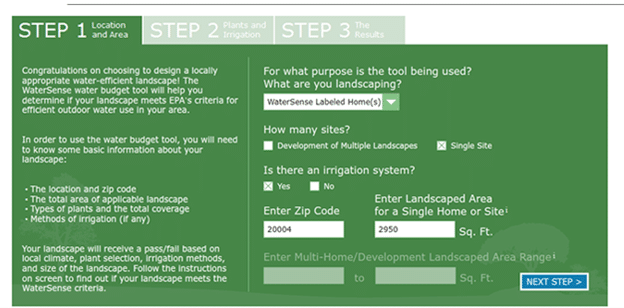
🧮 WaterSense Tool – Key Steps

🔹 Step 1: Climate Data

  • input project location (ZIP code)
  • tool generates:
    • precipitation
    • evapotranspiration

🔹 Step 2: Landscape Inputs

  • enter:
    • plant types
    • landscape areas

⚠️ Important Rule:

👉 Include:

  • vegetated areas

👉 Exclude:

  • hardscape
  • non-irrigated surfaces
  • mulched pathways

🔹 Step 3: Results

  • baseline water use
  • design water use
  • % reduction

🌱 WE Credit: Outdoor Water Use Reduction

Intent

👉 Same as prerequisite—but with higher performance

Compliance Options

✅ Option 1: No Irrigation Required

Same as prerequisite

👉 Eligible for maximum performance

✅ Option 2: Reduced Irrigation

📏 Thresholds

  • 50% reduction → 1 point
  • 100% reduction → 2 points

⚠️ Critical Rule (VERY TESTABLE)

👉 First 30% reduction MUST come from:

  • plant selection
  • irrigation efficiency

👉 Beyond 30%, you can use:

  • alternative water (rainwater, graywater)
  • smart controls
  • advanced systems

🎯 Exam Insight

LEED = Efficiency First → Then Alternative Water

🌿 Strategies to Achieve This Credit

🌱 1. Native / Adaptive Plants

  • require less water
  • suited to local climate

💧 2. Efficient Irrigation Systems

Example:

👉 Drip Irrigation

  • low-pressure system
  • delivers water directly to roots
  • minimizes evaporation

🌵 3. Xeriscaping

👉 Landscaping that:

  • requires little to no irrigation

♻️ 4. Alternative Water Sources

  • rainwater harvesting
  • graywater reuse
  • reclaimed water

📊 5. Smart Irrigation Controls

  • weather-based controllers
  • soil moisture sensors

📈 6. Submetering

  • track irrigation use
  • identify inefficiencies

🧠 Where People Get Confused

❌ Misconception 1:

“Alternative water helps meet prerequisite”

👉 No

👉 First 30% must be from:

  • efficiency + plant selection

❌ Misconception 2:

“Credit and prerequisite are the same”

👉 No

  • 30% → prerequisite
  • 50–100% → credit

❌ Misconception 3:

“All landscaped areas are included in calculations”

👉 No

👉 Only:

  • vegetated areas count
What is the minimum reduction required for the prerequisite?
30%
What tool is used for calculations?
EPA WaterSense Water Budget Tool
A project achieves 40% reduction using only efficient irrigation. Does it meet the prerequisite?
Yes
A project uses rainwater to achieve the first 30% reduction. Does it comply?
No
Must use:
• efficiency + plant selection
Why does LEED require efficiency before alternative water?
Because:
• reduces overall demand
• ensures long-term sustainability
• avoids over-reliance on systems

No comments yet. Be the first to post!

WE: Indoor Water Use Reduction (Prerequisite + Credit)

View Full Page ↗

Use less water first → then reuse water

Why This Matters

Indoor water use is one of the most controllable sources of water consumption in buildings.

👉 LEED focuses on:

Reducing fixture demand first → then using alternative water

🧩 Prerequisite vs Credit (Quick Comparison)

RequirementPrerequisiteCredit
Mandatory?✅ Yes❌ No
Points0Up to 6
Reduction Required≥20%25%–50%+
Alternative water allowed?❌ Not for first 20%✅ Yes (beyond 20%)

🚿 WE Prerequisite: Indoor Water Use Reduction

Intent

👉 Reduce indoor potable water consumption

📏 Requirement

👉 Must achieve:

👉 ≥20% reduction from baseline

🚽 Baseline Fixture Flow Rates (VERY IMPORTANT)

FixtureBaseline (IP)Baseline (SI)
Toilet (Water Closet)1.6 gpf6 lpf
Urinal1.0 gpf3.8 lpf
Public Lav Faucet0.5 gpm1.9 lpm
Private Lav Faucet2.2 gpm8.3 lpm
Kitchen Faucet2.2 gpm8.3 lpm
Showerhead2.5 gpm9.5 lpm

🧠 Exam Tip

👉 Memorize at least:

  • 1.6 gpf (toilet)
  • 1.0 gpf (urinal)
  • 2.5 gpm (shower)

🚰 WaterSense Requirement

👉 Required for:

  • Toilets
  • Urinals
  • Private lavatory faucets
  • Showerheads

👉 Must be:

EPA WaterSense labeled

👥 Usage Assumptions (VERY TESTABLE)

👨‍👩‍👧 Occupancy Ratio

👉 50% male / 50% female

🚻 Daily Use Patterns

Women:

  • 3 toilet flushes/day

Men:

  • 1 toilet + 2 urinal uses/day

👉 This is used for:

  • calculating baseline water use
  • determining % reduction

⚠️ Critical Rule (EXAM TRAP)

👉 The first 20% reduction must come from:

  • fixture efficiency

👉 NOT from:

  • alternative water

💧 WE Credit: Indoor Water Use Reduction

Intent

👉 Go beyond prerequisite → deeper savings

📊 Points Structure

ReductionPoints
25%1 point
30%2 points
35%3 points
40%4 points
45%5 points
50%+6 points

⚠️ Key Rule (VERY IMPORTANT)

👉 First 20% = efficiency only

👉 Beyond 20% = you may use:

  • nonpotable water
  • reuse systems

♻️ Nonpotable Water Sources

Projects may use:

  • Reclaimed water
  • Greywater
  • Rainwater
  • Stormwater
  • Condensate (HVAC)
  • Foundation dewatering water
  • Seawater
  • Process water
  • Reverse osmosis reject water

🧠 Exam Insight

Alternative water is a bonus strategy, not a shortcut

🧠 Strategies to Reduce Indoor Water Use

🚿 1. Low-Flow Fixtures

  • dual flush toilets
  • ultra-low flow faucets

🚰 2. Efficient Appliances

  • dishwashers
  • clothes washers

📊 3. Submetering

  • track usage
  • identify inefficiencies

♻️ 4. Water Reuse Systems

  • greywater reuse
  • rainwater flushing

⚠️ Common Misconceptions

❌ “We can use rainwater to meet prerequisite”

👉 No
👉 First 20% must be from efficiency

❌ “All faucets have same baseline”

👉 No

👉 Public vs Private = different values

❌ “Urinals are optional in calculations”

👉 No

👉 Male usage assumptions must be included

What is the minimum reduction required for the prerequisite?
20%
What is the baseline flow rate for toilets?
1.6 gpf
A project achieves 18% reduction using efficient fixtures. Does it comply?
❌ No
Must reach 20%
A project uses rainwater to achieve 25% reduction but only 10% comes from efficient fixtures. Does it comply?
❌ No
First 20% must be efficiency
Why does LEED require efficiency before alternative water?
Because:
• reduces demand permanently
• ensures system resilience
• avoids dependence on supply systems

No comments yet. Be the first to post!

WE: Building-Level Water Metering (Prerequisite + Credit)

View Full Page ↗

Measure everything → Then optimize what matters most

Why This Matters

“You can’t manage what you don’t measure.”

LEED emphasizes measurement first, because:

  • tracking → identifies inefficiencies
  • data → drives future savings
  • accountability → supports long-term performance

🧩 Prerequisite vs Credit (Quick Comparison)

Requirement

Prerequisite

Credit

Mandatory?

✅ Yes

❌ No

Points

0

1

Scope

Whole building

Subsystems

Data Sharing

5 years

Ongoing (monthly)

Meter Type

Total building water

Specific uses

🚰 WE Prerequisite: Building-Level Water Metering

Intent

👉 Track total building water use to support long-term water management

📏 Requirements

Projects must:

✅ 1. Install permanent meters

  • measure total potable water use
  • includes:
    • building
    • associated grounds

✅ 2. Record and summarize data

  • monthly
  • annually

✅ 3. Share data with USGBC

👉 For 5 years

Starting from:

  • certification acceptance OR
  • typical occupancy

(whichever comes first)

⚠️ Important Exam Detail

👉 Data sharing continues for 5 years:

  • OR until ownership/tenant changes

🧠 What This Really Means

👉 This prerequisite is about:

  • accountability
  • performance tracking
  • post-occupancy validation

💧 WE Credit: Water Metering

Intent

👉 Track specific water uses to identify savings opportunities

📏 Requirement

👉 Install meters for at least TWO subsystems

🔧 Eligible Subsystems (VERY TESTABLE)

🌿 1. Irrigation

👉 Must cover:

👉 ≥80% of irrigated landscape area

🚽 2. Indoor Plumbing Fixtures

👉 Must cover:

👉 ≥80% of fixtures

(from Indoor Water Use Reduction scope)

🔥 3. Domestic Hot Water

👉 Must cover:

👉 ≥80% of system capacity

Includes:

  • storage tanks
  • on-demand heaters

🏭 4. Process Water

👉 Must cover:

👉 ≥80% of expected daily use

Examples:

  • dishwashers
  • clothes washers
  • pools
  • humidification

♻️ 5. Reclaimed Water

👉 Must be metered:

👉 100% (regardless of volume)

💧 6. Boiler Water

👉 Required if:

👉 ≥100,000 gallons/year

⚠️ Critical Rules (EXAM FOCUS)

🔴 Rule 1:

👉 Must meter at least TWO subsystems

🔴 Rule 2:

👉 Most systems require 80% coverage

🔴 Rule 3 (VERY IMPORTANT):

👉 Reclaimed water:

Must ALWAYS be metered (no % threshold)

🔴 Rule 4:

👉 Must share data with USGBC:

👉 Monthly

🔴 Rule 5:

👉 Meters must be:

  • permanent
  • accessible

🧠 Common Misconceptions

❌ “Only whole building metering is enough for credit”

👉 No

👉 That’s the prerequisite

❌ “All subsystems must be metered”

👉 No

👉 Only two or more

❌ “80% applies to everything”

👉 Not always

👉 Exception:

  • Reclaimed water = 100%

❌ “Data sharing is optional”

👉 No

👉 Required for:

  • prerequisite (5 years)
  • credit (monthly reporting)
How long must projects share whole-building water data?
5 years
How many subsystems must be metered for the credit?
At least 2
A project meters irrigation (80%) and domestic hot water (80%). Does it qualify?
✅ Yes
A project meters only indoor fixtures (80%). Does it qualify?
❌ No
Needs at least 2 subsystems
Why is submetering important beyond whole-building metering?
Because it:
• identifies high-use systems
• enables targeted improvements
• supports operational efficiency

No comments yet. Be the first to post!

WE Credit: Cooling Tower Water Use

View Full Page ↗

Reuse water as many times as possible → then supplement with alternative sources

Why This Credit Matters

Cooling towers are one of the largest water consumers in commercial buildings.

👉 LEED focuses on:

Using water efficiently in cooling systems while maintaining system health

⚙️ Key Concept First (VERY IMPORTANT)

💡 What is Makeup Water?

👉 Makeup water = water added to replace:

  • evaporation
  • blowdown (bleed-off)
  • drift losses

💡 What are Cycles of Concentration?

👉 Cycles = how many times water is reused before discharge

  • Higher cycles → less water waste
  • Lower cycles → more water wasted

🧠 Simple Understanding:

  • 5 cycles → water reused 5 times
  • 10 cycles → water reused 10 times

👉 More cycles = better efficiency

🧩 Credit Overview

Intent

👉 Reduce cooling tower water use

👉 While controlling:

  • scale
  • corrosion
  • biological growth

📏 Step 1: Water Quality Analysis (MANDATORY)

Projects must perform a one-time potable water analysis

🔬 Measure ALL 5 parameters:

  • Calcium (Ca as CaCO₃)
  • Total Alkalinity
  • Silica (SiO₂)
  • Chlorine (Cl)
  • Conductivity

⚠️ Exam Tip:

👉 You don’t need to memorize exact chemistry
👉 But you must know that 5 parameters are required

📏 Step 2: Control Cycles of Concentration

👉 System must be designed so:

None of the parameters exceed maximum limits

🏆 Points Structure

🥇 Option 1: Increase Cycles

  • Up to 10 cycles → 1 point
  • >10 cycles → 2 points

🥈 Option 2: Combine Efficiency + Nonpotable Water

👉 Earn 2 points if:

  • achieve up to 10 cycles
    AND
  • use ≥20% nonpotable water

♻️ Nonpotable Water Sources

(from your slide + expanded)

  • HVAC condensate
  • Steam condensate
  • Ice machine condensate
  • Rainwater
  • Reclaimed water
  • Process water

💡 High-Value Strategy

👉 100% nonpotable water (if feasible)
= strong sustainability + easier compliance

🧠 Where People Get Confused

❌ Misconception 1:

“More chemicals = more cycles”

👉 Not necessarily

👉 Cycles depend on:

  • water quality
  • system design

❌ Misconception 2:

“Nonpotable water alone earns points”

👉 No

👉 Must still meet:

  • cycle requirements

❌ Misconception 3:

“10 cycles = maximum”

👉 No

👉 More than 10 cycles = best performance

How many water quality parameters must be measured?
5
What does “cycles of concentration” mean?
Number of times water is reused before discharge
A project achieves 9 cycles and uses no nonpotable water. Points?
1 point
A project achieves 9 cycles and uses 25% nonpotable water. Points?
2 points
A project achieves 11 cycles. Points?
2 points
Why does LEED promote higher cycles of concentration?
Because it:
• reduces makeup water demand
• minimizes water discharge
• improves system efficiency

No comments yet. Be the first to post!

Synergies in Water Efficiency (WE)

View Full Page ↗

The best LEED strategies don’t solve one problem—they solve multiple problems at once.

Big Picture

The synergies within Water Efficiency—and across other LEED categories—are easy to spot once you understand the system.

👉 For example:

  • Prerequisites and credits naturally build on each other
    • Indoor Water Use Reduction (Prereq → Credit)
    • Outdoor Water Use Reduction (Prereq → Credit)

👉 But the real value comes from:

Strategies that help achieve multiple credits at the same time

💡 Core Strategies That Unlock Multiple Credits

🚿 1. Efficient Fixtures (Indoor Water + Energy)

Strategy:

  • low-flow fixtures
  • WaterSense products
  • efficient appliances

Benefits:

  • reduces indoor water use
  • reduces hot water demand

🔗 Credit Connection:

  • WE → Indoor Water Use Reduction
  • EA → Optimize Energy Performance

🧠 Why it matters:

Heating water requires energy → less hot water = less energy use

🔥 2. Domestic Hot Water Reduction

Strategy:

  • low-flow showerheads
  • efficient faucets
  • efficient dishwashers

Benefits:

  • reduces water consumption
  • reduces energy for heating

🔗 Credit Connection:

  • WE → Indoor Water Use Reduction
  • EA → Optimize Energy Performance

❄️ 3. Cooling Tower Optimization (Water + Energy Nexus)

Strategy:

  • increase cycles of concentration
  • use nonpotable water
  • optimize system design

Benefits:

  • reduces cooling tower makeup water
  • improves HVAC efficiency

🔗 Credit Connection:

  • WE → Cooling Tower Water Use
  • EA → Optimize Energy Performance

🧠 Key Insight:

Cooling systems use both water and energy → improving one improves the other

🌿 4. Efficient Irrigation Systems

Strategy:

  • drip irrigation
  • smart controllers
  • native/adaptive plants

Benefits:

  • reduces irrigation water use
  • reduces pumping energy

🔗 Credit Connection:

  • WE → Outdoor Water Use Reduction
  • EA → Reduced energy for pumping

🌧 5. Green Infrastructure (Multi-Category Synergy)

Strategies:

  • green roofs
  • bioswales
  • rain gardens
  • permeable paving
  • rainwater harvesting

Benefits:

  • reduces stormwater runoff
  • supports groundwater recharge
  • reduces heat island effect
  • lowers cooling demand

🔗 Credit Connection:

  • SS → Rainwater Management
  • WE → Water reuse / reduced irrigation
  • EA → Reduced cooling loads

🌱 6. Green Roofs (High-Impact Strategy)

Strategy:

  • vegetated roof systems

Benefits:

  • reduces irrigation demand (if native plants used)
  • reduces building heat gain
  • reduces heat island effect

🔗 Credit Connection:

  • SS → Heat Island Reduction
  • WE → Outdoor Water Use Reduction
  • EA → Energy Performance

💧 7. Alternative Water Use

Strategy:

  • rainwater harvesting
  • greywater reuse
  • condensate reuse

Benefits:

  • reduces potable water demand
  • supports irrigation and cooling systems

🔗 Credit Connection:

  • WE → Indoor/Outdoor Water Use Reduction
  • WE → Cooling Tower Water Use
  • SS → Rainwater Management

🧠 Exam + Project Insight

Water and energy are closely connected in buildings

Key Examples:

  • less hot water → less energy
  • better irrigation → less pumping energy
  • efficient cooling towers → water + energy savings
  • green infrastructure → water + heat reduction

No official FAQs available for this concept yet.

No comments yet. Be the first to post!

Energy Efficiency Overview

Welcome to Energy Efficiency. Please select a concept from the sidebar.

EA: Commissioning (Fundamental vs Enhanced)

View Full Page ↗

🎯 What is Commissioning (Cx)?

Commissioning is the process of verifying that building systems are designed, installed, and operate according to the Owner’s Project Requirements (OPR).

🧠 In simple terms:

👉 “Did we build what the owner actually wanted—and does it work properly?”

📌 Key Documents (VERY IMPORTANT)

📄 OPR (Owner’s Project Requirements)

  • defines what the owner wants
  • includes:
    • goals
    • performance targets
    • budget
    • operational expectations

📄 BOD (Basis of Design)

  • explains how the design meets the OPR
  • created by designers
  • reviewed by CxA

👉 Exam memory trick:

  • OPR → “WHAT”
  • BOD → “HOW”

🧩 EA Prerequisite: Fundamental Commissioning

Intent

👉 Ensure building systems meet:

  • energy
  • water
  • indoor environmental quality
  • durability goals

   Core Requirements

✅ Engage a Commissioning Authority (CxA)

✅ Develop:

  • OPR
  • BOD
  • Commissioning Plan

✅ Perform:

  • design review
  • installation verification
  • functional testing

✅ Deliver:

  • Commissioning Report
  • O&M documentation

👤 Who Can Be the CxA? (VERY TESTABLE)

👉 Allowed:

  • owner’s employee
  • independent consultant
  • design/construction firm employee (with restrictions)
  • disinterested subcontractor

⚠️ Exception:

👉 For projects < 20,000 sq ft
→ CxA can be part of design/construction team

🔴 Key Rule:

👉 CxA must:

Report directly to the owner

🧩 EA Credit: Enhanced Commissioning

Intent

👉 Go beyond basic commissioning

👉 Improve long-term performance

🧠 Common Misconceptions

❌ “Commissioning is just testing”

👉 No

👉 It includes:

  • design review
  • documentation
  • training
  • post-occupancy

❌ “CxA must always be independent”

👉 Not for prerequisite

👉 Only for Enhanced Cx

❌ “Commissioning ends at construction”

👉 No

👉 Enhanced Cx continues into operations

📊 Fundamental vs Enhanced Commissioning (KEY TABLE)

Feature

Fundamental Cx (Prereq)

Enhanced Cx (Credit)

Required?

✅ Yes

❌ No

Points

0

Up to 6

Start Phase

Design

Earlier + deeper involvement

CxA Independence

Flexible

❗ Must be independent

OPR/BOD Review

Basic

Updated + expanded

Construction Review

Yes

More detailed

Post-Occupancy Review

❌ No

✅ Yes (within 10 months)

Monitoring-Based Cx

❌ No

✅ Optional (Path 2)

Envelope Commissioning

❌ No

✅ Option

⚠️ BIG DIFFERENCE (EXAM & PROJECT IMPLEMENTATION)

👉 Fundamental Cx:

  • CxA can be part of design/construction team (with limits)

👉 Enhanced Cx:

  • CxA must be fully independent

🧭 Enhanced Commissioning Options

🔹 Option 1: Enhanced Systems Commissioning

🥇 Path 1 (3 points)

👉 Extends fundamental commissioning:

  • updates OPR, BOD, Cx plan
  • reviews contractor submittals
  • verifies training

👉 Adds:

  • post-occupancy review (within 10 months)
  • corrective action plan

🥈 Path 2 (4 points)

👉 Includes Path 1 PLUS:

  • Monitoring-Based Commissioning (MBCx)

💡 What is MBCx?

  • real-time performance tracking
  • sensors + data
  • ongoing optimization

👉 Best for:

  • complex / energy-intensive buildings

🔹 Option 2: Envelope Commissioning (2 points)

👉 Focuses on:

  • building envelope
  • thermal performance
  • air/water leakage

📘 Reference:

  • NIBS Guideline 3–2012

⚠️ Important:

👉 Must still complete:

  • Fundamental Cx
  • Envelope-specific commissioning

🔧 CxA Responsibilities (Simplified)

📋 During Design:

  • review OPR + BOD
  • develop commissioning plan

🏗 During Construction:

  • verify installation
  • review submittals
  • create checklists

⚙️ During Testing:

  • perform functional testing
  • identify issues

📊 After Completion:

  • document findings
  • prepare final report

🔁 For Enhanced Cx:

  • review building after 10 months
  • create ongoing commissioning plan

🎯 Final Takeaway

Fundamental Cx = Verify design and construction
Enhanced Cx = Ensure long-term performance

🔗 Synergy Insight

Commissioning connects with:

  • EA Optimize Energy Performance → systems efficiency
  • IEQ → occupant comfort
  • WE → water systems performance

💡 Quick Memory Rule

  • OPR = Owner wants
  • BOD = Design response
  • Fundamental = Required
  • Enhanced = Deeper + Independent + Ongoing
What are the two key documents in commissioning?
OPR and BOD
When must the CxA be engaged?
By end of design development phase
Can a design engineer act as CxA for Fundamental Cx?
Yes (with restrictions)
Can the same person act as CxA for Enhanced Cx?
❌ No (must be independent)
Why is post-occupancy review required in Enhanced Cx?
👉 Because:
• real performance differs from design
• systems drift over time
• optimization improves long-term efficiency

No comments yet. Be the first to post!

EA Prerequisite + Credit: Energy Performance

View Full Page ↗

🔹 EA Prerequisite: Minimum Energy Performance

🎯 Intent

👉 To reduce environmental and economic harms of excessive energy use
👉 by establishing a minimum level of energy efficiency

🧩 Compliance Options (VERY IMPORTANT)

🥇 Option 1: Whole-Building Energy Simulation (Performance Path)

📊 Requirement:

Compare Proposed Building vs Baseline Building

👉 Using:

  • ASHRAE 90.1–2010 (Appendix G)

📉 Minimum Improvement Required:

Project TypeRequired Improvement
New Construction5%
Major Renovation3%
Core & Shell2%

👉 ⚠️ MEMORIZE: 5% – 3% – 2%


💡 Key Insight:

👉 This is the only option that unlocks maximum points later

🥈 Option 2: Prescriptive – ASHRAE 50% AEDG

👉 Follow:

  • ASHRAE 90.1–2010
  • ASHRAE 50% Advanced Energy Design Guide

📌 Characteristics:

  • No modeling required
  • “Checklist-based”
  • Less flexible

👉 ⚠️ Limitation:

  • Max 6 points in Optimize Energy Performance

🥉 Option 3: Core Performance Guide

👉 Follow:

  • ASHRAE 90.1–2010
  • Advanced Buildings™ Core Performance Guide

⚠️ Eligibility:

  • Must be < 100,000 sq ft
  • ❌ Not allowed for:
    • Healthcare
    • Warehouse
    • Laboratory

👉 ⚠️ BIG:

  • Not eligible for Optimize Energy Performance points

🧠 Key Comparison

Feature

Option 1 (Simulation)

Option 2 (AEDG)

Option 3 (Core Guide)

Approach

Performance

Prescriptive

Prescriptive

Flexibility

High

Medium

Low

Requires modeling

✅ Yes

❌ No

❌ No

Max points later

18

6

0

Best for

High performance

Simpler projects

Small buildings


⚠️ CRITICAL EXAM INSIGHT

👉 Your choice here:

Directly limits how many points you can earn later

⚡ EA Credit: Optimize Energy Performance

🎯 Intent

👉 Achieve higher energy performance beyond prerequisite

👉 Reduce:

  • energy use
  • costs
  • environmental impact

🧩 Options (Linked to Prerequisite)

🥇 Option 1: Energy Simulation

👉 Must use:

  • ASHRAE 90.1–2010 Appendix G

📊 Starting Threshold:

Project Type

Minimum for Credit

New Construction

6%

Major Renovation

4%

Core & Shell

3%

👉 ⚠️ Notice:

Credit starts at +1% above prereq

🏆 Maximum:

👉 Up to 18 points

⭐ Exemplary Performance:

👉 ~54% improvement

(You don’t need all numbers—just remember this high benchmark)

🥈 Option 2: Prescriptive (AEDG)

👉 Must have used AEDG in prerequisite

📊 Points:

👉 Up to 6 points only

🧠 Key Concept: Energy Modeling

💡 What is Energy Modeling?

👉 A computer simulation comparing:

  • Proposed building
    vs
  • Baseline (code-compliant building)

⏱️ When should it be done?

❌ Late design:

  • Only compliance tool

✅ Early design:

  • Decision-making tool
  • Optimizes performance

👉 ⚠️ BEST PRACTICE (Exam concept):

Start energy modeling early in design

🔍 Exceptional Calculation Method (ECM)

📌 When is it used?

👉 When:

  • Energy model cannot simulate a system or feature

Examples:

  • new technology
  • non-standard systems
  • non-regulated loads

👉 ⚠️ LEED allows ECM to:

Estimate energy savings outside normal modeling capability

⚡ Process vs Non-Process Energy

🔵 Non-Process (Regulated Loads)

👉 Included in energy model

  • HVAC
  • lighting
  • service water heating

🟠 Process Energy

👉 Not fully regulated

Examples:

  • computers
  • kitchen equipment
  • laundry

👉 ⚠️ Important:

  • harder to model
  • may require ECM

🎯 Strategies to Achieve This Credit

  1. 🔻 Reduce Energy Demand
  • building orientation
  • insulation
  • glazing design
  1. ⚙️ Improve Efficiency
  • high-efficiency HVAC
  • LED lighting
  • smart controls
  1. 🌱 Incorporate Renewables
  • solar PV
  • wind
  • geothermal

👉 This aligns perfectly with your visual:

👉 Reduce → Optimize → Generate
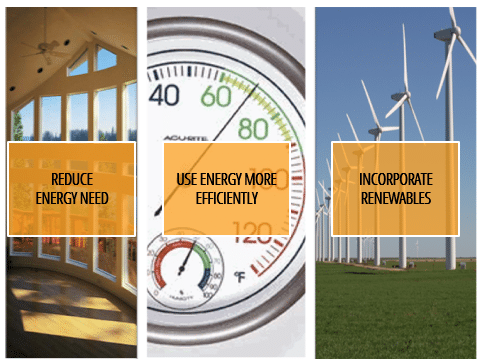
🔗 Synergy Insight (VERY IMPORTANT)

Energy is connected to:

  • WE → hot water = energy
  • SS → heat island reduction
  • LT → location affects energy use

🧠 Common Misconceptions

❌ “All options give same points”

👉 No

👉 Only simulation → max points

❌ “Prescriptive is always easier and better”

👉 Easier = yes
👉 Better = ❌ (limits points)

❌ “Energy modeling is only for documentation”

👉 No

👉 Best used for design decisions


⚡ EA: Minimum Energy Performance vs Optimize Energy Performance

CategoryEA Prerequisite: Minimum Energy PerformanceEA Credit: Optimize Energy Performance
TypeRequired (Prerequisite)Optional (Credit)
Points0 pointsUp to 18 points
PurposeEstablish minimum energy efficiencyAchieve higher performance beyond minimum
IntentReduce environmental and economic harms from excessive energy useReduce energy use further and optimize building performance
When appliedMust be met for certification eligibilityBuilds directly on prerequisite
Approach Options1. Energy Simulation
2. ASHRAE 50% AEDG
3. Core Performance Guide
1. Energy Simulation
2. Prescriptive (AEDG only)
Energy Simulation (Option 1)Required improvement:
5% (New)
3% (Renovation)
2% (Core & Shell)
Required improvement starts at:
6% (New)
4% (Renovation)
3% (Core & Shell)
Key RelationshipEstablishes baselineMust exceed prerequisite thresholds
Reference StandardASHRAE 90.1–2010 (Appendix G)Same (ASHRAE 90.1–2010 Appendix G)
Prescriptive Option (AEDG)AllowedAllowed only if used in prerequisite
Core Performance GuideAllowed (Option 3)❌ Not eligible
Max Points PotentialNot applicable18 points (Simulation)
6 points (Prescriptive)
FlexibilitySimulation = High
Prescriptive = Low
Simulation = High
Prescriptive = Limited
Energy Modeling RoleCan be used (Option 1)Critical for maximizing points
Exemplary Performance❌ Not applicable✅ ~54% improvement (Simulation only)
Key LimitationMust be achieved to pursue LEEDPoints limited by option selected in prerequisite
Strategic ImpactDetermines pathwayDetermines how many points you can earn

🧠 Key Takeaways (Exam Gold)

👉 Prerequisite = Minimum threshold (5–3–2)
👉 Credit = Starts at +1% (6–4–3)

👉 BIG IDEA:

The option you choose in the prerequisite controls your ceiling in the credit

👉 Most Important Exam Insight:

  • Simulation → max flexibility + max points
  • Prescriptive → simpler but capped points
  • Core Performance → ❌ no Optimize Energy points
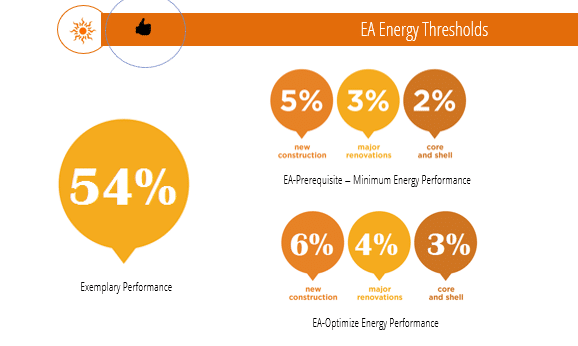
🎯 Final Takeaway

Prerequisite = Minimum performance (5-3-2)
Credit = Improve beyond (6-4-3 and up)

Simulation = flexibility + maximum points
Prescriptive = simplicity + limited points
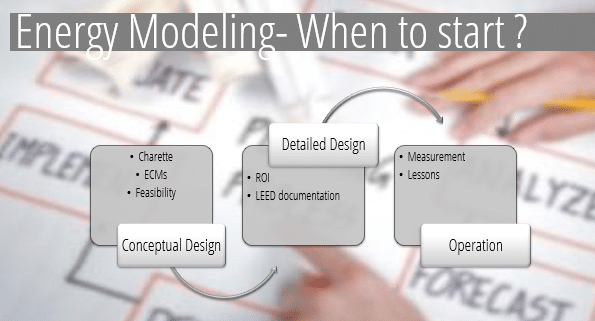
What standard is used for baseline building?
ASHRAE 90.1–2010
What are prereq thresholds?
5% / 3% / 2%
A project wants maximum points. Which option?
Whole-building simulation
Can a warehouse use Option 3?
❌ No
Why does Option 1 allow more points?
👉 Because:
• it evaluates actual performance
• allows innovation
• not limited to fixed strategies

No comments yet. Be the first to post!

EA: Building-Level Energy Metering vs Advanced Energy Metering

View Full Page ↗

Energy metering in LEED focuses on understanding, tracking, and managing energy use over time. While energy-efficient design reduces consumption, metering ensures that buildings continue to perform as intended after occupancy.

The Energy and Atmosphere category introduces metering in two stages:

  • Building-Level Energy Metering (Prerequisite) → focuses on tracking total energy use
  • Advanced Energy Metering (Credit) → focuses on tracking how energy is used within the building

Together, these requirements support long-term energy management, operational efficiency, and continuous improvement.

👉 This reflects a key LEED principle:

“You cannot manage what you do not measure.”

🔹 Why This Matters (Conceptual Understanding)

  • Helps identify inefficiencies and abnormal energy patterns
  • Supports data-driven decision making
  • Enables verification of energy savings
  • Improves building performance over time

👉 This is where LEED moves from:

  • Design → Operation

🔹 Big Picture Connection (Exam Insight)

  • Prerequisite = Baseline tracking
  • Credit = Detailed diagnostics + optimization

👉 Think of it like:

  • Electric bill → Prerequisite
  • Smart energy dashboard → Credit

🧠 Key Differences (Exam Gold)

🔹 Level of Detail

  • Prereq → “How much energy does the building use?”
  • Credit → “Where is energy being used?”

🔹 Threshold Concept (VERY IMPORTANT)

👉 Advanced metering must include:

Any system using ≥ 10% of total energy

🔹 Data Resolution

  • Prereq → Monthly
  • Credit → Hourly (or better)

🔹 Big Picture

Prerequisite = Tracking
Credit = Managing + Optimizing

⚠️ Common Exam Traps

❌ “Prerequisite requires system-level metering”

👉 Incorrect
👉 Only total building energy is required

❌ “Renewables must be metered for prereq”

👉 Incorrect
👉 On-site renewables are not required

❌ “Advanced metering is just more meters”

👉 Not exactly

👉 It’s about:

  • resolution (hourly)
  • connectivity
  • analytics capability

🎯 Simple Way to Remember

👉 Prerequisite = Whole Building Meter
👉 Credit = Smart Building Meter

🧠 Potential Questions (Descriptive – Exam Style)

⚡ EA: Building-Level Energy Metering vs Advanced Energy Metering

Category

EA Prerequisite: Building-Level Energy Metering

EA Credit: Advanced Energy Metering

Type

Required (Prerequisite)

Optional (Credit)

Points

0 points

1 point

Purpose

Track total building energy use

Track detailed/system-level energy use

Intent

Support energy management and identify savings opportunities

Improve energy management with more granular data

Scope

Whole-building only

Whole-building + system-level

Metering Requirement

Meter all energy sources used by the building

Meter all energy sources + major end uses (≥10%)

Examples of Energy Sources

Electricity, gas, district energy, fuel oil, etc.

Same as prerequisite + system breakdown

Renewables

❌ Not required to meter on-site renewables (e.g., solar PV)

Same logic applies unless part of system tracking

Data Granularity

Monthly (minimum)

Hourly or less (high resolution)

Data Tracking Duration

Must share data for 5 years

Must store data for 36 months (minimum)

Data Sharing

Required with USGBC (monthly minimum)

Not focused on sharing; focused on internal tracking

System-Level Tracking

❌ Not required

✅ Required for systems ≥ 10% of energy use

Data Accessibility

Basic tracking

Must be remotely accessible

Infrastructure

Standard meters acceptable

Requires advanced system (BAS, network, etc.)

Electricity Requirements

Consumption tracking

Consumption + demand + power factor (if applicable)

Use Case

Understand total energy consumption

Diagnose performance + optimize systems

Applicability to Additions

Can use existing meters if they cover addition

Must meet advanced requirements separately

Final Takeaway

LEED metering is not just about compliance—it is about enabling continuous performance improvement.

What is the main purpose of building-level energy metering in LEED?
To track total building energy use and identify opportunities for energy savings over time.
What types of energy must be included in building-level metering?
All energy supplied to the building, such as electricity, gas, and district energy systems.
Why does LEED require sharing energy data for five years?
To ensure ongoing performance tracking and to support long-term energy management and benchmarking.
A project installs meters only for electricity but not for gas. Does it meet the prerequisite?
No. All energy sources used by the building must be metered.
How does advanced energy metering improve building performance compared to basic metering?
Advanced metering provides system-level data (e.g., HVAC, lighting), allowing operators to identify inefficiencies, diagnose issues, and optimize performance more effectively than whole-building metering alone.
Why does LEED require metering for systems that represent 10% or more of total energy use?
Because these systems have the greatest impact on energy consumption, and tracking them provides meaningful opportunities for optimization.
Does LEED require metering of on-site renewable energy?
No. On-site renewable energy systems are not required to be metered for the prerequisite.
What is the key difference between building-level and advanced energy metering?
• Building-level → total energy use
• Advanced → system-level + detailed data

No comments yet. Be the first to post!

EA: Refrigerant Management

View Full Page ↗
🔹 Introduction

Refrigerants used in HVAC&R systems pose two major environmental risks:

  1. Ozone depletion (ODP) → damages the ozone layer
  2. Global warming (GWP) → contributes to climate change

The LEED Energy and Atmosphere category addresses these risks in two stages:

  • Fundamental Refrigerant Management (Prerequisite) → eliminate ozone-damaging refrigerants
  • Enhanced Refrigerant Management (Credit) → minimize both ozone depletion and climate impact

👉 This reflects a key transition:

Step 1 → Remove worst offenders (CFCs)
Step 2 → Optimize refrigerant impact (ODP + GWP)

📊 Comparison Table: Fundamental vs Enhanced Refrigerant Management

Category

EA Prerequisite: Fundamental Refrigerant Management

EA Credit: Enhanced Refrigerant Management

Type

Required

Optional

Points

0 points

1 point

Primary Focus

Eliminate ozone depletion risk

Reduce both ODP and GWP

Intent

Reduce stratospheric ozone depletion

Reduce ozone depletion + climate change impact

Key Requirement

❌ No CFC-based refrigerants in new systems

Use low-impact or no refrigerants

Existing Equipment

Must phase out CFCs before completion

Must evaluate full refrigerant impact

Exemptions

Systems with < 0.5 lbs refrigerant

Not specifically applicable

Approach Options

No options (mandatory requirement)

Option 1: No or Low-Impact Refrigerants
Option 2: Calculation Method

ODP Requirement

Must eliminate CFCs (high ODP)

Must aim for ODP = 0

GWP Consideration

❌ Not addressed directly

✅ Must minimize GWP

Option 1 (Simple Path)

Not applicable

ODP = 0 AND GWP < 50

Option 2 (Calculation)

Not applicable

LCGWP + LCODP × 10⁵ ≤ 100

Complexity

Simple compliance

More technical (calculation-based)

Environmental Scope

Ozone only

Ozone + climate

🧠 Memory Tips (CRITICAL FOR EXAM)

🔹 Refrigerant Progression (Your Image – Perfect)

👉 Think of this timeline:

  • CFCs → ❌ BANNED (high ODP)
  • HCFCs → ⚠️ PHASING OUT
  • HFCs / HFOs / Natural → ✅ PREFERRED

🔹 ODP vs GWP (Most Important Concept)

🌍 ODP (Ozone Depletion Potential)

👉 Damages ozone layer

  • CFCs → Very high ODP
  • HCFCs → Lower but still harmful
  • HFCs/HFOs → ODP = 0

🌡️ GWP (Global Warming Potential)

👉 Measures climate impact

  • HFCs → ❗ High GWP
  • HFOs → ✅ Low GWP
  • Natural refrigerants → ✅ Very low

🔹 Simple Way to Remember

👉 Prerequisite = “No CFCs”
👉 Credit = “Low ODP + Low GWP”

🔹 Golden Exam Rule

Eliminating ozone damage (ODP) is minimum requirement
Reducing climate impact (GWP) earns points

⚠️ Common Exam Traps

❌ “HFCs are bad because of ozone”

👉 Incorrect
👉 HFCs = ODP = 0

❌ “Prerequisite considers GWP”

👉 Incorrect
👉 Only about CFC elimination (ODP)

❌ “Any low GWP refrigerant earns the credit”

👉 Not enough

👉 Must meet:

  • ODP = 0
  • GWP < 50 (Option 1)
    OR
  • Pass calculation formula

Final Takeaway

Prerequisite → Eliminate ozone damage (CFCs)
Credit → Optimize refrigerant impact (ODP + GWP)

What is the main requirement of Fundamental Refrigerant Management?
Eliminate the use of CFC-based refrigerants in new HVAC systems.
What are the two environmental concerns addressed by refrigerants?
Ozone depletion (ODP) and global warming (GWP).
A project uses HFC refrigerants with zero ODP but high GWP. Does it meet the prerequisite and credit?
• ✅ Meets prerequisite (no CFCs)
• ❌ May not meet credit (high GWP)
A project uses equipment with less than 0.5 lbs of refrigerant. Does it need to comply?
No, it is exempt from prerequisite requirements.
Why does LEED require elimination of CFCs before addressing GWP?
Because CFCs cause severe ozone depletion, which has immediate global environmental consequences.
Why does the credit include a calculation method?
To evaluate overall refrigerant impact across systems, especially when multiple refrigerants are used.
How does using natural refrigerants benefit a project?
• ODP = 0
• Very low GWP
• Helps meet both environmental goals

No comments yet. Be the first to post!

EA Credit: Demand Response

View Full Page ↗

🔹 Introduction

Demand Response (DR) focuses on reducing or shifting building energy use during peak demand periods, when electricity grids are under the most stress.

During extreme weather conditions (very hot or very cold), energy demand spikes due to increased use of HVAC systems. Instead of building more power plants, utilities use demand response programs to balance supply and demand by encouraging buildings to temporarily reduce consumption.

👉 This is a shift from:

  • Energy efficiency (using less energy overall)
    ➡️ to
  • Energy flexibility (using energy at the right time)

🔹 Intent

👉 To:

  • Improve grid reliability
  • Reduce peak demand
  • Lower greenhouse gas emissions
  • Encourage participation in demand response programs

🔹 Core Concept

Demand Response is about WHEN you use energy, not just HOW MUCH

🧩 Compliance Paths (Cases)

🥇 Case 1: Demand Response Program Available

👉 Projects must:

  • Enroll in a utility DR program
  • Design systems for:
    • Load shedding (reducing usage)
    • Load shifting (rescheduling usage)

🥈 Case 2: No DR Program Available

👉 Projects must:

  • Design building for future DR participation
  • Include:
    • DR-ready systems
    • Communication-capable meters
    • Load reduction plan

👉 Also:

  • Coordinate with local utility (important for exam)

⚠️ CRITICAL EXAM NOTE

👉 On-site renewable energy does NOT count

❌ Solar panels ≠ Demand Response
✅ Adjusting energy use during peak = Demand Response

📊 Quick Summary Table

Aspect

Demand Response Credit

Points

Up to 2 points

Focus

Peak demand reduction

Key Strategy

Load shedding / shifting

Program Required?

Yes (if available)

If not available

Design for future participation

On-site renewables

❌ Not acceptable

System Requirement

DR-capable controls + communication

🧠 Memory Tips (VERY IMPORTANT)

🔹 Simple Way to Remember

👉 Efficiency = Use less energy
👉 Demand Response = Use energy at better times

🔹 Two Key Words

👉 SHED + SHIFT

  • Shed → reduce load
  • Shift → move load

🔹 Think Like the Grid

👉 Grid problem = peak demand

👉 Solution = buildings reduce usage temporarily

⚠️ Common Exam Traps

❌ “Installing solar panels earns DR credit”

👉 Incorrect

👉 That’s Renewable Energy credit, not DR

❌ “Demand response reduces total annual energy”

👉 Not necessarily

👉 It reduces peak demand, not total consumption

❌ “DR only applies when program exists”

👉 Incorrect

👉 Must design for future participation if not available

Final Takeaway

Demand Response is about grid interaction, not just building efficiency

LEED is rewarding buildings that behave like “smart grid participants”

What is the main purpose of demand response in LEED?
To reduce or shift energy use during peak demand periods to improve grid efficiency.
A project installs solar panels but does not reduce peak demand. Does it earn this credit?
No. On-site renewable energy does not meet demand response requirements.
A building increases cooling setpoints during peak hours. Does this support demand response?
Yes. This is an example of load shedding.
Why is demand response important for utilities?
It reduces strain on the grid during peak demand, avoiding the need for additional power generation capacity.
How does demand response contribute to sustainability?
By reducing peak demand, it lowers emissions associated with high-load energy generation and improves grid efficiency.

No comments yet. Be the first to post!

EA Credit: Renewable Energy Production

View Full Page ↗

Renewable Energy Production = Generate clean energy ON-SITE and OWN the benefits


🔹 Introduction

This credit focuses on generating clean energy on-site to reduce reliance on fossil fuels.

Instead of purchasing all energy from the grid, the building produces its own energy using renewable sources like:

  • Solar (PV, solar thermal)
  • Wind
  • Geothermal (in specific cases)
  • Biofuels (with restrictions)

👉 This is about self-supply of energy, not just efficiency.

🔹 Intent

👉 To:

  • Reduce dependence on fossil fuels
  • Lower GHG emissions
  • Encourage on-site renewable energy generation

🔹 Core Concept

The more energy you generate on-site, the more LEED points you earn

⚙️ How It Works

👉 Projects must:

  • Install on-site renewable energy systems
  • Offset a percentage of annual energy cost

👉 Points are based on:

  • % of energy cost offset by renewables

📊 Key Structure

% Energy Cost OffsetPoints
~1–5%1 point
~5–10%2 points
~10%+3 points

👉 Exemplary Performance:

  • 15% (BD+C) → Innovation point
  • 10% (Core & Shell)

⚡ Eligible Renewable Systems

✔️ Photovoltaic (solar panels)
✔️ Solar thermal
✔️ Wind
✔️ Low-impact hydro
✔️ Wave/tidal
✔️ Certain geothermal systems
✔️ Certain biofuels

🚫 NOT Eligible (Very Important)

❌ Passive design (daylighting, orientation)
❌ Architectural strategies
❌ Ground-source heat pumps (GSHP)
❌ Some biofuels (treated wood, MSW, etc.)

👉 Exam trap:

Not everything “sustainable” = renewable energy

🔁 Special Rules (VERY TESTABLE)

🔹 RECs (Renewable Energy Certificates)

👉 If you sell RECs, you lose environmental claim

👉 To still earn credit:

  • Must buy equivalent RECs back

🔹 Third-Party Systems

👉 Allowed ONLY if:

  • Contract ≥ 10 years
  • Project retains environmental benefits (RECs)

🔹 Off-Site Fuel (e.g., landfill gas)

👉 Allowed if:

  • 10-year contract
  • RECs included OR offsets purchased

📊 Comparison Table

Aspect

Renewable Energy Production

Points

Up to 3

Focus

On-site energy generation

Metric

% of energy cost offset

System Type

Renewable only

Passive strategies

❌ Not eligible

RECs requirement

Must retain or replace

Third-party allowed?

Yes (with conditions)

Exemplary performance

Yes

🧠 Memory Tips

🔹 Simple Way to Remember

👉 Efficiency = use less energy
👉 Renewables = generate your own energy

🔹 3-Step Mental Model

  1. Reduce energy need
  2. Use energy efficiently
  3. Generate renewable energy

👉 This is exactly what your slide shows ✔️

🔹 Key Phrase

“ON-SITE + OWNERSHIP of environmental benefits”

⚠️ Common Exam Traps

❌ “Daylighting counts as renewable energy”

👉 Incorrect
👉 That’s energy efficiency, not generation

❌ “Geothermal always qualifies”

👉 Incorrect

👉 Only:

  • Natural geothermal energy ✔️
  • GSHP (heat pumps) ❌

❌ “Selling RECs is fine”

👉 Incorrect

👉 Must retain or replace RECs

❌ “Off-site renewable energy qualifies”

👉 Only under strict contract + REC conditions

🔗 Synergy (Important for Teaching)

👉 This credit connects strongly with:

  • EA Optimize Energy Performance
  • EA Green Power & Carbon Offsets
  • SS Heat Island Reduction (solar shading)
What determines points in this credit?
Percentage of annual energy cost offset by on-site renewable energy.
A project installs solar panels but sells all RECs. Can it earn this credit?
Only if it purchases equivalent RECs.
Does a ground-source heat pump qualify as renewable energy?
No.
Why does LEED require REC ownership?
To ensure the project retains the environmental benefit of renewable energy.
Why is passive design excluded?
Because it reduces energy demand but does not generate energy.

No comments yet. Be the first to post!

EA Credit: Green Power & Carbon Offsets

View Full Page ↗

If you can’t produce clean energy → buy it or offset it

 🔹 Introduction

This credit focuses on reducing greenhouse gas emissions from energy use by purchasing clean energy or carbon mitigation products from off-site sources.

👉 Unlike the previous credit (Renewable Energy Production), this one does NOT require on-site systems.

🔹 Intent

👉 To:

  • Reduce greenhouse gas emissions
  • Support renewable energy markets
  • Encourage carbon mitigation projects

🔹 Core Concept

If you cannot generate clean energy on-site → buy clean energy or offsets off-site

⚙️ How It Works

👉 Projects must:

  • Enter a minimum 5-year contract
  • Purchase 50% or 100% of total energy use

👉 Sources can include:

  1. Green Power (direct renewable electricity)
  2. RECs (Renewable Energy Certificates)
  3. Carbon Offsets

👉 All must be:

  • ✔️ Green-e Energy certified (for RECs/Green Power)
  • ✔️ Green-e Climate certified (for offsets)

📊 Point Structure

Energy Offset

Points

50%

1 point

100%

2 points

🔁 Three Paths Explained

🔹 1. RECs (Renewable Energy Certificates)

👉 Represent renewable electricity produced elsewhere

  • No physical electricity delivered
  • Only environmental attributes

🔹 2. Carbon Offsets

👉 Fund projects that reduce emissions:

  • Reforestation
  • Methane capture
  • Energy efficiency

👉 Measured in:

  • Metric tons of CO₂e

🔹 3. Green Power Purchase

👉 Direct purchase of renewable electricity from:

  • Wind
  • Solar
  • Hydro

👉 Think of this as:

  • “Real electricity” vs RECs = “attributes”

⚖️ Key Calculations (VERY TESTABLE)

👉 Electricity → convert to MWh (for RECs/Green Power)

👉 All energy → convert to CO₂e (for carbon offsets)

👉 Must include:

  • Electricity
  • Non-electric fuels (gas, oil, etc.)

🔄 CRITICAL COMPARISON (WITH PREVIOUS CREDIT)

Aspect

Renewable Energy Production

Green Power & Carbon Offsets

Location

On-site

Off-site

Metric

% energy cost offset

% energy consumed offset

System required

Yes

No

Contract required

Not required

5 years required

RECs

Must retain

Purchased

Points

Up to 3

Up to 2

Focus

Self-generation

Market support

👉 🔥 Exam GOLD:

On-site = cost-based
Off-site = consumption-based

🧠 Memory Tips

🔹 Simple Rule

👉 Generate vs Purchase

  • Generate → Renewable Energy Production
  • Purchase → Green Power & Offsets

🔹 3 Keywords

👉 “OFF-SITE + CONTRACT + CERTIFIED

🔹 Units Trick

Path

Unit

RECs / Green Power

MWh

Carbon Offsets

CO₂e

⚠️ Common Exam Traps

❌ “This credit requires on-site renewables”

👉 Incorrect
👉 That’s the previous credit

❌ “RECs and Green Power are the same”

👉 Not exactly:

  • RECs = environmental attributes
  • Green power = actual electricity

❌ “Contract duration doesn’t matter”

👉 Incorrect

👉 Must be minimum 5 years

❌ “Cost-based calculation”

👉 Incorrect

👉 This credit = energy consumption-based

🔗 Synergies (VERY IMPORTANT)

👉 Strong connections with:

  • EA Renewable Energy Production
  • EA Optimize Energy Performance
  • EA Demand Response

👉 Example:

  • Efficient building → lower energy use
  • → lower cost to offset 100%

→ easier to earn full points

What is the minimum contract duration?
5 years
What certification is required?
Green-e (Energy or Climate)
A project cannot install solar panels. How can it still earn points?
By purchasing RECs, green power, or carbon offsets.
What unit is used for carbon offsets?
Metric tons of CO₂ equivalent
Why does LEED include this credit?
To support renewable energy markets even when on-site generation is not feasible.
Why is this credit based on consumption rather than cost?
Because it reflects actual energy use and emissions impact

No comments yet. Be the first to post!

Materials and Resources Overview

Welcome to Materials and Resources. Please select a concept from the sidebar.

MR Prerequisite: Storage and Collection of Recyclables

View Full Page ↗

Intent

The intent of this prerequisite is to reduce waste generated by building occupants and ensure that recyclable materials are properly collected, stored, and diverted from landfills.

This requirement reinforces the idea that sustainability is not just about design and construction—it continues throughout the operational life of the building.

Requirements

Projects must provide dedicated areas that are:

  • Easily accessible to building occupants and waste haulers
  • Appropriately sized for the building’s needs
  • Designed for the collection and storage of recyclables

Required Materials

At a minimum, recycling must include:

  • Paper, Cardboard, Glass, Plastics, Metals

In addition, projects must also address at least two of the following waste streams:

  • Batteries
  • Mercury-containing lamps
  • Electronic waste (e-waste)

Key Design Considerations

To successfully implement this prerequisite, project teams should consider:

Location and Accessibility

Recycling areas should be convenient for occupants and efficient for waste collection.

Sizing and Flexibility

Storage areas should accommodate current needs and anticipate future waste volumes.

Separation vs. Commingling

Depending on local recycling infrastructure, materials may be separated on-site or combined and sorted off-site.

Coordination with Haulers

Understanding local recycling capabilities is critical to designing an effective system.

Special Case: Retail Projects

Retail projects may need to conduct a waste stream study to identify the most common recyclable materials and design storage accordingly.

Why This Matters

This prerequisite establishes the foundation for operational waste management, ensuring that buildings are equipped to support recycling throughout their lifecycle.

Without proper infrastructure, even the most sustainable material strategies during construction can be undermined during building operations.

Which of the following materials is REQUIRED to be included in recycling collection under LEED for MR Prerequisite: Storage and Collection of Recyclables?
A. Wood
B. Plastic
C. Concrete
D. Gypsum
✅ Answer: B
In addition to standard recyclables, how many additional waste streams must be addressed for MR Prerequisite: Storage and Collection of Recyclables?
A. 1
B. 2
C. 3
D. 5
✅ Answer: B
• 👉 In addition to Paper, Cardboard, Glass, Plastics and Metals
projects must also address at least two of the following waste streams:
• Batteries
• Mercury-containing lamps
• Electronic waste (e-waste)
Which of the following is a required recyclable material?
A. Batteries
B. E-waste
C. Cardboard
D. Lamps
✅ Answer: C
A project provides recycling for paper, cardboard, glass, plastics, and metals but does not include batteries or e-waste. Does it comply?
A. Yes
B. No
✅ Answer: B
👉 Must include at least 2 additional streams
A project provides recycling areas that are difficult for occupants to access but easy for waste haulers. Does it meet the prerequisite?
A. Yes
B. No
✅ Answer: B
👉 Must be accessible to both occupants AND haulers
A project uses a commingled recycling system where materials are sorted off-site. Does this meet LEED requirements?
A. Yes
B. No
✅ Answer: A
👉 LEED allows commingling if supported by local infrastructure
Why is this prerequisite critical to LEED?
A. It reduces construction cost
B. It supports operational waste management
C. It improves energy performance
D. It reduces water use
✅ Answer: B

No comments yet. Be the first to post!

MR Prerequisite: PBT Source Reduction – Mercury

View Full Page ↗

Intent

For healthcare projects, LEED includes an additional prerequisite focused on reducing mercury, a persistent bioaccumulative toxin (PBT) with significant environmental and human health impacts.

The goal is to:

  • Minimize mercury-containing products
  • Reduce mercury release through proper handling and disposal
  • Promote safer alternatives

Requirements

Healthcare projects must:

  • Identify mercury-containing products and establish handling procedures
  • Eliminate or reduce the use of mercury-containing devices where feasible
  • Ensure proper recycling and disposal methods

Projects must also comply with established limits on mercury content in lighting products.

Common Sources

This includes common sources such as:

  • Lamps (fluorescent, HID, etc.)
  • Medical and dental equipment (e.g., amalgam)

Why This Matters

Healthcare facilities have a higher potential for exposure to hazardous materials. This prerequisite ensures that material choices protect both patients and the environment, aligning with broader goals of human health and safety.

What does PBT stand for?
A. Persistent Building Toxins
B. Potential Bioactive Toxins
C. Persistent Bioaccumulative Toxins
D. Process-Based Toxins
✅ Answer: C
Which material is specifically targeted in this prerequisite?
A. Lead
B. Mercury
C. Asbestos
D. VOCs
✅ Answer: B
A healthcare project continues to use mercury-containing devices without a reduction plan. Does it meet LEED MR Prerequisite: PBT Source Reduction – Mercury requirements?
A. Yes
B. No
✅ Answer: B
A healthcare project replaces mercury lamps with low-mercury alternatives and establishes recycling procedures. Does it comply?
A. Yes
B. No
✅ Answer: A
Why is mercury reduction specifically emphasized in healthcare projects?
A. Higher construction waste
B. Increased risk to patients and environment
C. Energy savings
D. Lower cost
✅ Answer: B
Which of the following is MOST likely a source of mercury in healthcare facilities?
A. Concrete
B. Fluorescent lamps
C. Steel framing
D. Insulation
✅ Answer: B

No comments yet. Be the first to post!

Construction Waste Management in LEED v4

View Full Page ↗

(Prerequisite + Credit Explained)

Construction and Demolition Waste Management Planning (Prerequisite)
Construction and Demolition Waste Management (Credit)

Why This Matters

Construction and demolition (C&D) waste is one of the largest waste streams globally. LEED addresses this by shifting the industry from:

👉 “dispose waste” → “manage materials as resources”

This is done in two steps:

  1. Plan first (Prerequisite)
  2. Perform and optimize (Credit)

1. Prerequisite: Construction and Demolition Waste Management Planning

Intent

To reduce waste sent to landfills and incinerators by requiring a structured plan for:

  • Recycling
  • Reuse
  • Diversion

What the Prerequisite Requires

Projects must create and implement a Construction Waste Management (CWM) Plan that includes:

1. Identify at Least 5 Material Streams

  • Must target at least five different materials
  • Can include: Concrete, Wood, Metal, Drywall, Cardboard

👉 This is where your earlier explanation fits perfectly: These are material streams = separate flows to recycling/reuse markets

2. Define Diversion Strategies

The plan must explain:

  • Will materials be: Source separated (on-site) or Commingled (off-site sorting)
  • Where materials will go (recycling facilities, reuse markets)

3. Track and Report

At the end of the project:

  • Provide a final waste report
  • Include: Total waste generated, Total waste diverted, Diversion rate

Key Clarification: 🚫 No minimum diversion percentage required.
👉 This is critical: the prerequisite is about planning, not performance.

What This Really Means (Teaching Insight):
Think of the prerequisite as: “Show me you have a strategy to manage waste responsibly.”
NOT: “Show me how much waste you actually diverted.”

2. Credit: Construction and Demolition Waste Management

Intent

To actually reduce waste through measurable outcomes:

  • Divert waste from landfill
  • Reduce total waste generated

How the Credit Builds on the Prerequisite

Prerequisite Credit
Plan waste management Execute and measure results
Identify 5 streams Achieve diversion or reduction targets
No performance threshold Requires measurable performance

👉 In simple terms:
Prerequisite = Plan
Credit = Perform
Construction Waste Management Chart

Credit Options

Option 1: Diversion (Most Common)

Path 1

  • Divert ≥ 50%
  • Minimum 3 material streams
  • 1 point

Path 2

  • Divert ≥ 75%
  • Minimum 4 material streams
  • 2 points

Option 2: Total Waste Reduction

  • Generate ≤ 2.5 lbs/sf (12.2 kg/m²)
  • Focus is on reducing waste at the source, not just diverting it
  • 2 points

Core Concepts You Must Understand

1. Waste Stream vs Material Stream

Waste Stream:

  • All waste generated by the project
  • Includes everything (landfill + recycling + reuse)

Material Stream (LEED Focus):

  • Specific type of material diverted
  • Example: Concrete → crushing facility, Metal → scrap recycling

👉 Each separated category = one material stream

2. What Counts as Diversion?

Counts:

  • Recycling, Reuse, Salvage, Donation

Does NOT count:

  • Alternative Daily Cover (ADC)
  • Land clearing debris
  • Hazardous waste

3. Source Separation vs Commingling

Source Separation (Preferred): Materials separated on-site, Higher quality recycling, More reliable diversion.

Commingled: Mixed waste sent to facility, Sorted off-site, Must have verified diversion rates.

4. Waste-to-Energy (WTE)

Key Idea: WTE = burning waste to generate energy

In LEED:

  • Generally NOT preferred
  • Can count only under strict conditions (European Commission Waste Framework Directive)

👉 Important nuance: If recycling/reuse options are available → WTE should not be used

5. Source Reduction (Most Powerful Strategy)

Instead of managing waste… 👉 Eliminate it before it exists

Examples: Prefabrication, Modular construction, Standard material sizing, Reduced packaging.

Why it matters: This is the focus of Option 2 (Reduction)

Real Project Insight

A strong project will:

  • Start planning early (design phase)
  • Coordinate with haulers and recyclers
  • Track waste continuously (not at the end)
  • Adjust strategies during construction

Common Exam Traps

  • Confusing prerequisite with credit → Prerequisite = no diversion % required
  • Miscounting material streams → Must be distinct material types, not destinations
  • Thinking commingled = 1 stream → It can count as multiple if properly documented
  • Assuming all diversion counts → ADC and landfill cover do NOT count

Simple Mental Model

If you remember nothing else, remember this:

👉 Prerequisite = Plan the system (5 streams, no % required)

👉 Credit = Prove it works/ Perform (50% / 75% OR ≤2.5 lbs/sf)

Which of the following is a requirement of MR Prerequisite: Construction and Demolition Waste Management Planning?
A. Divert at least 50% of construction waste
B. Identify at least five material streams
C. Limit waste generation to 2.5 lbs/sf
D. Use only source separation
✅ Answer: B
Explanation:
The prerequisite requires identifying at least 5 material streams.
👉 It does NOT require any diversion percentage (common trap).
Which of the following best describes the intent of MR Credit: Construction and Demolition Waste Management?
A. Develop a waste management plan
B. Reduce indoor air contamination
C. Divert construction waste from landfill and reduce total waste generated
D. Track building energy use
✅ Answer: C
Explanation:
The credit focuses on actual performance—diversion and/or reduction.
(Requested “All Except” Question) Construction and demolition debris includes all of the following EXCEPT:
A. Concrete
B. Wood
C. Hazardous waste
D. Drywall
✅ Answer: C
Explanation:
Hazardous waste is excluded from LEED C&D calculations.
👉 Only non-hazardous construction waste counts.
A project creates a plan identifying five material streams but does not track diversion percentages. Which requirement has the project met?
A. MR Credit: Construction and Demolition Waste Management
B. MR Prerequisite: Construction and Demolition Waste Management Planning
C. MR Credit: Building Product Disclosure and Optimization
D. MR Prerequisite: Storage and Collection of Recyclables
✅ Answer: B
Explanation:
The prerequisite is about planning, not performance.
👉 No diversion tracking required to meet the prerequisite.
A project diverts 60% of construction waste across 3 material streams. Which credit level has the project achieved under MR Credit: Construction and Demolition Waste Management?
A. No credit
B. 1 point
C. 2 points
D. Exemplary performance
✅ Answer: B
Explanation:
• ≥50% diversion + ≥3 streams → 1 point (Path 1)
• ≥75% + ≥4 streams → 2 points
A project generates only 2.0 lbs/sf of construction waste. Which option under MR Credit: Construction and Demolition Waste Management does this support?
A. Option 1 – Diversion
B. Option 2 – Total Waste Reduction
C. Both options
D. Neither
✅ Answer: B
Explanation:
Option 2 focuses on source reduction, not diversion.
👉 Threshold = ≤ 2.5 lbs/sf
A project uses a commingled waste system and sends all waste to a facility that provides verified diversion reports. How are material streams counted for MR Credit: Construction and Demolition Waste Management?
A. Counts as one material stream only
B. Cannot be counted
C. Can count as multiple streams if properly documented
D. Automatically qualifies for 2 points
✅ Answer: C
Explanation:
👉 Commingled waste can count as multiple streams
ONLY if facility provides documentation
Which of the following waste management strategies would NOT contribute toward diversion under MR Credit: Construction and Demolition Waste Management?
A. Recycling concrete
B. Donating wood
C. Using waste as alternative daily cover (ADC)
D. Salvaging metal
✅ Answer: C
Explanation:
👉 ADC = does NOT count as diversion (major exam trap)
A project team focuses on prefabrication and modular construction to reduce material waste. Which strategy under MR Credit: Construction and Demolition Waste Management does this represent?
A. Diversion
B. Recycling
C. Source reduction
D. Waste-to-energy
✅ Answer: C
Explanation:
👉 Source reduction = highest priority in waste hierarchy
A project sends construction waste to a waste-to-energy facility instead of recycling, even though recycling facilities are available nearby. How would this impact compliance?
A. Fully acceptable and preferred
B. Counts as diversion automatically
C. Not preferred and may not count toward LEED credit
D. Required under LEED
✅ Answer: C
Explanation:
👉 Waste-to-energy:
• Not preferred
• Only allowed under strict conditions
• Recycling is always prioritized
Which statement best distinguishes the prerequisite from the credit?
A. Both require 50% diversion
B. Prerequisite requires performance; credit requires planning
C. Prerequisite requires planning; credit requires measurable performance
D. Both are optional
✅ Answer: C
How is diversion rate calculated under MR Credit: Construction and Demolition Waste Management?
A. Diverted waste ÷ recycled waste
B. Diverted waste ÷ total waste generated
C. Total waste ÷ landfill waste
D. Recycled waste ÷ total materials used
✅ Answer: B

No comments yet. Be the first to post!

MR Credit Building Life-Cycle Impact Reduction

View Full Page ↗

If there is one credit that truly represents sustainability thinking in LEED, this is it.

Instead of focusing only on:

  • Energy (EA)
  • Water (WE)

This credit asks:

“What is the total environmental impact of this building over its entire life?”

It encourages project teams to:

  • Reuse what already exists
  • Reduce material consumption
  • Make data-driven decisions using Life Cycle Assessment (LCA)

Intent

To:

  • Encourage adaptive reuse of existing buildings
  • Reduce environmental impacts of materials
  • Promote life-cycle thinking instead of short-term decisions

Big Picture: How This Credit Works

Projects must choose ONE of the following strategies:

Option Strategy Focus
Option 1 Historic Building Reuse Preserve cultural + environmental value
Option 2 Renovation of Abandoned Buildings Revitalize existing assets
Option 3 Building & Material Reuse Reuse components/materials
Option 4 Whole-Building LCA Optimize environmental performance

Option 1: Historic Building Reuse

Concept
Preserve and reuse historic structures instead of demolishing them.

Key Requirements
Maintain:

  • Structure
  • Envelope
  • Interior elements

Building must be:

  • Listed or eligible for historic designation

Why It Matters
👉 The greenest building is the one already built

Avoids:

  • Demolition waste
  • New material extraction

Preserves:

  • Cultural and architectural value

Option 2: Renovation of Abandoned or Blighted Buildings

Concept
Bring underutilized or damaged buildings back into productive use

Key Requirement

  • Reuse ≥ 50% of building surface area

Why It Matters

  • Reduces urban sprawl
  • Revitalizes communities
  • Avoids new construction impacts

Option 3: Building and Material Reuse

Concept
Reuse materials or structural elements in the project.

Examples

  • Structural frame reuse
  • Reclaimed wood
  • Reused doors, ceilings, flooring

Important Note
Applies to:

  • Structure
  • Envelope
  • Interior elements


Excludes:

  • Hazardous materials
  • Windows (in many cases)

Why It Matters

  • Reduces demand for virgin materials
  • Supports circular economy
  • Lowers embodied carbon

1. Abandoned (Adjective)

Definition:
A property or building is considered abandoned when its owner has voluntarily given up all rights, control, and responsibility, with no intention of reclaiming or maintaining it.

🧠 Memory Tip:
👉 Abandoned = No owner, no return

📌 LEED Context:
Used in MR Credit: Building Life-Cycle Impact Reduction (Option 2)
→ Renovation of abandoned or blighted buildings

2. Blighted (Adjective)

Definition:
A blighted property is one that is deteriorated, unsafe, or neglected, posing a risk to public health, safety, or welfare.

🧠 Memory Tip:
👉 Blighted = Bad condition, still exists (but harmful)

📌 Key Distinction (Exam Favorite):

  • Abandoned = ownership given up
  • Blighted = still exists but in poor/dangerous condition

🔍 Quick Comparison

Term Meaning Ownership Status Condition
Abandoned Given up No active ownership/control May be deteriorated
Blighted Unsafe/deteriorated May still have owner Poor condition (key)

Option 4: Whole-Building Life Cycle Assessment (LCA)

👉 This is the most technical and most tested option on the exam

Concept
Compare:
Proposed Design vs Baseline Building
And prove that the proposed design has lower environmental impact

Requirements

  • Minimum 10% reduction in at least 3 impact categories
  • No more than +5% increase in any category

Impact Categories (Know These)
At least 3 must be improved:

  • Global warming potential (GWP)
  • Ozone depletion
  • Acidification
  • Eutrophication
  • Smog formation
  • Nonrenewable energy depletion

Key Standards

  • Must comply with ISO 14044 (LCA standard)

What Gets Analyzed?

  • Structure
  • Envelope

👉 Not full interiors (important exam nuance)

Why This Matters

This is where LEED shifts from:

👉 Prescriptive → Performance-based

Instead of saying:
“Use recycled materials”
LEED asks:
“Prove your design is better for the environment”

Connecting This Credit to Earlier Topics

1. LCA vs EPD

  • LCA (this credit) → Whole building analysis
  • EPDs (BPDO credit) → Product-level data

👉 EPDs feed into LCA tools

2. Cradle-to-Grave Context

Whole-building LCA considers:

  • Extraction, Manufacturing, Transportation, Use, End-of-life

👉 This is typically cradle-to-grave

3. Link to Waste Management

Reuse strategies reduce:

  • Construction waste
  • Material demand

👉 So this credit works upstream, while waste management works downstream

Strategy Comparison (Very Important for Teaching)

Strategy Best Use Case Difficulty
Historic reuse Existing historic buildings Medium
Renovation Urban redevelopment Medium
Material reuse Selective reuse Medium
LCA New construction optimization High

Think of the 4 options as a hierarchy:

Level 1: Don’t build new
→ Historic reuse

Level 2: Fix what exists
→ Renovation

Level 3: Reuse materials
→ Material reuse

Level 4: Optimize new design
→ LCA

Common Exam Traps

  • Thinking LCA is required
    → It’s only one option
  • Confusing LCA with EPD
    → LCA = building level
    → EPD = product level
  • Forgetting thresholds
    → 10% reduction in 3 categories
  • Assuming all building elements included
    → Focus on structure + envelope

Real-World Insight

Most projects choose:

  • Option 4 (LCA) → for new construction
  • Option 3 (Reuse) → for renovation projects

Historic reuse is less common but high-impact.

Simple Mental Model

👉 This credit is about one question:
“Should we build new, reuse, or optimize?”

👉 Best strategy hierarchy:

  1. Reuse building
  2. Renovate
  3. Reuse materials
  4. Optimize (LCA)

👉 LCA Rule (Must Memorize):

  • 10% reduction in 3 categories
  • No more than 5% increase in any

👉 Key Distinction:

  • LCA = Building level
  • EPD = Product level
What is the primary intent of MR Credit: Building Life-Cycle Impact Reduction?
A. Reduce indoor air contaminants
B. Reduce operational energy use
C. Reduce environmental impacts of building materials over their life cycle
D. Increase renewable energy use
✅ Answer: C
Explanation:
This credit focuses on life-cycle impacts of materials, not operational performance.
Which of the following is NOT an option under MR Credit: Building Life-Cycle Impact Reduction?
A. Historic Building Reuse
B. Building Product Disclosure
C. Building and Material Reuse
D. Whole-Building Life Cycle Assessment
✅ Answer: B
Explanation:
👉 Building Product Disclosure is a separate MR credit (BPDO)
This credit includes only:
• Historic reuse
• Renovation
• Material reuse
• LCA
Which standard is referenced for Whole-Building Life Cycle Assessment under this credit?
A. ASHRAE 90.1
B. ISO 14044
C. EPA WaterSense
D. SMACNA
✅ Answer: B
A project team decides to reuse an existing historic structure, including its structure and envelope. Which option under MR Credit: Building Life-Cycle Impact Reduction are they pursuing?
A. Option 2: Renovation of abandoned building
B. Option 3: Building and material reuse
C. Option 1: Historic building reuse
D. Option 4: Whole-building LCA
✅ Answer: C
Explanation:
👉 Historic designation + preserving structure/envelope = Option
A project reuses 60% of its structural and enclosure materials. How many points can it earn under Option 3: Building and Material Reuse?
A. 1 point
B. 2 points
C. 3 points
D. 5 points
✅ Answer: C
Explanation:
• 25% → 2 pts
• 50% → 3 pts
• 75% → 4–5 pts
👉 60% falls in ≥50% range → 3 points
A project performs a Whole-Building Life Cycle Assessment and achieves a 10% reduction in global warming potential, acidification, and eutrophication, but increases smog formation by 8%. Does it comply?
A. Yes
B. No
✅ Answer: B
Explanation:
👉 Rule:
• ≥10% reduction in 3 categories ✅
• BUT no category can increase >5% ❌
👉 +8% = fails requirement
Which strategy under MR Credit: Building Life-Cycle Impact Reduction is MOST aligned with the waste hierarchy?
A. Whole-building LCA
B. Material recycling
C. Historic building reuse
D. Waste-to-energy
✅ Answer: C
Explanation:
👉 Highest priority = reuse existing building (source reduction)
This avoids:
• New materials
• Demolition waste
What is the key difference between Whole-Building LCA and Environmental Product Declarations (EPDs)?
A. LCA is optional, EPD is required
B. LCA evaluates building-level impacts; EPD evaluates product-level impacts
C. EPD includes operational energy; LCA does not
D. They are identical
✅ Answer: B
A project performs LCA focusing only on interior finishes such as flooring and paint. Does it meet the requirements of MR Credit: Building Life-Cycle Impact Reduction (Option 4)?
A. Yes
B. No
✅ Answer: B
Explanation:
👉 LCA must focus on:
• Structure
• Envelope
👉 Not interior finishes (major exam nuance)
A project team is designing a new building and wants flexibility in optimizing environmental performance across multiple impact categories. Which option under MR Credit: Building Life-Cycle Impact Reduction is MOST appropriate?
A. Historic reuse
B. Renovation
C. Material reuse
D. Whole-building LCA
✅ Answer: D
Explanation:
👉 LCA = performance-based + design flexibility
Best for new construction
Which of the following best describes the shift represented by MR Credit: Building Life-Cycle Impact Reduction?
A. From operational efficiency to water conservation
B. From prescriptive requirements to performance-based analysis
C. From recycling to energy efficiency
D. From indoor air quality to lighting design
✅ Answer: B
Which strategy provides the greatest reduction in embodied environmental impact?
A. Recycling materials
B. Using low-VOC materials
C. Reusing an existing building
D. Installing efficient HVAC
✅ Answer: C
What is the minimum improvement required in Whole-Building LCA?
A. 5% in 2 categories
B. 10% in 3 categories
C. 20% in 1 category
D. 15% in all categories
✅ Answer: B
What is the maximum allowable increase in any impact category under LCA?
A. 0%
B. 5%
C. 10%
D. 15%
✅ Answer: B

No comments yet. Be the first to post!

LEED MR Credits – BPDO (Building Product Disclosure and Optimization)

View Full Page ↗

What is BPDO and Why It Matters

In LEED v4, the Building Product Disclosure and Optimization (BPDO) credits represent a major shift in how we think about materials. Traditionally, material selection focused on cost, performance, and aesthetics. BPDO expands this thinking to include three critical dimensions:

  • Environmental impact
  • Responsible sourcing
  • Human health

Rather than rewarding a single attribute, BPDO encourages project teams to make informed, data-driven decisions about materials. It promotes transparency first, then performance improvement, and ultimately industry transformation.

At its core, BPDO is about answering three fundamental questions:

  • What is the environmental impact of the product?
  • Where does the material come from?
  • What is it made of, and is it safe?

The Structure of BPDO Credits

All BPDO credits follow a consistent progression:

  1. Disclosure – Understanding and documenting material information
  2. Optimization – Selecting better-performing materials
  3. Leadership (where applicable) – Advancing supply chain and industry practices

This progression mirrors real-world sustainability practice: you first measure, then improve, and eventually lead.

1. MR Credit Building Product Disclosure and Optimization – Environmental Product Declarations (EPD)

This credit focuses on the environmental impacts of materials, quantified through Life Cycle Assessment (LCA).

Option 1: Environmental Product Declarations (Disclosure)

Projects must use at least 20 permanently installed products from at least 5 different manufacturers that have EPDs.

An EPD is a standardized, third-party verified document that reports the environmental impacts of a product based on LCA.

At this stage, LEED is not asking whether the product is better—only whether the data is available and transparent.

Option 2: Multi-Attribute Optimization

Projects must demonstrate that products have improved environmental performance, typically across multiple impact categories such as global warming potential, ozone depletion, and acidification.

At least 50% of the total material cost must meet this requirement.

This option builds directly on Option 1 by moving from transparency to measurable improvement.

2. MR Credit Building Product Disclosure and Optimization – Sourcing of Raw Materials

This credit focuses on where materials come from and how they are extracted or harvested.

Option 1: Raw Material Source and Extraction Reporting

Projects must use at least 20 products from 5 manufacturers that disclose information about their sourcing practices.

This may include:

  • Corporate sustainability reports
  • Responsible sourcing policies
  • Environmental and social impact reporting

The goal is to increase transparency in the supply chain.

Option 2: Leadership Extraction Practices

Projects must demonstrate that at least 25% (by cost) of materials meet responsible sourcing criteria, such as:

  • Recycled content
  • FSC-certified wood
  • Reused or salvaged materials
  • Bio-based materials
  • Extended Producer Responsibility programs

This option rewards projects for actively selecting materials that reduce environmental and social impacts.

3. MR Credit Building Product Disclosure and Optimization – Material Ingredients

This credit focuses on what materials are made of, particularly chemical composition and potential impacts on human health.

Option 1: Material Ingredient Reporting

Projects must use at least 20 products from 5 manufacturers that disclose their chemical ingredients.

Common tools include:

  • Health Product Declarations (HPDs)
  • Declare labels
  • Manufacturer inventories

This step improves transparency and awareness of material composition.

Option 2: Material Ingredient Optimization

Projects must demonstrate that at least 25% (by cost) of materials use safer chemical ingredients.

This may include:

  • GreenScreen assessments
  • Cradle to Cradle certifications
  • Avoidance of hazardous substances

This option moves beyond disclosure to safer product selection.

Option 3: Supply Chain Optimization

This advanced option focuses on manufacturer practices and supply chain engagement.

Projects must demonstrate that manufacturers are actively improving chemical management practices across their supply chains.

Building Product Disclosure and Optimization Credits Summary

Credit Focus Option 1 (Disclosure) Option 2 (Optimization) Option 3
EPD Environmental impact 20 products, 5 manufacturers ≥50% cost optimized
Sourcing Where materials come from 20 products, 5 manufacturers ≥25% cost responsibly sourced
Ingredients Chemical composition 20 products, 5 manufacturers ≥25% cost optimized Supply chain optimization

How These Credits Work Together

Although these are three separate credits, they are most effective when approached as a holistic material strategy.

A single product can contribute to multiple credits simultaneously. For example:

  • A flooring product may have an EPD (environmental impact), an HPD (ingredient transparency), and recycled content (responsible sourcing)

This allows project teams to maximize impact and efficiency by selecting products strategically.

Understanding the Metrics: 20 Products and 5 Manufacturers

Across BPDO credits, LEED consistently requires:

  • 20 products to ensure meaningful coverage across the project
  • 5 manufacturers to ensure diversity and avoid reliance on a single supplier

This structure promotes both scale and market transformation.

🧠 Exam Rule: All BPDO disclosure options = 20 products + 5 manufacturers

Strategy & Planning

Relationship with Whole Building LCA and Reuse Strategies

BPDO operates at the product level, while other strategies such as Whole Building Life Cycle Assessment (LCA) and Building Reuse operate at a system or building level.

  • Whole Building LCA evaluates the overall environmental performance of the building
  • Building reuse reduces the need for new materials altogether

These strategies can complement BPDO, but they may also introduce trade-offs. For example, reusing structural elements reduces environmental impact but may limit the number of new products available to count toward BPDO thresholds.

Successful projects balance these strategies based on their goals.

How to Approach BPDO in a Real Project

A practical approach includes:

  1. Identifying major material categories (structure, enclosure, interiors)
  2. Selecting products with:
    • EPDs
    • Responsible sourcing certifications
    • Ingredient transparency
  3. Tracking:
    • Number of qualifying products
    • Number of manufacturers
    • Percentage of total material cost

The most effective strategy is to select products that satisfy multiple criteria at once.

What BPDO Achieves

When implemented effectively, BPDO leads to:

  • Reduced environmental impacts
  • Healthier indoor environments
  • More responsible supply chains
  • Increased transparency in the materials market

⚠️ COMMON BPDO TRAPS

Trap Reality
20 products = 20 materials ❌ Must be distinct products
Same manufacturer repeated ❌ Need 5 manufacturers
Count by quantity ❌ Count by cost
LCA = BPDO ❌ LCA = building level
EPD = optimization ❌ Disclosure only

Maximizing Points: Cumulative Strategies

One of the key advantages of BPDO credits is that their options are not mutually exclusive. Project teams can pursue multiple options within the same credit to maximize their overall score.

For example:

  • A project may achieve both disclosure and optimization under the EPD credit
  • Similarly, teams can combine reporting and responsible sourcing strategies under the raw materials credit
  • In the material ingredients credit, projects can pursue multiple pathways, including ingredient reporting, optimization, and supply chain engagement

This cumulative approach allows teams to move beyond minimum compliance and develop a more comprehensive material strategy.

Exemplary Performance Opportunities

LEED also provides opportunities for Exemplary Performance, rewarding projects that significantly exceed standard thresholds.

Examples include:

  • Increasing the number of products with EPDs (e.g., from 20 to 40 products)
  • Expanding the percentage of optimized materials beyond minimum requirements
  • Demonstrating broader adoption of responsible sourcing or safer material chemistry

Exemplary performance reflects a deeper commitment to sustainability and often requires early planning, strong coordination with manufacturers, and a well-structured procurement strategy.

Strategic Insight

Projects that perform well in BPDO typically:

  • Start early in the design process
  • Engage manufacturers and suppliers proactively
  • Track materials consistently across all three credits

Rather than treating each credit independently, successful teams take an integrated approach, selecting materials that contribute to multiple credits while also positioning themselves for exemplary performance.

Final Perspective

BPDO is more than a set of credits—it represents a shift toward data-driven, responsible material selection.

By moving from disclosure to optimization and, in some cases, to leadership, LEED encourages project teams to not only understand materials, but to actively improve them.

As the industry transitions toward LEED v5 and beyond, this foundation becomes even more critical, supporting broader goals related to carbon reduction, human health, and circular economy principles.

Important Concepts under BPDO Credit

1. Recycled Content: Post-Consumer vs Pre-Consumer

This is VERY commonly tested, so let’s simplify it.

The Formula (LEED)

👉 Post-consumer counts 100%
👉 Pre-consumer counts 50%

A Simple Way to Understand It

Post-Consumer = After Use
👉 Material used by people → thrown away → recycled

Examples:

  • Plastic bottle → recycled into carpet
  • Aluminum cans → recycled into metal products
  • Old newspapers → recycled paper


Pre-Consumer = Before Use
👉 Waste generated during manufacturing (never used by a consumer)

Examples:

  • Wood scraps from factory → reused in particleboard
  • Metal shavings → melted and reused
  • Carpet trimmings → recycled internally

Key Idea:
It never reached a consumer—it’s factory waste

Why Does LEED Value Them Differently?

Post-Consumer (100%)

  • Harder to recover
  • Prevents landfill waste
  • Requires collection systems

Pre-Consumer (50%)

  • Easier to reuse
  • Often already part of manufacturing efficiency

Simple Memory Trick
👉 Post = People used it
👉 Pre = Factory never sold it

Quick Example (Exam Style)
A product contains:

  • 40% post-consumer
  • 20% pre-consumer

LEED Calculation:
👉 Final recycled content = 50%

Recycled Content

  • Post-consumer = better (100%)
  • Pre-consumer = less impact (50%)

2. Chain of Custody (CoC)

Definition:
A Chain of Custody (CoC) is a tracking system that verifies a material’s journey from its origin (harvest or extraction) through processing, manufacturing, and distribution, all the way to its final use.

🧠 Memory Tip:
👉 CoC = “Follow the material from forest → factory → project”

📌 LEED Context (VERY IMPORTANT)
Used in:
👉 MR Credit: Sourcing of Raw Materials

Common Example:

  • FSC-certified wood
    • Ensures wood comes from responsibly managed forests
    • Verified through Chain of Custody

🔍 Simple Breakdown

Stage Example
Harvest Tree cut from forest
Processing Wood milled into lumber
Manufacturing Made into flooring
Distribution Delivered to site

👉 CoC ensures every step is verified

Under MR Credit: Building Product Disclosure and Optimization – Environmental Product Declarations, how many products are required for Option 1 (Disclosure)?
A. 10 products
B. 15 products
C. 20 products
D. 25 products
✅ Answer: C
Explanation:
👉 Standard rule across BPDO:
• 20 products
• 5 manufacturers
Which of the following best describes an Environmental Product Declaration (EPD)?
A. A document showing recycled content
B. A third-party verified report of environmental impacts based on LCA
C. A certification for indoor air quality
D. A sourcing transparency report
✅ Answer: B
Which BPDO credit focuses on chemical composition and human health?
A. Environmental Product Declarations
B. Sourcing of Raw Materials
C. Material Ingredients
D. Construction Waste Management
✅ Answer: C
A project uses 25 products with EPDs from 3 manufacturers. Does it meet MR Credit: BPDO – Environmental Product Declarations (Option 1)?
A. Yes
B. No
✅ Answer: B
Explanation:
👉 Need BOTH:
• 20 products ✅
• 5 manufacturers ❌
A project achieves 30% of total material cost from responsibly sourced materials. Which credit requirement has it met?
A. EPD Optimization
B. Sourcing Optimization
C. Material Ingredients Optimization
D. Waste Management
✅ Answer: B
Explanation:
👉 Sourcing optimization threshold = 25%
A product contains: •40% post-consumer recycled content •20% pre-consumer recycled content, What is its LEED recycled content value?
A. 50%
B. 60%
C. 40%
D. 30%
✅ Answer: A
Explanation:
👉 Formula:
= 40% + (0.5 × 20%)
= 40% + 10% = 50%
Which of the following best describes the progression of BPDO credits?
A. Design → Construction → Operation
B. Disclosure → Optimization → Leadership
C. Energy → Water → Materials
D. Cost → Performance → Certification
✅ Answer: B
A project selects products that have: • EPDs • HPDs • Recycled content. What is the primary advantage?
A. Reduces construction time
B. Contributes to multiple BPDO credits simultaneously
C. Eliminates need for LCA
D. Reduces operational energy
✅ Answer: B
Which of the following best distinguishes Whole-Building LCA from BPDO credits?
A. BPDO evaluates building performance
B. LCA evaluates product-level impacts
C. BPDO evaluates products; LCA evaluates the entire building
D. They are identical
✅ Answer: C
A project team focuses only on selecting products with EPDs but does not consider performance improvements. Which level of BPDO are they addressing?
A. Optimization
B. Leadership
C. Disclosure
D. Certification
✅ Answer: C
Which BPDO credit has the highest optimization threshold?
A. Sourcing
B. Ingredients
C. EPD
D. All equal
✅ Answer: C
Explanation:
👉 EPD Optimization = 50%
👉 Others = 25%
Why does LEED require 5 manufacturers?
A. Reduce cost
B. Improve product diversity and avoid single supplier reliance
C. Meet ASHRAE standards
D. Simplify documentation
✅ Answer: B

No comments yet. Be the first to post!

INNOVATION (IN) and REGIONAL PRIORITY (RP) Overview
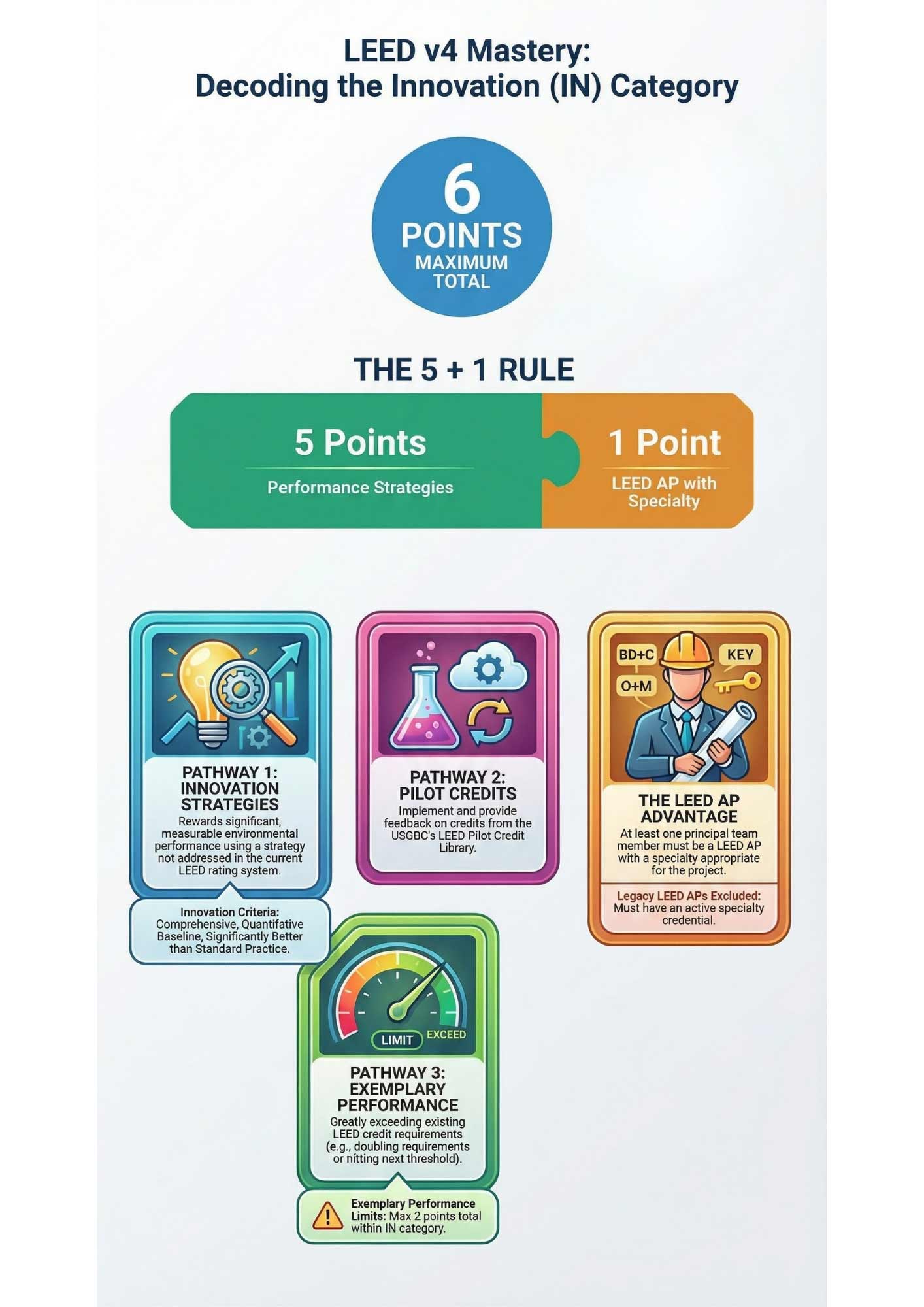
Welcome to INNOVATION (IN) and REGIONAL PRIORITY (RP). Please select a concept from the sidebar.

INNOVATION (IN)

View Full Page ↗

👉 IN = Go beyond LEED

👉 Bonus category that rewards going beyond LEED requirements

🎯 Intent

Encourage exceptional and innovative performance

🔑 KEY TERMS (VERY TESTABLE)

Term Meaning
Innovation New strategy not in LEED
Pilot Credit Testing future LEED credits
Exemplary Performance Exceeding existing credit thresholds
LEED AP Accredited professional on team
Quantifiable Benefits Must be measurable

📊 INNOVATION CREDIT STRUCTURE

Option Description Points
Innovation New strategy not in LEED 1
Pilot Credit From LEED Pilot Credit Library 1
Exemplary Performance Exceed existing credit 1–3
LEED AP Team member credential 1

🧠 MAX POINTS

👉 Total = 6 points

🔍 OPTION BREAKDOWN

🔹 1. Innovation Strategy

👉 Must be:

  • New (not in LEED)
  • Measurable
  • Documented

📄 REQUIRED DOCUMENTATION

  • Intent
  • Requirements
  • Submittals
  • Strategy

⚠️ Exam trap

🔹 2. Pilot Credits

👉 From:

  • USGBC Pilot Credit Library

👉 Think:

  • “Testing future LEED ideas”

🔹 3. Exemplary Performance

👉 Achieve:

  • Double threshold OR next level

📊 Examples

Credit Normal Exemplary
Water reduction 25-50% 55%
Waste diversion Option1 – 50-75%

Option 2 – Do not generate more than 2.5 pounds of construction waste per square foot
Achieve both Option 1 (either Path 1 or Path 2) and Option 2.

🔹 4. LEED AP

👉 Requirement:

  • At least one principal participant

👉 Must have:

  • Relevant specialty

📌 Example

Project Type Required LEED AP
BD+C LEED AP BD+C
O+M LEED AP O+M

🧠 MEMORY TRICK

👉 “I-P-E-A”

  • Innovation
  • Pilot
  • Exemplary
  • Accredited Professional

⚠️ COMMON EXAM TRAPS

Trap Reality
Innovation = creativity only ❌ Must be measurable
Pilot credits optional knowledge ❌ Know source
LEED AP = any team member ❌ Must be principal participant
Max points unlimited ❌ Max = 6
Maximum points under Innovation category?
A. 4
B. 5
C. 6
D. 10
✅ Answer: C
A project achieves performance beyond the highest threshold defined in a LEED credit (e.g., exceeding the maximum water savings level such as going beyond 50%). What is this considered?
A. Pilot credit
B. Innovation
C. Exemplary performance
D. Regional priority
________________________________________
✅ Correct Answer: C. Exemplary performance
A project proposes a new sustainability strategy not in LEED but cannot quantify results. Does it qualify?
A. Yes
B. No
✅ Answer: B

No comments yet. Be the first to post!

REGIONAL PRIORITY (RP)

View Full Page ↗

👉 RP = Focus on what matters locally

🎯 Big Picture

👉 Location-based bonus credits

🎯 Intent

Address regional environmental priorities

📊 STRUCTURE

Item Value
Available RP credits 6
Max points achievable 4
Points per credit 1

🔑 HOW IT WORKS

👉 USGBC identifies:

  • 6 priority credits per region

👉 Project can earn:

  • Max 4 points

🔍 KEY TOOL

👉 USGBC RP Credit Lookup Tool

⚠️ Exam favorite


🧠 SIMPLE EXPLANATION

👉 “What matters most in your location?”

📌 Examples

Region Priority Focus
Water-scarce Water efficiency
Urban Heat island
Coastal Resilience

⚠️ IMPORTANT RULE

👉 Must earn the base credit first

Example:

  • Earn WE credit → THEN earn RP point

🧠 MEMORY TRICK

👉 “6 available → 4 max”

⚠️ COMMON EXAM TRAPS

Trap Reality
RP gives new credits ❌ Bonus on existing credits
Can earn all 6 ❌ Max = 4
Automatic points ❌ Must achieve credit
Same everywhere ❌ Region-specific
Maximum RP points?
A. 2
B. 4
C. 6
D. 10
✅ Answer: B
A project achieves a water credit that is also an RP credit. What happens?
A. No additional points
B. Gains 1 RP point
C. Gains 2 RP points
D. Gains innovation point
✅ Answer: B
A project targets all 6 RP credits. What is the maximum it can earn?
A. 6
B. 5
C. 4
D. 3
✅ Answer: C

No comments yet. Be the first to post!

Indoor Environmental Quality Overview

Welcome to Indoor Environmental Quality. Please select a concept from the sidebar.

EQ PREREQ + CREDIT

View Full Page ↗

Minimum IAQ Performance vs Enhanced IAQ Strategies

  • Prerequisite → Minimum IAQ
    Meet baseline ventilation + monitoring requirements
  • Credit → Enhanced IAQ
    Go beyond minimum → better filtration, control, monitoring

👉 Memory shortcut:

Prereq = “Bring in enough clean air”
Credit = “Keep pollutants out + monitor better”

🔹 2. PREREQUISITE SUMMARY (Minimum IAQ)

🎯 Intent

Ensure minimum indoor air quality for occupant health and comfort

🧩 Two Core Requirements

RequirementWhat it Means
VentilationProvide enough outdoor air
MonitoringEnsure system is working properly

🌬️ A. Ventilation Requirements

  1. Mechanically Ventilated Spaces
OptionStandardNotes
Option 1 (US)ASHRAE 62.1–2010MOST IMPORTANT (memorize)
Option 2 (EU)CEN EN 15251 + EN 13779Outside US

👉 Must meet minimum outdoor air ventilation rates

  1. Naturally Ventilated Spaces
RequirementStandard
Natural ventilation designASHRAE 62.1–2010
Effectiveness validationCIBSE Applications Manual

👉 Exam Trap:

  • ASHRAE → design
  • CIBSE → effectiveness

📡 B. Monitoring Requirements

Mechanically Ventilated Systems

System TypeRequirement
VAVOutdoor airflow monitor (+/-10% accuracy + alarm at 15%)
CAVMaintain airflow via balancing + monitoring device

Naturally Ventilated Systems (Choose ONE)

OptionStrategy
1Exhaust airflow monitoring
2Opening status monitoring (windows, vents)
3CO₂ monitoring

👉 Exam Tip:
ONLY one option required for natural ventilation

🔹 3. CREDIT SUMMARY (Enhanced IAQ Strategies)

🎯 Intent

Improve IAQ beyond minimum ventilation


🧩 Two Options

OptionRequirementPoints Logic
Option 1Implement ALL required strategies1 point
Option 2Implement ANY ONE strategy+1 point

👉 Memory shortcut:

Option 1 = “Do everything required”
Option 2 = “Pick one advanced strategy”

🔹 4. OPTION 1 – REQUIRED STRATEGIES

Based on Ventilation Type

Ventilation TypeRequired Strategies
MechanicalEntryway + Cross-contamination + Filtration
NaturalEntryway + Natural ventilation calc
Mixed-modeALL (Mechanical + Natural + Mixed-mode calc)

🧠 KEY STRATEGIES

StrategyKey RequirementExam Tip
Entryway systems10 ft long systems at entrances⭐ Common question
Cross-contaminationNegative pressure + exhaust (0.5 cfm/sf)Hazardous spaces
FiltrationMERV 13+⭐ Very important
Natural ventilation calcUse CIBSE 
Mixed-mode calcCIBSE AM13 

🔹 5. OPTION 2 – PICK ONE STRATEGY

StrategyRequirementExam Tip
Exterior contamination preventionModeling (CFD, etc.)Advanced
Increased ventilation+30% above ASHRAE⭐ Common
CO₂ monitoringDensely occupied spaces 
Source control + monitoringIdentify pollutants + sensors 
Room-by-room calcCIBSE airflow modeling 

👉 Key takeaway:
Only ONE strategy needed
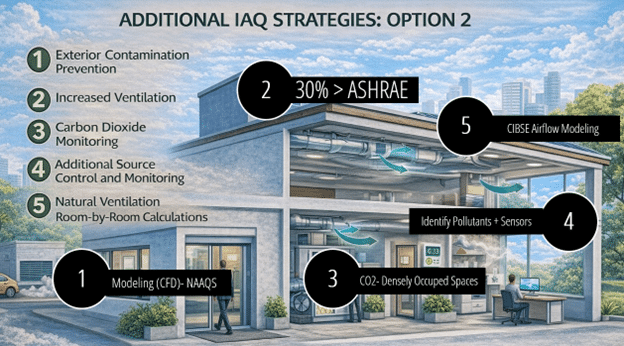
🔹 6. EXAM/Project-FOCUSED MASTER TABLE

TopicRequirementStandardRemember
Ventilation (mechanical)Min outdoor airASHRAE 62.1–2010
Ventilation (natural)Design + effectivenessASHRAE + CIBSE
FiltrationMERV ≥ 13ASHRAE 52.2
Entryway10 ft system
Increased ventilation+30%Based on ASHRAE
CO₂ monitoringAlarm at +10%

🔹 7. COMMON EXAM TRAPS 🚨

❗ 1. Entryway Systems

  • Must be permanent
  • Must be 10 feet long
  • Carpet = ❌ NOT acceptable

❗ 2. Filtration

  • Minimum = MERV 13
  • Not optional for mechanical systems

❗ 3. CO₂ Monitoring

  • Applies to:
    • Densely occupied spaces
  • Alarm at +10% above setpoint

❗ 4. Natural Ventilation

  • Uses BOTH:
    • ASHRAE 62.1 (design)
    • CIBSE (effectiveness)

❗ 5. Option Logic

  • Option 1 = ALL required strategies
  • Option 2 = ONLY ONE strategy

🔹 8. PRACTICAL PROJECT STRATEGIES

Goal

Strategy

Reduce contaminants

Entryway + source control

Improve air quality

MERV 13 filters

Monitor performance

CO₂ sensors + alarms

Improve ventilation

Increase airflow +30%

🔹 9. ULTRA-SIMPLE MEMORY TOOL

Minimum IAQ = Ventilation + Monitoring
Enhanced IAQ = Filtration + Control + Smarter Design

Which standard is primarily used to determine minimum ventilation rates for mechanically ventilated spaces in LEED?
A. ASHRAE 55–2010
B. ASHRAE 90.1–2010
C. ASHRAE 62.1–2010
D. CIBSE AM13
✅ Answer: C
Explanation:
ASHRAE 62.1–2010 is the primary standard for ventilation and IAQ requirements in LEED.
What is the minimum filtration requirement for mechanically ventilated systems under Enhanced IAQ Strategies?
A. MERV 8
B. MERV 11
C. MERV 13
D. HEPA
✅ Answer: C
Explanation:
LEED requires MERV 13 or higher filtration (or equivalent).
What is the minimum required length for permanent entryway systems?
A. 5 feet
B. 8 feet
C. 10 feet
D. 12 feet
✅ Answer: C
Explanation:
Entryway systems must be at least 10 feet (3 meters) long in the primary direction of travel.
Which of the following is required for naturally ventilated spaces to confirm effectiveness?
A. ASHRAE 55
B. CIBSE Applications Manual
C. ASHRAE 90.1
D. EPA WaterSense
✅ Answer: B
Explanation:
CIBSE is used to confirm effectiveness, while ASHRAE 62.1 is used for design.
A project uses a mechanically ventilated VAV system. What is required to comply with IAQ monitoring requirements?
A. CO₂ sensors only
B. Direct outdoor airflow measurement device with alarm
C. Entryway system
D. Natural ventilation openings
✅ Answer: B
Explanation:
VAV systems require direct outdoor airflow measurement (+/-10%) with alarm at 15% deviation.
A project team wants to pursue Enhanced IAQ Strategies (Option 2). What is the minimum requirement?
A. Implement all applicable strategies
B. Implement two strategies
C. Implement one strategy
D. Perform energy modeling
✅ Answer: C
Explanation:
Option 2 requires only ONE strategy.
A project increases ventilation rates by 30% above ASHRAE 62.1. Which credit strategy does this support?
A. Minimum IAQ Performance
B. Enhanced IAQ – Option 1
C. Enhanced IAQ – Option 2
D. Thermal Comfort
✅ Answer: C
Explanation:
“Increased ventilation (+30%)” is an Option 2 strategy.
A project installs CO₂ sensors in densely occupied spaces that trigger alarms when levels exceed setpoints by 10%. Which requirement is this meeting?
A. Minimum IAQ – Ventilation
B. Minimum IAQ – Monitoring
C. Enhanced IAQ – Filtration
D. Enhanced IAQ – Entryway systems
✅ Answer: B
Explanation:
CO₂ monitoring with alarms is part of monitoring requirements in the prerequisite (and also appears in credit strategies).
A mixed-mode building includes both natural and mechanical ventilation systems. Under Enhanced IAQ Option 1, which of the following is required?
A. Only mechanical ventilation strategies
B. Only natural ventilation strategies
C. All applicable strategies for both systems
D. Only one strategy from either system
✅ Answer: C
Explanation:
Mixed-mode = must implement ALL applicable strategies for both systems.
Which strategy BEST addresses pollutant entry at the building entrance?
A. CO₂ monitoring
B. Increased ventilation
C. Entryway systems
D. Filtration
✅ Answer: C
Explanation:
Entryway systems are source control—they stop pollutants before entering the building.
Which of the following materials is acceptable as a permanent entryway system?
A. Standard carpet
B. Roll-out mat designed for entryways
C. Decorative rug
D. Vinyl flooring
✅ Answer: B
Explanation:
Only designed entryway systems (grilles, mats, etc.) qualify.
Carpet = ❌ not acceptable.

No comments yet. Be the first to post!

EQ PREREQ – Environmental Tobacco Smoke (ETS) Control

View Full Page ↗

25 ft away → 10 ft signage → 0 indoor smoking

  • Goal: Keep smoke OUT of the building and away from people
  • Approach:
    → No smoking indoors
    → Control smoking outdoors

👉 Memory shortcut:

“No smoking inside + Keep smoke far away outside”

🔹 2. INTENT

Protect occupants from:

  • Secondhand smoke (ETS)
  • Health risks (lung cancer, heart disease)

🔹 3. COMPLIANCE OPTIONS

📊 Option Comparison Table

Requirement

Option 1 (All Projects)

Option 2 (Residential Only)

Indoor smoking

❌ Prohibited

❌ Prohibited in common areas

Outdoor smoking

Allowed ONLY in designated areas

Same (if applicable)

Distance rule

25 ft from entries, intakes, windows

Same

Property line control

Must prohibit smoking in business-use areas

Not emphasized

Signage

Required

Required

Documentation

Not required

Must be in lease/covenants

🔹 4. KEY REQUIREMENTS

🚫 Indoor Smoking

  • Completely prohibited
  • ❗ No indoor smoking rooms allowed

🌬️ Outdoor Smoking

Must be:

  • At least 25 feet (7.5 m) away from:
    • Entrances
    • Air intakes
    • Operable windows

👉 Classic exam number

🏢 Property Line Rule

  • Must prohibit smoking:
    • Even outside property line
    • If space is used for business (e.g., sidewalk café)

👉 Very common tricky question

🪧 Signage

  • Required within:
    • 10 feet (3 m) of entrances

👉 Another classic exam number

🏠 Residential Exception (Option 2)

  • Smoking banned in:
    • Common areas
  • Must be included in:
    • Lease agreements
    • Covenants

🏫 Special Case: Schools

  • Smoking prohibited on:
    • Entire site
  • Signage at:
    • Property boundary

👉 Exam favorite

🔹 5. IMPORTANT NUMBERS (MEMORIZE)

Requirement

Value

Smoking distance

25 feet

Signage distance

10 feet

Indoor smoking

0 tolerance

🔹 6. COMMON EXAM TRAPS 🚨

❗ Trap 1: Indoor Smoking Rooms

  • NOT allowed (except residential nuance)
  • Even with ventilation → ❌

❗ Trap 2: Property Line

  • Applies even outside site boundary
  • If used for business → must control

❗ Trap 3: Local Codes

  • If local code conflicts:
    • You can still comply with LEED
    • OR document code limitation

❗ Trap 4: Residential Projects

  • Only exception where:
    • Smoking allowed in private units
    • But NOT in common areas
What is the minimum required distance for outdoor smoking areas from building entrances?
A. 10 feet
B. 15 feet
C. 25 feet
D. 50 feet
✅ Answer: C
Where must no-smoking signage be located?
A. At property boundary
B. Within 25 feet of entrances
C. Within 10 feet of entrances
D. Inside only
✅ Answer: C
Which of the following is allowed under LEED?
A. Indoor smoking rooms with ventilation
B. Smoking in mechanical rooms
C. Smoking in designated outdoor areas ≥25 ft away
D. Smoking near air intakes
✅ Answer: C
A building allows smoking 15 feet from the entrance. Does it comply?
A. Yes
B. No
✅ Answer: B
Explanation:
Minimum distance is 25 feet
A cafe places seating on a public sidewalk outside its property line. What must the project do?
A. No requirement
B. Allow smoking
C. Prohibit smoking in that area
D. Install filtration systems
✅ Answer: C
Explanation:
If used for business → must control smoking
A residential building prohibits smoking in common areas and includes it in lease agreements. Which option is this?
A. Option 1
B. Option 2
C. Both
D. Not compliant
✅ Answer: B
A project cannot meet the 25-foot rule due to local code restrictions. What should the team do?
A. Ignore LEED requirement
B. Cancel certification
C. Provide documentation of code limitation
D. Move entrances
✅ Answer: C
Which strategy BEST achieves the intent of this prerequisite Environmental Tobacco Smoke (ETS) Control?
A. Installing better filters
B. Increasing ventilation
C. Eliminating smoking exposure
D. Monitoring CO₂ levels
✅ Answer: C
Which project type has the MOST stringent ETS requirement?
A. Office building
B. Residential building
C. School
D. Retail
✅ Answer: C
Explanation:
Schools require no smoking on entire site

No comments yet. Be the first to post!

EQ CREDIT

View Full Page ↗

Low-Emitting Materials (Up to 3 Points)

  • Goal: Reduce harmful chemicals (VOCs) inside buildings
  • Focus: Materials used during construction

👉 Memory shortcut:

“Choose materials that don’t pollute indoor air”

🔹 2. WHY THIS MATTERS

  • VOCs → cause:
    • Asthma
    • Irritation
    • Long-term health issues
  • Materials = major source of indoor pollution

🔹 3. KEY CONCEPTS (SUPER IMPORTANT)

🧪 Emissions vs Content

Type

What it Means

Easy Way to Remember

Emissions

What comes OUT of product

“What you breathe”

Content

What’s INSIDE product

“What it’s made of”

👉 Exam Tip:

  • Both are required (especially for wet-applied products)

🔹 4. CREDIT STRUCTURE

📊 Two Options

Option

Approach

Complexity

Option 1

Product Category Thresholds

Easier

Option 2

Budget Calculation

Flexible but complex

🔹 5. OPTION 1 – PRODUCT CATEGORY METHOD

🎯 Concept

Meet requirements across product categories

📊 Product Categories

Category

Threshold

Key Requirement

Interior paints & coatings

≥ 90% (emissions) + 100% VOC content

Must meet emissions + VOC limits (wet-applied rule)

Interior adhesives & sealants

≥ 90% (emissions) + 100% VOC content

Same wet-applied rule applies

Flooring

100% compliant

Must meet emissions standards

Composite wood

100% compliant (if not covered elsewhere)

Must meet composite wood evaluation

Ceilings, walls, insulation

100% compliant

General emissions evaluation

Furniture

≥ 90% by cost

Furniture emissions evaluation

Exterior applied products (Healthcare/Schools only)

≥ 90% by volume

Applies only to specific project types

💧 Wet-Applied Products (VERY IMPORTANT)

👉 Includes:

  • Paints
  • Coatings
  • Adhesives
  • Sealants

Requirements:

Category Type

Threshold Logic

Wet-applied products (paints, adhesives)

90% emissions + 100% VOC

Most other categories

100% compliance

Furniture

90% by cost

Requirement

Threshold

Emissions

≥ 90% compliant

VOC content

100% compliant

👉 Classic exam question

🔹 6. OPTION 2 – BUDGET METHOD

🎯 Concept

Allows trade-offs across assemblies

👉 If some products don’t comply → others compensate

📊 Assemblies Used

Assembly

Flooring

Ceilings

Walls

Insulation

Furniture

Exterior (schools/healthcare only)

🧠 Key Rule (VERY IMPORTANT)

Scenario

What to Do

All layers compliant

Count full area

Some layers NOT compliant

Use weighted average

👉 High-value exam concept

🔹 7. IMPLEMENTATION STRATEGIES

Strategy

Description

Non-emitting materials

Stone, glass, metal, concrete

Manufacturer declaration

Self-reported compliance

Third-party certification

BEST approach (CDPH, etc.)

👉 Exam Tip:
Third-party certification = easiest + safest

🔹 8. IMPORTANT DEFINITIONS

Term

Meaning

Interior

Inside waterproofing membrane

Exterior

Outside weather barrier

Furniture

Counts if installed at occupancy

🔹 9. COMMON EXAM TRAPS 🚨

❗ Trap 1: Wet-Applied Products

  • 90% emissions + 100% VOC content
  • BOTH required

❗ Trap 2: Furniture

  • Included if installed at occupancy
  • Even if NOT specified by design team

❗ Trap 3: This is a Construction Credit

  • Based on installed materials
  • NOT just design intent

❗ Trap 4: Budget Method

  • Uses assemblies
  • Uses weighted averages
What is the primary goal of the Low-Emitting Materials credit?
A. Reduce energy consumption
B. Reduce water usage
C. Reduce indoor air pollutants
D. Improve daylight
✅ Answer: C
For wet-applied products, what percentage must meet VOC content requirements?
A. 50%
B. 75%
C. 90%
D. 100%
✅ Answer: D
Which of the following is considered a non-emitting material?
A. Paint
B. Adhesive
C. Concrete
D. Sealant
✅ Answer: C
A project has 85% of paints meeting emissions criteria. Does it comply?
A. Yes
B. No
✅ Answer: B
Explanation:
Minimum = 90%
A project installs furniture at occupancy. Should it be included in calculations?
A. No
B. Only if specified by architect
C. Yes
D. Only for healthcare projects
✅ Answer: C
A flooring system has compliant finish but non-compliant adhesive. Under Option 2, how is this handled?
A. Entire area counts
B. Excluded entirely
C. Weighted average calculation
D. Automatically fails
✅ Answer: C
A project cannot meet requirements in one product category. What is the best approach?
A. Drop the credit
B. Use Option 2 (budget method)
C. Ignore category
D. Substitute materials randomly
✅ Answer: B
Which approach BEST ensures compliance with this credit?
A. Using cheapest materials
B. Using third-party certified products
C. Increasing ventilation
D. Using more insulation
✅ Answer: B
Which statement BEST describes the difference between emissions and content standards?
A. Both measure cost
B. Emissions = ingredients, Content = performance
C. Emissions = what is released, Content = what is inside
D. No difference
✅ Answer: C
Why is this considered a construction credit?
A. It uses ASHRAE standards
B. It depends on installed materials
C. It requires commissioning
D. It involves energy modeling
✅ Answer: B

No comments yet. Be the first to post!

EQ Credit: Construction Indoor Air Quality (IAQ) Management Plan

View Full Page ↗

👉 “Clean during construction = healthy after occupancy”

This credit is about protecting air quality during construction so that:

  • Workers are protected during construction
  • Occupants are protected after occupancy
  • Building systems perform better long-term

👉 Think: “Don’t contaminate the building before people even move in.”

🎯 Intent

To promote the well-being of construction workers and building occupants by minimizing indoor air quality problems associated with construction and renovation.

✅ Core Requirement

Projects must:

Develop AND implement a Construction IAQ Management Plan
✔ Follow SMACNA IAQ Guidelines (key exam item)

📊 REQUIRED STRATEGIES (SMACNA + LEED)

🔹 Must Address ALL of These

Requirement

What It Means

Exam Tip

Follow SMACNA Guidelines

Control dust, pollutants, airflow

⭐ Core requirement

Protect absorptive materials

Prevent moisture damage (e.g., drywall, insulation)

Mold prevention

HVAC protection

Use MERV 8 filters if running systems

⭐ Compare with MERV 13

No tobacco use

No smoking inside or within 25 ft

Same as ETS prereq

🧠 SMACNA STRATEGIES (MEMORIZE THIS LIST)

Category

Meaning

HVAC Protection

Keep ducts/equipment clean

Source Control

Control dust at source

Pathway Interruption

Prevent pollutant spread

Housekeeping

Clean regularly

Scheduling

Sequence work to reduce exposure

👉 Memory Trick:
“HSPHS” → HVAC, Source, Pathway, Housekeeping, Scheduling

⚠️ KEY NUMBERS TO REMEMBER

Item

Value

Smoking distance

25 feet

Filter requirement

MERV 8 (during construction)

Enhanced IAQ (comparison)

MERV 13 (post-construction)

🏗️ IMPLEMENTATION (PROJECT TIP)

  • Include IAQ plan in:
    • Construction documents
    • Specifications
    • Subcontractor agreements

👉 This is often tested:

“Where should the IAQ plan be included?” → Construction documents (Specifications)

🏥 HEALTHCARE ADD-ON (VERY TESTABLE)

Healthcare projects require:

🔹 Environmental Quality Management Plan (EQMP)

Requirement

Description

Infection Control Risk Assessment (ICRA)

Evaluate contamination risks

Follow FGI Guidelines (2010)

Healthcare standard

Integrative team

Owner + Designer + Contractor

Coordinate with design

Not just construction phase

👉 Exam Tip:
Healthcare ≠ just IAQ → includes infection control

👉 During construction:

  • Keep air clean
  • Protect materials
  • Protect HVAC
  • No smoking
  • Follow SMACNA

❗ COMMON EXAM TRAPS

  • MERV 8 (this credit) vs 13 (Enhanced IAQ)
  • Plan must be implemented, not just written
  • Smoking restriction applies during construction
  • SMACNA = construction phase, not operations
Which standard must be followed for this credit?
A. ASHRAE 62.1
B. SMACNA IAQ Guidelines
C. CIBSE Manual
D. EPA WaterSense
✅ Answer: B
What is the minimum filtration requirement if HVAC is used during construction?
A. MERV 13
B. MERV 10
C. MERV 8
D. MERV 5
✅ Answer: C
A contractor stores drywall in an open, humid area. Which requirement is being violated?
A. Source control
B. HVAC protection
C. Protection of absorptive materials
D. Pathway interruption
✅ Answer: C
A project includes IAQ measures but does not include them in construction documents. What is the issue?
A. No issue
B. Plan is incomplete
C. Plan is not enforceable
D. Violates ASHRAE
✅ Answer: C
A project runs HVAC systems during construction without filtration. What are the likely impacts?
A. Improved airflow
B. Contaminant buildup in ducts
C. Energy savings
D. Better commissioning
✅ Answer: B
A healthcare project follows SMACNA but skips infection control risk assessment. Does it comply?
A. Yes
B. No
C. Only for new construction
D. Only if HVAC is off
✅ Answer: B

No comments yet. Be the first to post!

EQ Credit: Indoor Air Quality Assessment (1–2 Points)

View Full Page ↗

👉 “Flush it OR prove it—but don’t mix it.”

This credit ensures that:

👉 After construction, the air is actually clean before people use the building

You can either:

  • Flush the building with fresh air
    OR
  • Test the air to prove it’s clean

🎯 Intent

To establish better indoor air quality after construction and during occupancy.

🔄 TWO OPTIONS (CORE STRUCTURE)

Option

Approach

Best For

Option 1: Flush-Out

Flush building with outdoor air

Simpler, no testing

Option 2: Air Testing

Test contaminants in air

Faster occupancy

🌬️ OPTION 1: FLUSH-OUT (MOST TESTED)

🔹 Two Paths

Path

When Used

Requirement

Before Occupancy

Building empty

14,000 cu ft/sf of outdoor air

During Occupancy

Occupancy starts early

Start at 3,500 cu ft/sf, then continue


📊 KEY REQUIREMENTS (MEMORIZE THESE)

Parameter

Value

Total air required

14,000 cu ft/sf

Partial flush (before occupancy)

3,500 cu ft/sf

Ventilation rate (during occupancy)

0.30 cfm/sf

Temperature

60–80°F

Humidity

≤ 60%

⚠️ DURING OCCUPANCY RULES

If using Path 2:

  • Must continue flushing until 14,000 cu ft/sf total
  • Ventilation must:
    • Start 3 hours before occupancy
    • Continue during occupancy

🧠 MEMORY TRICK

👉 “3,500 → 14,000 → 0.30”

  • Start = 3,500
  • Finish = 14,000
  • Rate = 0.30

🧪 OPTION 2: AIR TESTING

🔹 When to Use

  • Faster occupancy needed (Possible Exam Question)
  • Want proof instead of flushing


📊 REQUIREMENTS

Requirement

Details

Timing

After construction, before occupancy

Conditions

Normal occupied ventilation

Sampling

Breathing zone

Locations

≥ 1 per space + ≥ 1 per floor

Retesting

Required if limits exceeded

⚠️ SPECIAL NOTE

  • Retail projects: testing allowed within 14 days after occupancy

🚫 CRITICAL RULE

👉 Options CANNOT be combined

🧱 COMMON REQUIREMENT (BOTH OPTIONS)

Before either option:

✔ All finishes must be installed
✔ VOC sources must be complete

Examples:

  • Paint
  • Carpet
  • Furniture
  • Ceiling tiles

👉 Possible Question Alert

⚠️ COMMON EXAM TRAPS

Trap

Reality

Flush-out is optional

Must choose one option

Air testing can be partial

Must meet all thresholds

HVAC not needed

Must run at normal conditions

Can combine options

❌ Not allowed

Flush-out before finishes

❌ Must be after finishes

👉 Two choices:

  • Flush the air
  • Test the air

👉 But always:

  • Finish construction first
  • Prove clean air before occupancy
What is the total outdoor air required for a full flush-out?
A. 3,500 cu ft/sf
B. 10,000 cu ft/sf
C. 14,000 cu ft/sf
D. 0.30 cfm/sf
✅ Answer: C
What is the minimum ventilation rate during occupancy flush-out?
A. 0.10 cfm/sf
B. 0.30 cfm/sf
C. 1.0 cfm/sf
D. 14,000 cfm
✅ Answer: B
A project begins occupancy after delivering 3,500 cu ft/sf but stops ventilation. What is wrong?
A. Nothing
B. Needs higher temperature
C. Must continue ventilation until 14,000 cu ft/sf
D. Must switch to testing
✅ Answer: C
A project performs IAQ testing before installing carpets and furniture. Is this compliant?
A. Yes
B. No
C. Only for retail
D. Only if HVAC is off
✅ Answer: B
A project wants early occupancy but minimal disruption. Which option is best?
A. Flush-out before occupancy
B. Flush-out during occupancy
C. Air testing
D. Skip IAQ credit
✅ Answer: C
Air testing shows high VOC levels in one zone. What must the team do?
A. Ignore it
B. Reduce ventilation
C. Retest entire building
D. Correct issue and retest affected area
✅ Answer: D

No comments yet. Be the first to post!

EQ Credit: Thermal Comfort (1 Point)

View Full Page ↗

👉 “Comfort = 6 factors + user control

👉 This credit ensures people feel comfortable inside the building

Not just temperature—but a combination of factors

🎯 Intent

To promote occupants’ productivity, comfort, and well-being

Exam Tip: These 3 words are often tested together

🔑 CORE REQUIREMENT

Projects must meet BOTH:

Requirement

Meaning

Thermal Comfort Design

Design conditions properly

Thermal Comfort Control

Give occupants control

👉 Possible Question Alert

🌡️ THE 6 FACTORS OF THERMAL COMFORT

These define how people actually feel:

Factor

Explanation

Air temperature

How hot/cold the air is

Radiant temperature

Heat from surfaces

Humidity

Moisture in air

Air speed

Air movement

Clothing

What people wear

Metabolic rate

Activity level

📊 PART 1: THERMAL COMFORT DESIGN

🔹 Two Compliance Options

Option

Standard

Where Used

Option 1

ASHRAE 55-2010

Most common (U.S.)

Option 2

ISO / CEN standards

International projects

🔹 What Design Must Address

  • HVAC systems
  • Building envelope
  • Occupant conditions

👉 Goal: Maintain comfort under expected conditions

🎛️ PART 2: THERMAL COMFORT CONTROL

🔹 What This Means

Occupants must have control over their environment

📊 EXAMPLES OF CONTROLS

Space Type

Control Type

Individual spaces

Thermostat

Shared spaces

Group controls

Natural ventilation

Operable windows

Shading

Blinds, shades

⚠️ KEY RULE

👉 Controls must be provided for:

  • Individual occupant spaces
  • Shared multi-occupant spaces

🧠 IMPLEMENTATION FLOW

  1. Set comfort goals
  2. Choose system (HVAC/natural)
  3. Apply standard (ASHRAE/ISO)
  4. Provide user controls

💡 REAL-WORLD STRATEGY

  • Flexible dress code = wider temperature range
  • Better envelope = more stable comfort
  • Smart controls = energy + comfort

⚠️ COMMON EXAM TRAPS

Trap

Reality

Only temperature matters

❌ 6 factors matter

Only design required

❌ Must include controls

ASHRAE only option

❌ ISO/CEN also allowed

Controls optional

❌ Required

Same controls for all spaces

❌ Depends on space type

🧠 SUPER SIMPLE SUMMARY

👉 Comfort = Design + Control

👉 Design = follow standard
👉 Control = give users control

Which standard is commonly used for thermal comfort design in LEED?
A. ASHRAE 62.1
B. ASHRAE 55
C. SMACNA
D. CIBSE
✅ Answer: B
Which of the following is NOT one of the six thermal comfort factors?
A. Air speed
B. Humidity
C. Lighting level
D. Clothing
✅ Answer: C
A building meets ASHRAE 55 but occupants cannot adjust temperature. Does it comply?
A. Yes
B. No
C. Only for residential
D. Only if HVAC is efficient
✅ Answer: B
A naturally ventilated building provides operable windows. What requirement does this support?
A. Energy efficiency
B. Thermal comfort control
C. IAQ testing
D. Daylighting
✅ Answer: B
A project increases air speed instead of lowering temperature. What is this demonstrating?
A. Poor design
B. Ignoring standards
C. Adjusting thermal comfort factors
D. Increased energy use
✅ Answer: C
A project provides thermostats only in private offices but not in conference rooms. What is the issue?
A. No issue
B. Violates design requirement
C. Missing controls for shared spaces
D. HVAC inefficiency
✅ Answer: C

No comments yet. Be the first to post!

EQ Credit: Interior Lighting (1–2 Points)

View Full Page ↗

👉 “Control it OR improve it—or do both for max points”

👉 This credit is about how lighting feels and functions for people

Not just brightness—but:

  • Control
  • Quality
  • Comfort

🎯 Intent

To promote occupants’ productivity, comfort, and well-being by providing high-quality lighting

⭐ Same 3 keywords again → productivity, comfort, well-being

🔑 TWO OPTIONS

Option

Focus

Points

Option 1

Lighting Control

1 point

Option 2

Lighting Quality

1 point

Both

Control + Quality

2 points

🎛️ OPTION 1: LIGHTING CONTROL (VERY TESTABLE)

📊 REQUIREMENTS

Space Type

Requirement

Individual spaces

≥ 90% must have controls

Shared spaces

100% must have controls

🔹 CONTROL FEATURES

  • At least 3 lighting levels/scenes:
    • On
    • Off
    • Mid-level

👉 “90–100–3”

  • 90% individual
  • 100% shared
  • 3 levels

⚠️ COMMON TRAP

  • Shared spaces are NOT 90% → they are 100%

✨ OPTION 2: LIGHTING QUALITY (SELECT 4 OF 8)

👉 Projects must meet ANY 4 strategies

📊 LIGHTING QUALITY STRATEGIES (SIMPLIFIED)

🔹 PERFORMANCE + VISUAL COMFORT

Strategy

Requirement

Exam Tip

A

Luminance < 2,500 cd/m²

Glare control

B

CRI ≥ 80

⭐ Very important

C

Life ≥ 24,000 hours

LEDs (L70)

🔹 LIGHT DISTRIBUTION

Strategy

Requirement

Exam Tip

D

Direct-only lighting ≤ 25%

Reduce glare

🔹 SURFACE REFLECTANCE

Surface

Requirement

Ceiling

85%

Walls

60%

Floor

25%

👉 Furniture:

  • Work surfaces: 45%
  • Partitions: 50%

🔹 LIGHT BALANCE (RATIOS)

Strategy

Requirement

Wall ratio

1:10

Ceiling ratio

1:10

👉 Prevents uneven lighting

🧠 MEMORY STRUCTURE

👉 Think in 4 groups:

  1. Glare → 2,500 cd/m²
  2. Color → CRI ≥ 80
  3. Life → 24,000 hrs
  4. Distribution + Reflectance + Ratios

 ⚠️ COMMON EXAM TRAPS

Trap

Reality

Must meet all 8 strategies

❌ Only 4 required

CRI optional

❌ Often tested

Reflectance ignored

❌ Very testable

Direct lighting unlimited

❌ Max 25%

Controls only for individuals

❌ Also for shared spaces

🧠 SUMMARY

👉 Option 1 = Control lighting
👉 Option 2 = Improve lighting quality

👉 Best projects = Do both

Requirement

Key Number

Individual controls

90%

Shared controls

100%

Lighting strategies

4 out of 8

Direct lighting limit

≤ 25%

CRI

≥ 80

Lighting levels

3 (on/off/mid)

What percentage of individual occupant spaces must have lighting controls?
A. 75%
B. 80%
C. 90%
D. 100%
✅ Answer: C
💡 Explanation
Under EQ Credit: Interior Lighting (Option 1 – Lighting Control):
• At least 90% of individual occupant spaces must have individual lighting controls
👉 These controls allow occupants to adjust lighting based on their needs and preferences.
⚠️ Exam Tip
• 90% = individual spaces
• 100% = shared multioccupant spaces
What is the minimum CRI requirement?
A. 60
B. 70
C. 80
D. 90
✅ Answer: C
💡 Explanation
Under Option 2: Lighting Quality:
• Light sources must have a Color Rendering Index (CRI) ≥ 80
👉 CRI measures how accurately colors appear under lighting.
⚠️ Exceptions (Exam Favorite)
• Colored lighting (e.g., theatrical)
• Site lighting
• Specialty applications
A project provides lighting controls for 90% of shared spaces. Does it comply?
A. Yes
B. No
C. Only for residential
D. Only if CRI is met
✅ Answer: B
💡 Explanation
LEED requires:
• 90% for individual spaces
• 100% for shared multioccupant spaces
👉 Since only 90% of shared spaces have controls → ❌ NOT compliant
⚠️ Exam Trap
👉 Students often confuse:
• Individual (90%)
• Shared (100%) ← stricter requirement
A design uses only direct overhead lighting for 40% of the load. What is the issue?
A. No issue
B. Too much indirect lighting
C. Exceeds 25% limit
D. Violates CRI requirement
✅ Answer: C
💡 Explanation
Under Lighting Quality Strategy D:
• Direct-only overhead lighting must be ≤ 25% of total connected load
👉 40% > 25% → ❌ exceeds limit
🎯 Why this matters
• Too much direct lighting → glare + discomfort
• LEED promotes balanced lighting design
A project provides controls but no mid-level lighting option. What is missing?
A. CRI requirement
B. Required lighting scenes
C. Reflectance requirement
D. Energy efficiency
✅ Answer: B
💡 Explanation
Lighting controls must include at least 3 lighting levels/scenes:
• ON
• OFF
• MID-LEVEL
👉 Missing mid-level = ❌ incomplete control system

No comments yet. Be the first to post!

EQ Credit: Daylight (1–3 Points)

View Full Page ↗

👉 “Daylight = 300–3000 lux + glare control”

👉 This credit is about bringing natural light into the building

Benefits:

  • Better health (circadian rhythm)
  • Higher productivity
  • Reduced electric lighting

🎯 Intent

To connect occupants with the outdoors, reinforce circadian rhythms, and reduce electric lighting use

⚠️ CORE REQUIREMENT (VERY TESTABLE)

👉 Glare control devices are REQUIRED

  • Must be:
    • Manual OR
    • Automatic with manual override

🔑 THREE OPTIONS

Option

Method

When Used

Option 1

Simulation (Spatial Daylight)

Most common

Option 2

Simulation (Illuminance levels)

Simpler calc

Option 3

Measurement

Existing buildings

💻 OPTION 1: SIMULATION (SPATIAL DAYLIGHT)

📊 REQUIREMENTS

Points

Requirement

2 points

55% of floor area

3 points

75% of floor area

👉 Uses daylight simulation models

💡 OPTION 2: SIMULATION (ILLUMINANCE LEVELS)

📊 REQUIREMENTS

Points

Requirement

1 point

75% area

2 points

90% area

🔹 KEY CONDITION

  • Illuminance must be:
    👉 300–3,000 lux
  • At:
    👉 9 AM and 3 PM
  • On:
    👉 Clear day at equinox

📏 OPTION 3: MEASUREMENT

📊 REQUIREMENTS

Points

Requirement

2 points

75% area

3 points

90% area

🔹 KEY RULES

  • Measure:
    • Between 9 AM – 3 PM
    • At workplane height (30 inches)
  • Take 2 measurements
    • At least 4–5 months apart

🧠 MEMORY STRUCTURE

👉 3 Options = Simulation, Simulation, Measurement

👉 Key numbers:

  • 55 / 75 (Option 1)
  • 75 / 90 (Option 2 & 3)
  • 300–3000 lux
  • 9 AM / 3 PM

🌞 GLARE CONTROL (VERY IMPORTANT)

✅ ACCEPTABLE

  • Blinds
  • Shades
  • Curtains
  • Movable louvers
  • Movable screens/awnings

❌ NOT ACCEPTABLE

  • Fixed overhangs
  • Fixed fins/louvers
  • Dark glazing
  • Fritted glass

⚠️ SPECIAL CASE

👉 No glare control needed for:

  • Diffused/translucent glazing

🧠 MEMORY TRICK

👉 “Movable = acceptable, Fixed = NOT acceptable”

💡 DESIGN STRATEGIES (PROJECT + EXAM)

  • Building orientation (early design)
  • Open floor plans
  • Low partitions
  • Interior glazing
  • Daylight simulations early

⚠️ COMMON EXAM TRAPS

Trap

Reality

Glare control optional

❌ Required

Fixed shading acceptable

❌ Not allowed

Any lux value acceptable

❌ Must be 300–3000

Measurement anytime

❌ 9 AM–3 PM only

One measurement enough

❌ Need two

Options can be combined

❌ Only one option

🧠 SUMMARY

👉 Daylight = light + no glare

👉 3 ways to prove it:

  • Simulate it
  • Calculate it
  • Measure it

Requirement

Key Rule

Glare control

Required for ALL options

Acceptable devices

Operable only

Measurement option

2 measurements

Lux range

300–3000 lux

Option 1 thresholds

55% / 75%

Fixed shading

❌ Not allowed

What illuminance range is required?
A. 100–1000 lux
B. 300–3000 lux
C. 500–5000 lux
D. 1000–10,000 lux
✅ Answer: B
A project uses fixed exterior louvers for glare control. Does it comply?
LEED requires glare-control devices to be operable (manual or automatic with override).
👉 Fixed exterior louvers are NOT acceptable because:
• They cannot be adjusted by occupants
• They do not respond to changing daylight conditions
________________________________________
📌 Acceptable Devices:
• Interior blinds/shades
• Curtains
• Movable exterior louvers/screens/awnings
❌ Not Acceptable:
• Fixed louvers
• Fixed overhangs
• Tinted/dark glazing
A project measures daylight only once. What is missing?
A. Lux range
B. Second measurement
C. Simulation model
D. Glare control
✅ Answer: B
Under Option 3: Measurement:
• Daylight must be measured TWICE
• Measurements must be taken:
o At two different times of the year
o At least 4–5 months apart
👉 This ensures seasonal variation (sun angle changes)
________________________________________
⚠️ Exam Tip
👉 Measurement option = 2 measurements required
A project meets illuminance levels but does not install glare controls. What is the result?
A. Earns full points
B. Earns partial points
C. Does not comply
D. Needs retesting
✅ Answer: C
Explanation
Glare control is a mandatory requirement for ALL options in the Daylight credit.
👉 Even if:
• Illuminance levels are correct
• Simulation or measurement is perfect
❌ Without glare control → NO compliance
________________________________________
🎯 Why LEED requires this:
• Too much daylight = glare
• Glare reduces:
o Comfort
o Productivity
o Usability of space
________________________________________
⚠️ Exam Trap
👉 Daylight ≠ just light levels
👉 Must include glare control ALWAYS

No comments yet. Be the first to post!

EQ Credit: Quality Views (1 Point)

View Full Page ↗

👉 “75% + 2 good views = credit”

👉 This credit is about what people see from inside the building

Not just windows—but meaningful, quality views to the outside

🎯 Intent

To give occupants a connection to the natural outdoor environment

🔑 CORE REQUIREMENTS (TWO PARTS)

📊 PART 1: ACCESS TO VIEWS

Requirement

Value

Floor area with views

75%

Measurement height

42 inches (seated eye level)

View type

Direct line of sight through vision glazing

⚠️ IMPORTANT

  • View must be:
    ✔ Clear
    ✔ Unobstructed
    ✔ To the outdoors

📊 PART 2: QUALITY OF VIEWS

👉 75% of area must meet at least 2 of these 4

🔹 THE 4 VIEW TYPES

Type

Requirement

Simplified Meaning

1

Multiple view directions (≥ 90° apart)

Look different ways

2

Nature + movement + distance

Real, dynamic views

3

View distance ≥ 3× head height

Deep view

4

View factor ≥ 3

Wide view cone

🧠 MEMORY TRICK

👉 “Direction – Nature – Distance – Depth”

Pick any 2 of 4

🌿 SPECIAL CASE

Item

Rule

Interior atrium views

Max 30% can count

📏 KEY TERM: VIEW FACTOR

👉 Measure of how much you can see within a 90° cone of vision

🧠 MEMORY STRUCTURE

👉 75% access + 2 of 4 quality criteria

💡 DESIGN STRATEGIES (PROJECT + EXAM)

  • Orient building toward:
    • Nature (trees, sky)
    • Activity (streets, people)
  • Use:
    • Interior glazing
    • Open layouts
    • Low partitions

⚠️ COMMON EXAM TRAPS

Trap

Reality

Any window counts

❌ Must be clear & unobstructed

Interior views unlimited

❌ Max 30%

Only one view type needed

❌ Need 2 of 4

Distance not important

❌ Must include depth

Measurement from floor

❌ Must be 42 inches

🧠 SUPER SIMPLE SUMMARY

👉 Views =

  • 75% of space
  • 2 types of quality views


Summary

Requirement

Key Value

Area threshold

75%

Measurement height

42 inches

Quality types needed

2 of 4

Atrium limit

30% max

Line of sight

Must be unobstructed

What percentage of regularly occupied space must have views?
A. 50%
B. 60%
C. 75%
D. 90%
✅ Answer: C
💡 Explanation
Under EQ Credit: Quality Views:
• At least 75% of regularly occupied floor area must have direct line of sight to the outdoors
________________________________________
⚠️ Exam Tip
👉 75% = base requirement
👉 90% = exemplary performance
At what height is view measured?
A. 30 inches
B. 36 inches
C. 42 inches
D. 48 inches
✅ Answer: C
💡 Explanation
• Views are measured from 42 inches above finished floor
👉 This represents seated eye level
________________________________________
⚠️ Exam Trap
• 30 inches = daylight workplane height
• 42 inches = views
A project provides views for 80% of space but only meets 1 quality view type. Does it comply?
A. Yes
B. No
C. Only for schools
D. Only if atrium is included
✅ Answer: B
💡 Explanation
To comply, a project must:
1. Provide views to ≥ 75% of area ✔
2. Provide at least 2 of the 4 view quality types ❌
👉 Only meeting 1 type → NOT compliant
📌 4 View Quality Types (Know These)
1. Multiple directions (≥ 90° apart)
2. Natural elements / movement / distance
3. Unobstructed view (within 3x head height)
4. View factor ≥ 3
⚠️ Exam Tip
👉 BOTH required:
• Area threshold
• Quality criteria (≥ 2 types)
A project uses interior atrium views for 50% of area. What is the issue?
A. No issue
B. Exceeds 30% limit
C. Must add glazing
D. Must increase height
✅ Answer: B
💡 Explanation
• Interior atrium views can count for maximum 30% of required area
👉 50% > 30% → ❌ exceeds limit
⚠️ Exam Trap
👉 Atrium ≠ outdoor view
👉 Limited contribution only
A project provides views in two directions but no natural elements. Which requirement is met?
A. Nature
B. Distance
C. Multiple directions
D. View factor
✅ Answer: C
💡 Explanation
• Providing views in two directions ≥ 90° apart satisfies:
👉 Multiple lines of sight requirement
________________________________________
❌ Not met:
• Nature (no natural elements)
• Distance (not stated)
• View factor (not stated)
________________________________________
⚠️ Exam Tip
👉 Each quality type is independent
👉 You only need 2 of 4 total
A workspace has a clear window but is blocked by tall partitions. Does it qualify?
A. Yes
B. No
C. Only for offices
D. Only if 75% met
✅ Answer: B
💡 Explanation
• Views must be:
o Direct
o Unobstructed
👉 Tall partitions block line of sight → ❌ NOT compliant
________________________________________
🎯 Key Rule
👉 “Clear window” ≠ valid view
👉 Must have clear line of sight from occupant position
________________________________________
⚠️ Exam Trap
👉 Furniture and partitions count as obstructions

No comments yet. Be the first to post!

EQ Credit: Acoustic Performance (1 Point)

View Full Page ↗

👉 “Quiet, Private, Clear, Controlled”

👉 This credit is about how the building sounds inside

Not just noise reduction—but:

  • Clear communication
  • Reduced distractions
  • Better productivity

🎯 Intent

To support well-being, productivity, and communication through effective acoustic design

⚠️ KEY EXAM TRAP

👉 Prerequisite exists ONLY for Schools

Item

Applies To

Minimum Acoustic Performance (Prereq)

✅ Schools ONLY

Acoustic Performance (Credit)

✅ All BD+C

🔑 CORE REQUIREMENT

👉 Projects must address ALL applicable 4 components

📊 THE 4 ACOUSTIC COMPONENTS

#

Component

What It Means

Key Requirement

1

HVAC Background Noise

Mechanical noise levels

Limit noise from HVAC

2

Sound Isolation

Sound transfer between spaces

Use STC-rated assemblies

3

Reverberation Time

Echo in a space

Use sound-absorbing materials

4

Sound Reinforcement & Masking

Sound systems

If used → must meet criteria

🧠 MEMORY TRICK

👉 “Noise – Separation – Echo – Systems”

🔍 COMPONENT BREAKDOWN

🔹 1. HVAC Background Noise

Requirement

Details

Standard

ASHRAE Handbook / AHRI 885

Measurement

ANSI S1.4 sound meter

Goal

Quiet mechanical systems

👉 Think: No distracting hum

🔹 2. Sound Isolation

Requirement

Details

Metric

STC (Sound Transmission Class)

Goal

Prevent sound transfer between rooms

👉 Think: Privacy (conference rooms, offices)

🔹 3. Reverberation Time

Requirement

Details

Goal

Control echo

Strategy

Absorptive materials (ceilings, panels)

👉 Think: Clarity of speech

🔹 4. Sound Reinforcement & Masking

Requirement

Details

Required?

❌ Not required

If installed

✅ Must meet standards

👉 Think:

  • Sound masking (open offices)
  • PA systems

⚠️ IMPORTANT EXAM NOTES

Concept

Key Point

All 4 required?

✅ Yes (if applicable)

Sound systems required?

❌ No

Standards matter?

✅ Yes

Material selection important?

✅ Yes

🧠 SUMMARY

👉 Good acoustics =

  • Quiet systems
  • Private spaces
  • Low echo
  • Controlled sound

💡 DESIGN STRATEGIES (PROJECT SIDE)

  • Use:
    • Acoustic ceiling tiles
    • Carpets
    • Wall panels
  • Separate noisy spaces:
    • Mechanical rooms
    • Copy rooms
  • Design HVAC for low noise

⚠️ COMMON EXAM TRAPS

Trap

Reality

Acoustic prereq applies to all

❌ Schools only

Sound masking required

❌ Only if used

Only one component needed

❌ All applicable

Only design-based

❌ Must meet standards

Concept

Key Idea

Schools

Only project type with prereq

STC

Sound isolation

Reverberation

Echo control

HVAC noise

Background noise control

Sound masking

Reduce speech distraction

Which project type has a prerequisite for acoustics?
A. All BD+C
B. Schools only
C. Healthcare
D. Offices
✅ Answer: B
💡 Explanation
• Minimum Acoustic Performance is a prerequisite ONLY for Schools projects
• For all other BD+C projects, acoustics is only a credit (not required)
________________________________________
⚠️ Exam Tip
👉 Schools = stricter requirements (prereq + credit)
👉 Others = credit only
Which metric is used for sound isolation?
A. MERV
B. STC
C. CRI
D. lux
✅ Answer: B
💡 Explanation
Metric What it Measures
STC (Sound Transmission Class) Sound isolation between spaces
MERV Air filtration
CRI Lighting quality
lux Illuminance
👉 STC = ability of walls/partitions to block sound transmission
________________________________________
⚠️ Exam Tip
👉 STC = Sound Stops Through Construction
A project installs sound masking systems but does not verify performance. Does it comply?
A. Yes
B. No
C. Only for offices
D. Only if HVAC is quiet
✅ Answer: B
💡 Explanation
• LEED does NOT require sound masking systems
• BUT if installed → they must meet performance criteria
👉 No verification = ❌ NOT compliant
________________________________________
⚠️ Exam Trap
👉 Optional system ≠ optional performance
👉 If installed → must comply
A project improves HVAC noise but ignores reverberation. Does it meet the credit?
A. Yes
B. No
C. Only for schools
D. Depends on size
✅ Answer: B
💡 Explanation
LEED requires addressing ALL applicable acoustic components:
• HVAC background noise ✔
• Sound isolation ✔
• Reverberation time ❌ (missing)
• Sound masking/reinforcement (if applicable)
👉 Missing one required component → ❌ NO compliance
________________________________________
⚠️ Exam Tip
👉 Acoustic credit is holistic
👉 Not “pick and choose”
A conference room has echo issues. Which strategy helps most?
A. Increase lighting
B. Add absorptive materials
C. Increase airflow
D. Add glazing
✅ Answer: B
💡 Explanation
Echo = high reverberation time
👉 Solution:
• Add sound-absorbing materials:
o Acoustic ceiling tiles
o Wall panels
o Carpet
________________________________________
🎯 Key Concept
👉 Reverberation = sound bouncing in space
👉 Absorption reduces echo
Open office with distractions from conversations. Best strategy?
A. Increase HVAC noise
B. Sound masking system
C. Increase daylight
D. Reduce ventilation
✅ Answer: B
💡 Explanation
• Open offices suffer from speech distraction
• Best solution:
👉 Sound masking systems
These:
• Add background noise
• Reduce speech intelligibility
• Improve focus
________________________________________
⚠️ Exam Trap
• Increasing HVAC noise ❌ (not controlled/intentional)
• Sound masking ✔ (designed solution)

No comments yet. Be the first to post!

EQ Synergies

View Full Page ↗

👉 LEED is not about credits—it’s about connections

👉 EQ is not isolated

It connects strongly with:

  • EA (Energy)
  • MR (Materials)
  • SS (Site)
  • WE (Water) – (less obvious but still exists)

🔷 1. EQ + ENERGY (EA)

🔑 Core Concept:

👉 Better indoor quality can reduce energy use (if designed correctly)

📊 Key Synergies

Strategy

EQ Impact

EA Impact

Daylighting

Improves occupant comfort

Reduces lighting energy

Lighting controls

Improves user comfort

Reduces energy use

Task lighting

Better visual comfort

Lower watts/sq ft

Exterior shading

Reduces glare

Reduces cooling load

Thermal comfort design

Comfort

Efficient HVAC operation

⚠️ CRITICAL EXAM INSIGHT

👉 Daylighting only saves energy IF lighting is controlled/dimmed

💡 Example

  • Big windows = good EQ
  • BUT without controls = higher energy use ❌
  • With sensors/dimming = energy savings ✅

🔷 2. EQ + MATERIALS (MR)

🔑 Core Concept:

👉 Healthy materials = better indoor air quality

📊 Key Synergies

Strategy

EQ Credit

MR Credit

Low-emitting materials

EQ Low-Emitting Materials

MR Disclosure credits

Product transparency

Supports EQ documentation

MR EPD / HPD credits

Material selection

Reduces VOCs

Improves lifecycle impact

⚠️ IMPORTANT INSIGHT

👉 Same product documentation can support BOTH EQ + MR

💡 Example

  • Product with EPD + VOC compliance
    → Counts for:
  • MR (EPD credit)
  • EQ (Low-emitting materials)

🔷 3. EQ + SITE (SS)

🔑 Core Concept:

👉 Site decisions influence indoor experience

📊 Key Synergies

Site Strategy

EQ Impact

Building orientation

Daylight performance

Solar exposure analysis

Glare + daylight

Vegetation planning

Views + comfort

View shed analysis

Quality views credit

Site assessment

Supports daylight + views

💡 Example

  • Orient building for sun
    → Improves:
  • Daylight credit
  • Energy performance
  • Occupant comfort

🔷 4. EQ + WATER (WE)

👉 Not obvious—but still important

📊 Hidden Synergies

Strategy

EQ Impact

WE Impact

Humidity control

Comfort

Water + HVAC efficiency

Green infrastructure

Indoor comfort

Water management

🧠 MASTER SYNERGY SUMMARY

Category

Connection to EQ

EA

Energy + comfort

MR

Materials + health

SS

Site + daylight/views

WE

Water + comfort systems

🔹 Integration Thinking

👉 “Which strategy benefits multiple categories?”

🔹 Tradeoffs

👉 Example:

  • More glass = better daylight (EQ)
  • But worse energy (EA) unless controlled

🔹 Documentation Overlap

👉 Same product → multiple credits

Strategy

EQ Impact

Other Category

Daylighting

Comfort, circadian rhythm

EA (energy savings)

Lighting controls

Visual comfort

EA

Exterior shading

Glare reduction

EA

Low-VOC materials

IAQ

MR

EPD products

MR

Site analysis

SS → impacts EQ

Views/daylight design

Occupant well-being

LT (indirectly)

Which category is most directly linked with daylight energy savings?
A. MR
B. EA
C. WE
D. LT
✅ Answer: B
💡 Explanation
• Daylighting reduces artificial lighting demand
• This directly impacts:
👉 Energy consumption → EA (Energy & Atmosphere)
________________________________________
🎯 Key Concept
👉 Daylight = EQ strategy
👉 Energy savings = EA benefit
________________________________________
⚠️ Exam Tip
If you see:
• "reduced lighting energy" → think EA
• "occupant comfort" → think EQ
A project installs large windows but no lighting controls. What happens?
A. Improves both EQ and EA
B. Improves EQ but may hurt EA
C. Improves EA only
D. No impact
✅ Answer: B
💡 Explanation
• Large windows → ✔ improves:
o Daylight
o Views
→ EQ benefit
• BUT without lighting controls:
o Lights stay ON
o No energy savings
👉 Result:
• EQ improves ✔
• EA may suffer ❌
________________________________________
⚠️ Exam Trap
👉 Daylight ≠ energy savings automatically
👉 Must include controls (dimming, sensors)
A project selects low-VOC materials with EPDs. Which credits benefit?
A. EQ only
B. MR only
C. EQ and MR
D. EA and WE
✅ Answer: C
💡 Explanation
Strategy Category
Low-VOC materials EQ (Low-Emitting Materials)
EPDs MR (BPDO – Environmental Product Declarations)
👉 One product → contributes to multiple credits
________________________________________
🎯 Key Concept
👉 “One product → multiple credits”
👉 This is integrative design thinking
A project performs site analysis to optimize window placement. Which credits benefit?
A. EQ only
B. SS only
C. EQ and SS
D. MR and EA
✅ Answer: C
💡 Explanation
• Site analysis → SS (Site Assessment)
• Optimized windows → improves:
o Daylight
o Views
→ EQ credits
👉 Result:
✔ SS + EQ
________________________________________
🎯 Key Concept
👉 Site decisions → influence indoor quality
Which strategy improves BOTH energy and indoor comfort?
A. Increase plug loads
B. Exterior shading
C. Reduce ventilation
D. Remove glazing
✅ Answer: B
💡 Explanation
Exterior shading:
• Reduces solar heat gain → ✔ EA benefit
• Reduces glare → ✔ EQ benefit
________________________________________
❌ Why others are wrong:
• Increase plug loads → ❌ increases energy
• Reduce ventilation → ❌ harms IAQ (EQ)
• Remove glazing → ❌ reduces daylight & views

No comments yet. Be the first to post!

Scroll to Top
GBRI is your #1 source for sustainability education with more than 400+ courses to choose from!
gbri-logo

Welcome back!

Login to access your sustainability courses, certificates, badges, community and more!
Celebrate this New Year 2026 With 40% OFF LEED ,WELL, CE & membership Programs!
LEED, WELL, CE & Membership Programs

40% Off

Achieve your sustainability goals for less. Grab your discount before you go.

GBRI

Memorial Day Sale

June 1 to June 15 - 2024

GBRI

Annual Day Sale

March 15 to April 21 - 2024

The journey to become a sustainability guru begins here!
Jeslin Varghese
gbri-logo

Sustainability education should not have any boundaries!

Register now to get started.

OR REGISTER WITH