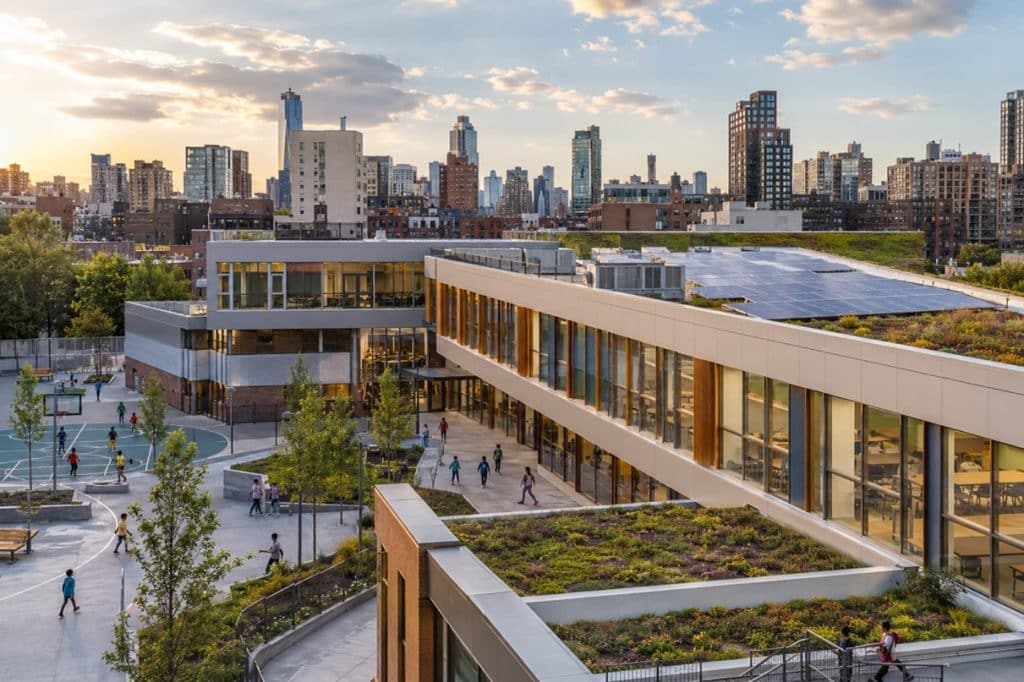
This article course explores how Passive House design can support urban decarbonization while improving indoor environmental quality in public schools. Using a Brooklyn Passive House school as a case study, participants will examine envelope-first strategies, balanced ventilation systems, policy alignment with New York City’s Local Laws, and the relationship between building performance and student health outcomes. The session highlights how high-performance civic infrastructure can reduce operational carbon emissions while supporting thermal comfort, ventilation, and long-term fiscal stability in school districts. To support different learning styles, this article course also includes a complimentary audio-visual explainer video and infographics designed to reinforce key concepts and provide additional clarity. These supplemental materials are intended to enhance the learning experience and do not replace the primary course article.
Buildings account for approximately 30–40% of global energy-related greenhouse gas emissions, and in dense cities such as New York, operational emissions from buildings represent the largest share of municipal carbon output. As cities pursue aggressive climate targets, public infrastructure — particularly schools — presents a significant opportunity for measurable decarbonization. This course examines Passive House as a performance-based framework for reducing heating and cooling demand through envelope optimization, airtight construction, thermal bridge reduction, and balanced heat recovery ventilation. Participants will explore how these strategies contribute not only to energy reduction but also to improved indoor environmental quality, including ventilation stability, thermal comfort, and filtration. Drawing from research linking classroom ventilation and thermal conditions to cognitive performance and absenteeism, the course connects building science principles to educational outcomes. A case study of a Passive House public school in Downtown Brooklyn illustrates how high-performance standards can be integrated into dense urban contexts while aligning with policies such as New York City’s Local Law 31 and Local Law 97. The article provides architects, planners, and school district decision-makers with practical insights into designing civic infrastructure that supports climate resilience, public health, and long-term operational stability.
Course Rating:
No ratings yet
Total Reviews: 0
Note: Rating is only available after course completion.