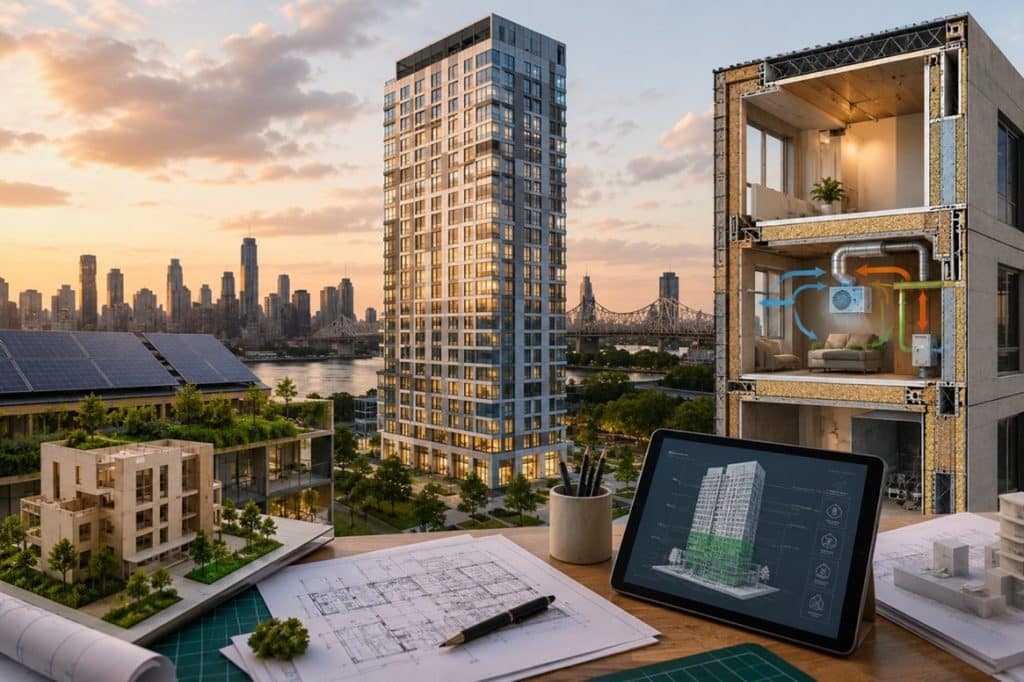
The House at Cornell Tech in New York City is one of the tallest and largest Passive House residential buildings in the world. This case study explores how the project team successfully adapted Passive House principles to a 26-story high-rise, demonstrating how envelope-first design, airtight construction, and energy recovery ventilation can dramatically reduce operational energy use. The article also examines how Passive House strategies can complement broader sustainability frameworks such as LEED, offering valuable insights for building professionals pursuing high-performance and low-carbon buildings in dense urban environments. To support different learning styles, this article course also includes a complimentary audio-visual explainer video and infographics designed to reinforce key concepts and provide additional clarity. These supplemental materials are intended to enhance the learning experience and do not replace the primary course article.
As cities pursue aggressive climate goals, buildings must dramatically reduce operational energy use and carbon emissions. Passive House has emerged as one of the most rigorous building performance standards for achieving deep energy reductions. However, the standard was originally developed for low-rise residential buildings, leaving many professionals wondering whether it could scale to dense urban environments. The House at Cornell Tech in New York City provides a compelling answer. Completed in 2017 on Roosevelt Island, this 26-story residential tower became one of the tallest and largest Passive House buildings in the world at the time of its completion. Designed by Handel Architects, the project demonstrates how Passive House principles can be successfully applied to high-rise construction while integrating with broader sustainability frameworks such as LEED. This article examines the strategies used to achieve Passive House certification, including high-performance envelope design, airtight construction, centralized energy recovery ventilation, and optimized mechanical systems. The case study also explores the technical, regulatory, and market challenges the project team encountered, from façade design expectations to HVAC equipment sizing limitations. By analyzing this pioneering project, building professionals can gain valuable insights into how Passive House and LEED can work together to support the broader goals of building decarbonization, improved indoor environmental quality, and long-term energy efficiency in urban environments.
Course Rating:
No ratings yet
Total Reviews: 0
Note: Rating is only available after course completion.