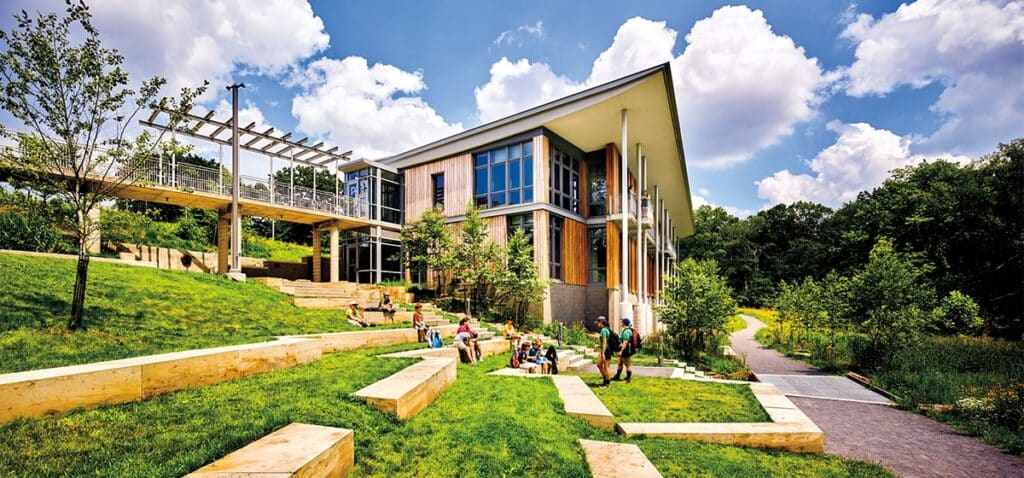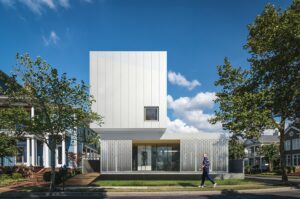
The Frick Environmental Center stands at the edge of Pittsburgh’s residential neighborhoods and the historic 644-acre Frick Park, acting as a physical and conceptual bridge between the built environment and the natural landscape. Conceived as a living learning center, the facility was designed to make sustainability tangible, accessible, and welcoming to all visitors—free of charge. A key focus of the project was restoring and enhancing the surrounding ecosystem. More than 7,000 native plants were introduced across the site following the removal of invasive species, helping reestablish local biodiversity and ecological health. The landscape design works in concert with a highly visible and interactive stormwater management system that reduces erosion, improves water quality, and reconnects visitors with natural hydrological processes. The building itself exemplifies high-performance design. On-site photovoltaic panels generate more energy than the center consumes, enabling year-round net-positive energy performance. These strategies, combined with passive design and educational features, transform the center into an immersive teaching tool rather than a static exhibit. With over 200,000 visitors since its opening, the Frick Environmental Center demonstrates how environmental education can be a lived experience—one that integrates architecture, ecology, and community engagement. This video-based case study explores the design strategies behind this energy-positive facility and highlights lessons applicable to future sustainable projects.
Course Rating: ★ 5 / 5
Total Reviews: 2
Note: Rating is only available after course completion.
★★★★★
Richard ✓ Verified Student - 2026-05-18 05:51
Richard ✓ Verified Student - 2026-05-18 05:51
Outstanding course that explains sustainability objectives for this well-designed facility.
★★★★★
David Nguyen ✓ Verified Student - 2026-03-27 11:35
David Nguyen ✓ Verified Student - 2026-03-27 11:35
Very good lesson.