LT Credit: Surrounding Density & Diverse Uses
Density brings people together.
Diverse uses give them a reason to stay.
What is the Intent of this Credit?
The intent of this credit is to conserve land and protect farmland and wildlife habitat by
encouraging development in areas with existing infrastructure. To promote walkability, and transportation efficiency and reduce vehicle distance traveled. To improve public health by encouraging daily physical activity.
This credit aims to:
👉 encourage development in dense, well-connected areas
So that we:
- conserve land and protect farmland/wildlife
- use existing infrastructure
- promote walkability & transit use
- reduce vehicle travel distance (VMT)
- improve public health through daily activity
🎯 Big Picture (Exam Insight)
This credit is about:
👉 Density + Walkability + Daily Needs Nearby
This credit rewards a project location that is surrounded by existing built density and within walking distance of a variety of services (“uses”). The density thresholds correspond to the minimum densities needed to support bus transit (seven dwelling units per acre, 17.5 DU per hectare) and fixed-rail transit (12 DU per acre, 30 DU per hectare). Two threshold types are listed, one combining residential and nonresidential densities, the second separating them. Project teams therefore have flexibility in calculating the surrounding built density based on the information available to them.
🧩 Two Options
👉 Projects can:
- pursue Option 1 only
- pursue Option 2 only
- OR combine both
✅ Important Exam Point
You do NOT need to do both
📊 Option 1: Surrounding Density
Requirement
👉 Project must be located in an area with existing density
Measured within:
👉 ¼ mile (400 m) radius
📏 Thresholds
🏠 For Residential
- 7 dwelling units/acre → 2 points
- 12 dwelling units/acre → 3 points
🏢 For Non-Residential
- FAR = 0.5 → 2 points
- FAR = 0.8 → 3 points
❓ What is FAR?
👉 Floor Area Ratio (FAR) =
Total building floor area ÷ total land area
🎯 Memory Trick
- 7 / 0.5 → lower threshold
- 12 / 0.8 → higher threshold
💡 Key Concept
LEED aligns density with transit viability:
- ~7 DU/acre → supports bus transit
- ~12 DU/acre → supports rail transit
🏪 Option 2: Diverse Uses
Requirement
👉 Project must be within:
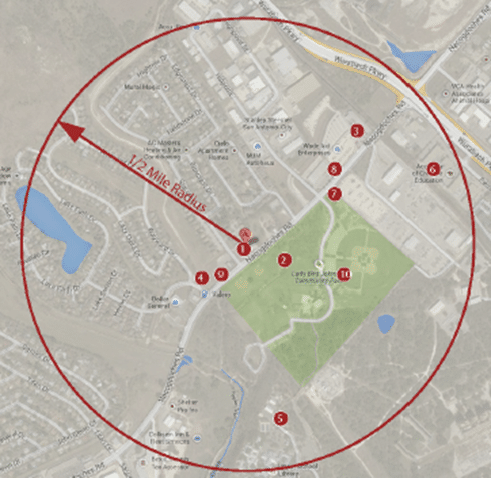
👉 ½ mile walking distance
from its main entrance to:
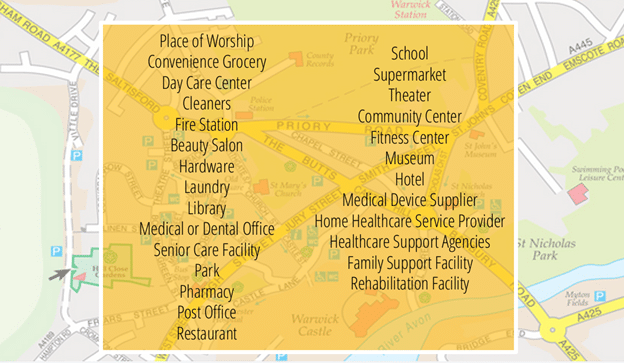
- 4–7 diverse uses → 1 point
- 8+ diverse uses → 2 points
🎯 Must Remember
½ mile + entrance to entrance
⚠️ Critical Rules (HIGH PROBABILITY QUESTIONS)
- ✅ Uses must be:
- existing
- publicly available
To be eligible, uses that are planned but not currently operating must be occupied within one year of the date of the LEED project’s initial certificate of occupancy.
- ❌ No double counting
👉 One location = one use type
- ❌ Limit per category
👉 Max 2 uses per use type
Example:
- 5 restaurants → only 2 count
- ✅ Diversity requirement
👉 Uses must include:
👉 at least 3 of 5 categories
(excluding project’s primary use)
🎯 Exam Insight
This is NOT about quantity alone
👉 It’s about diversity
🧠 What Counts as “Diverse Uses”?
You don’t need to memorize all, but understand:
👉 Daily life services:
- bank
- grocery
- restaurant
- school
- pharmacy
- park
- fitness center
- daycare
- medical office
💡 Best Way to Think
“Can I live my daily life without a car?”
🧠 Where People Get Confused
❌ Misconception 1:
“More uses = automatically qualifies”
👉 No
Must meet:
- category diversity
- max 2 per type
❌ Misconception 2:
“Distance is straight-line”
👉 No
👉 Must be walking distance
❌ Misconception 3:
“You must do both options”
👉 No
👉 One option is enough
❌ Misconception 4:
“Project entrance doesn’t matter”
👉 It does
👉 Measured entrance to entrance
Official FAQs
What are the two options under this credit?
2. Diverse Uses
What is the required radius for density calculations?
What is the required distance for diverse uses?
A project has 10 restaurants within ½ mile. Can it earn 2 points for diverse uses?
👉 Only 2 restaurants can be counted
👉 Must include different categories
A project meets density thresholds but has no nearby services. Can it still earn points?
👉 Option 1 alone is sufficient
A project has: • 8 total uses • but only from 2 categories . Does it qualify for 2 points?
👉 Must include at least 3 categories
Why does LEED emphasize both density and diverse uses?
• reduce car dependence
• support transit
• enable daily needs within walking distance
• improve health and reduce emissions
Comments
No comments yet. Be the first to post!