
LT Credit: Access to Quality Transit
Transit access is not about being close to a stop—it’s about having a reason to use it.
What is the Intent of this Credit?
The goal is to:
👉 encourage development in areas with strong transit access
So that we:
- reduce car dependency
- lower GHG emissions
- improve air quality
- support public health + mobility
🎯 Big Picture
This credit is about:
👉 Access + Frequency of Transit
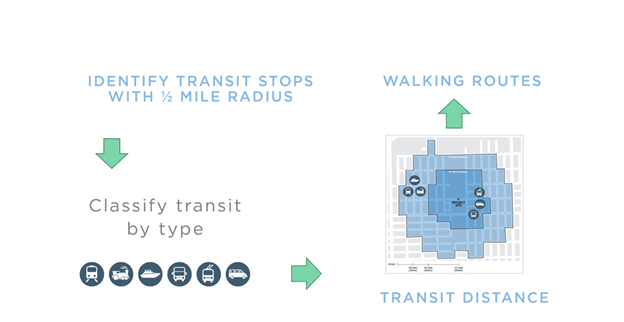
📍 Location Requirement
Projects must locate any functional entry within:
🚍 Transit Distance Thresholds (VERY IMPORTANT)
🟢 ¼ mile (400 m)
For:
- bus stops
- streetcar stops
- rideshare stops
🔵 ½ mile (800 m)
For:
- bus rapid transit (BRT)
- light rail
- heavy rail
- commuter rail
- ferry terminals
🎯 Memory Trick
¼ mile = basic transit (bus)
½ mile = high-capacity transit (rail)
⚠️ Important Clarification
👉 Distance must be:
- walking distance
- NOT straight-line radius
🏫 Special Rule for Schools (Common Question)
Schools must:
👉 ensure safe pedestrian access
From:
- surrounding residential neighborhoods
- within the walkshed boundary
🎯 Exam Insight
Schools = must consider student access + safety
Official FAQs
What are the two key distance thresholds in this credit?
• ¼ mile (400 m) → bus, streetcar
• ½ mile (800 m) → rail, BRT, ferry
• ½ mile (800 m) → rail, BRT, ferry
What is the key factor that determines “quality transit”?
👉 Frequency of trips (number of daily transit trips)
A project is within ¼ mile of a bus stop, but the bus runs only twice a day. Does it qualify?
No.
👉 Transit must meet minimum trip frequency requirements
👉 Transit must meet minimum trip frequency requirements
A project is within ½ mile of two rail stations. Can both be counted?
Yes.
👉 Trips from multiple stations can be aggregated
👉 Trips from multiple stations can be aggregated
A project is within ½ mile of a rail station and ¼ mile of a bus stop. How should it evaluate compliance?
👉 Include both transit types
• apply correct distance thresholds
• sum total trips from both
• apply correct distance thresholds
• sum total trips from both
Why does LEED focus on trip frequency instead of just proximity?
Because:
• reliable, frequent transit reduces car use
• low-frequency transit does not change behavior
• ensures true accessibility, not just proximity
• reliable, frequent transit reduces car use
• low-frequency transit does not change behavior
• ensures true accessibility, not just proximity
Comments
No comments yet. Be the first to post!