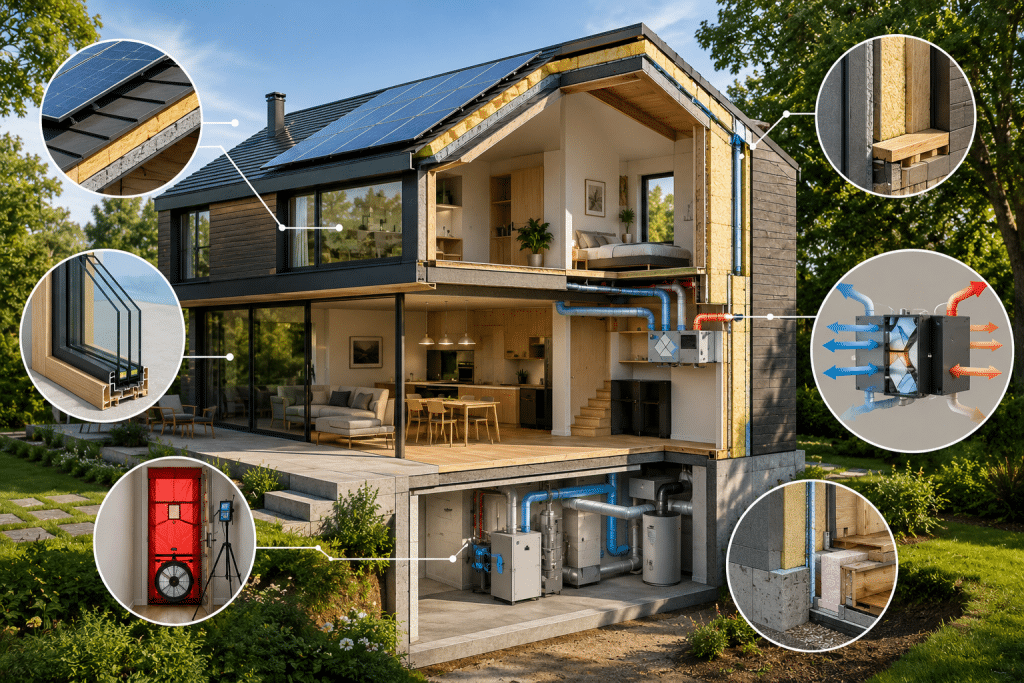
Passive House is one of the most rigorous performance-based building standards for reducing energy demand while improving occupant comfort and indoor environmental quality. This course introduces the core principles of Passive House design, including high-performance insulation, airtight construction, thermal bridge elimination, optimized glazing, and balanced heat recovery ventilation. Through real-world case studies and building science fundamentals, participants will explore how Passive House strategies support decarbonization and high-performance building design across diverse building types and climates. To support different learning styles, this article course also includes a complimentary audio-visual explainer video and infographic designed to reinforce key concepts and provide additional clarity. These supplemental materials are intended to enhance the learning experience and do not replace the primary course article.
Buildings account for a significant portion of global greenhouse gas emissions, largely due to energy used for heating, cooling, and ventilation. As cities adopt aggressive decarbonization policies and electrification strategies, reducing building energy demand has become a critical priority for architects, engineers, and building professionals. Passive House is one of the most rigorous performance-based building standards developed to address this challenge. Rather than relying primarily on mechanical systems to compensate for inefficient design, Passive House prioritizes envelope-first strategies that dramatically reduce heating and cooling demand. This course introduces the core principles of Passive House design, including continuous high-performance insulation, elimination of thermal bridges, airtight construction, high-performance windows and doors, and balanced mechanical ventilation with heat recovery. Participants will explore the building science concepts that underpin these strategies and understand how they improve thermal comfort, indoor air quality, and long-term building durability. The course also examines how Passive House performance integrates with broader sustainability frameworks and decarbonization strategies. Case studies such as the Bahnstadt district in Heidelberg and the Pavilion Y healthcare facility in Olomouc illustrate how Passive House principles can be applied across scales and building typologies. By understanding these foundational concepts, building professionals can better evaluate how envelope-driven performance strategies support operational carbon reduction, electrification readiness, and climate-responsive building design.
Course Rating:
No ratings yet
Total Reviews: 0
Note: Rating is only available after course completion.